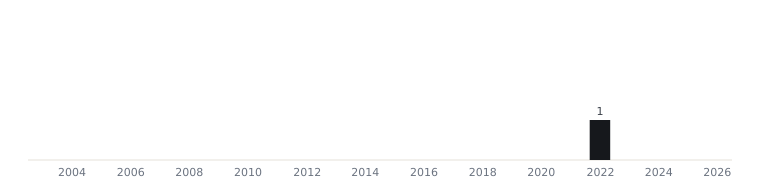
From the Form 300A summaries employers file with OSHA each year. Rate = recordable cases per 100 full-time workers.
In 2025, the Nevada site logged 9 recordable injuries or illnesses among about 662 workers: 1.4 per 100 full-time workers, against a median of 2.6 for its industry. Those cases cost 25 days away from work.
Site and year
Workers
Cases
Days-away cases
Rate
Industry median
Nevada site
Nevada · 2025
662
9
1
1.4
2.6
Columbia site
Columbia · 2025
586
9
2
1.5
2.5
Springfield site
Springfield · 2025
503
10
1
2.0
2.0
Severe injury reports
Employers must report any work-related amputation, in-patient hospitalization or loss of an eye to OSHA within 24 hours. 2 reports on file.
Aug 3, 2022, Nevada: Amputation · amputations · fingertip(s)
An employee was making an adjustment to an extruder. The employee's gloved left hand was caught in a roll-to-roll nip point causing fractures to the ring and little fingers. The employee underwent a medical amputation to the little fingertip.
An employee had just finished maintenance work on an HVAC system. He was closing the guard cover when it slipped, smashed his left hand (bruising two fingers), and severed the tip of the ring finger.
The rules behind these citations
Current text from the Code of Federal Regulations. Some citations were issued under older wording.
(a) Machine guarding—(1) Types of guarding. One or more methods of machine guarding shall be provided to protect the operator and other employees in the machine area from hazards such as those created by point of operation, ingoing nip points, rotating parts, flying chips and sparks. Examples of guarding methods are—barrier guards, two-hand tripping devices, electronic safety devices, etc.
(a) General requirements—(1) Machine guarding. Abrasive wheels shall be used only on machines provided with safety guards as defined in the following paragraphs of this section, except:
29 CFR 1910.215(b)(9)
(9) Exposure adjustment. Safety guards of the types described in subparagraphs (3) and (4) of this paragraph, where the operator stands in front of the opening, shall be constructed so that the peripheral protecting member can be adjusted to the constantly decreasing diameter of the wheel. The maximum angular exposure above the horizontal plane of the wheel spindle as specified in paragraphs (b) (3) and (4) of this section shall never be exceeded, and the distance between the wheel periphery and the adjustable tongue or the end of the peripheral member at the top shall never exceed one-fourth inch. (See Figures O-18, O-19, O-20, O-21, O-22, and O-23.)
Source: U.S. Department of Labor, OSHA enforcement data. A citation is OSHA's allegation; employers can contest it, and the status column shows where each item stands. Something wrong on this page? Tell us.