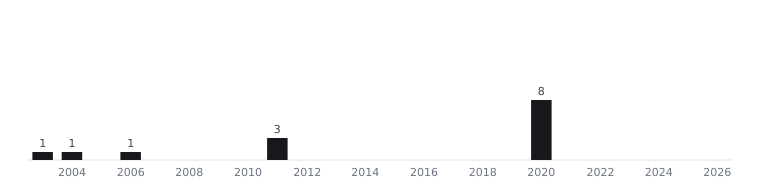
Since 2001, OSHA inspectors have visited Bodycote Thermal Processing, Inc. in California 10 times.
The most recent inspection opened on Aug 5, 2020 as a planned inspection, in Compton.
In all, OSHA issued 30 citation items: 10 serious and 20 other-than-serious.
The proposed penalties came to $194,585; today they stand at $88,995, 54% less.
Among manufacturing employers, the typical cited inspection since 2015 ends with a $3,600 penalty. Bodycote Thermal Processing, Inc. averages $8,970 across 1 cited inspection.
1 inspection on this page followed a fatal incident.
Bodycote Thermal Processing, Inc. also files yearly injury logs with OSHA, summarized below.
Citation items per year, by inspection date.
Want to know if OSHA cites Bodycote Thermal Processing, Inc. again? Add it to a watchlist and we will email you the morning the citation shows up.
Incident on Oct 18, 2011: Employee suffers burn from scalding water
On October 18, 2011, Employee #1, of Bodycote Thermal Processing Incorporated, w as performing duties of a maintenance supervisor. He needed to drain a clogged p ipe. Employee #1 loosened the collar of the clogged exit pipe that tightens the hose to the pipe fitting. Suddenly, the hose ejected off of the pipe and scalded him on the left side of his neck, shoulder, and his left arm. Employee # 1 was hospitalized and treated for second degree burns (due to the sudden release of h igh pressure water, steam, and black galvanized pipe residue), which included sk in grafts. The facility involved in the incident treats metal and employs approx imately 38 people. The machine involved in the incident was a continuous belt fu rnace (Number 70) manufactured by Mahler.
Citation and rule
Type
Proposed
Current
Issued
Status
Citation 1, item 1
29 CFR 3314 G01 C
Other-than-serious
$420
$420
Apr 4, 2012
Final
Citation 2, item 1
29 CFR 3329 D
Serious
$18,000
$6,750
Apr 4, 2012
Final
Citation 3, item 1
29 CFR 3203 A04
Other-than-serious
$5,060
$750
Apr 4, 2012
Final
Inspection 313167199 OPENED SEP 8, 2010Closed
Accident · Partial · Safety · 2,000 employees at the site · Closed Sep 27, 2010
Incident on Aug 31, 2010: Employee receives laceration when struck by object within pi
On August 31, 2010, Employee #1, a maintenance mechanic, was working on the lowe ring system of a thermal processing pit. As he worked, a section of the system t hat he was repairing fell and struck him. He was knocked against the side of the 15 ft deep pit and received a 3.15 in. laceration. Employee #1 did not fall fur ther into the pit because he was wear a personal fall arrest system. He was tran sported to a medical center where he underwent medical care and was hospitalized .
No citations from this inspection.
Inspection 309297364 OPENED DEC 17, 2006Closed
Accident · Partial · Safety · 1,500 employees at the site · Closed Nov 20, 2008
Incident on Dec 5, 2006: Employee falls to lower level and suffers fractured ribs
At approximately 2:00 p.m. on December 5, 2006, Employee #1 was standing on a pl ywood platform making adjustments to the overhead louvers of a Alumatherm therma l heat treatment oven (Model Number 12, Serial Number DWG NO 3705-12) when the p latform gave way causing Employee #1 to fall 9 ft 6 in., into the empty quenchin g sump floor. Employee #1 suffered a retroperitoneal hematoma and multiple rib f ractures on the left side. Employee #1 was hospitalized.
Citation and rule
Type
Proposed
Current
Issued
Status
Citation 1, item 1
29 CFR 3328 C
Other-than-serious
$300
$300
Jun 5, 2007
Closed
Inspection 300828431 OPENED DEC 20, 2004Closed
Accident · Partial · Safety · 44 employees at the site · Closed May 4, 2005
Incident on Nov 5, 2004: Employee suffers amputated finger
Around 9:00 p.m. on November 5, 2004, Employee #1, an oven operator working for Bodycote Thermal Processing, was operating a CAT-30 forklift to remove metal par ts that were being heat-treated from an oven. The parts are placed in a basket i n the oven and at the end of the process the bucket is withdrawn from the oven o nto the elevated forks of the forklift. From a seated position in the forklift, Employee #1 was using a T-handle extension tool with a hook which allows the too l to connect to the basket and slide it out of the oven. The tool was placed alo ngside the outside of the mast and through the rear guard of the forklift. Emplo yee #1 accidentally shifted the forklift in reverse, causing his finger to be pi nched between the handle of the tool and the rear of the mast of the vehicle. Em ployee #1 suffered an amputated tip of his left index finger and was transported to a regional medical center for surgery. Employee #1 was a ten-year employee a ccustomed to performing duties of an oven operator. The investigation found that the accident was a consequence of the unsafe method used to remove buckets from the ovens. The State of California Code of Regulations, Title 8, does not conta in an applicable standard. AS a result, no violations were issued in relation to this accident.
No citations from this inspection.
Inspection 307161356 OPENED MAY 25, 2004Closed
Accident · Partial · Safety · 27 employees at the site · Closed Jul 5, 2006
Incident on May 11, 2004: Employee crushes index finger from falling object
On May 11, 2004, Employee #1 and a coworker were setting an 800-lb fixture into its placement of a table. They did not use a crane, other hoisting device, or to ol to move the fixture into place. As they were moving the fixture, it fell into the slots of the table, crushing the right index finger of Employee #1. He was taken to a medical center, where medical personnel amputated the injured portion of the finger. After the medical treatment, he underwent outpatient care.
Citation and rule
Type
Proposed
Current
Issued
Status
Citation 1, item 1
29 CFR 3203 A07
Other-than-serious
$750
$600
Oct 26, 2004
Closed
Inspection 120310735 OPENED MAR 5, 2003Closed
Accident · Partial · Safety · 37 employees at the site · Closed Aug 25, 2005
Incident on Feb 7, 2003: Employee burned on hand and face by explosion
At approximately 6:00 a.m. on February 7, 2003, Employee #1 was working for Body cote Thermal Processing, a metal heat treating company that thermal processes me tal for use in aerospace. Employee #1, a heat-oven operator, was performing what is called a burn-out on a "BeaverMatic" oven, 18 in. by 48 in., which was built in 1967, Oven Number 5, preparing it for maintenance and a quality control surv ey. Employee #1 was standing in front of the oven and a coworker, a maintenance mechanic, was to the side of it. The burn-out procedures requires that the opera tor turns off the endothermic gas, open the inner and outer doors of the oven an d raise the temperature to 1800 degrees to burn off all the carbon and all the e ndothermic gas with the flame curtain on. Based on this investigation, Employee #1 did the follow burn-out procedures as directed. His actions were contrary to the employer's procedures. Employee #1 opened the outer door before all the endo thermic gas was burned off, did not have the inner door opened (during the entir e burn), did not have the flame curtain on, and did not have his face shield on. The unburned heated endothermic gas from the heat zone of the oven diffused out ward and mixed with air entering the oven when the outer door was opened which c aused an explosion. Employee #1 was burned by the explosion. He sustained second degree burns to his face and both hands and was hospitalized. Employee #1 did n ot recall if the flame curtain was on. There is some contradictory information r egarding when the inner oven door was opened and closed as well as when the endo thermic gas was turned off. Employee #1 said the inner door was closed during th e burn process but the Supervisor of the area reported that the inner door was o pened. However the supervisor is not certain of his report because after the acc ident he observed the inner door closed. The Supervisor indicated that the inner door could have been closed later after the accident. The Supervisor said there is a hole in the inner door where the flame could have come out even if the inn er door was closed. The General Manager of the company believed that Employee #1 : shut off the endothermic gas and opened the outer door with the flame curtain on while leaving the middle door closed; let the furnace sit for two hours to do the endothermic burn; then shut off the flame curtain and opened the inner door (outer door was open during the process). The injured employee in his interview indicated he was doing a burn out but this was inconsistent with his statement of just lowering the endothermic gas just prior to having Maintenance inspect th e oven.
No citations from this inspection.
2 older inspections
Inspection 300780772 OPENED JAN 17, 2003Closed
Accident · Partial · Safety · 83 employees at the site · Closed Jul 8, 2006
3370 Benedict Way, Huntington Park, CA 90255 · Metal Coating, Engraving (except Jewelry and Silverware), and Allied Services to Manufacturers · OSHA's record · Phone and website on Google Maps
Incident on Jan 7, 2003: Employee struck by freezer lid
On January 7, 2003, Employee #1 was conducting heat treatment of parts. Employee #1 reached down into a freezer to check the parts he had put in the freezer ear lier. As he was checking his parts, the door came down and struck Employee #1 on the back of the head, driving his face into the lip of the freezer. Employee #1 was hospitalized where treated for his injuries. Employee #1 sustained a nasal fracture.
Citation and rule
Type
Proposed
Current
Issued
Status
Citation 1, item 1
29 CFR 3328 E
Other-than-serious
$2,000
$2,000
May 14, 2003
Closed
Inspection 120309620 OPENED MAY 17, 2001Closed
Accident · Partial · Health · 43 employees at the site · Closed Nov 30, 2009
Incident on May 17, 2001 (fatal): Two employees killed when asphyxiated in furnace
At 9:30 a.m. on May 17, 2001, an accident occurred at the employer's facility lo cated in Tarzana, California. The employer is engaged in the heat treatment of m etal parts, specializing in the aerospace industry. At the time of the accident, Employee #1, a maintenance worker, was working to repair a hydraulic leak on th e inside of a Hayes Model VSQ Vacuum Furnace. This furnace opens to the side and has a quench oil tank, 6-feet in diameter by 9-feet deep, on the inside which i s used to cool metal parts once they have been heat treated under vacuum. Once t he parts have been placed in the quenching tank by the parts elevator, the furna ce is backfilled with an inert gas, either argon or nitrogen, to replace the vac uum from the system. The oil from this tank was drained three days before the ac cident in order to service the hydraulic lines and the motor located at the bott om of the quench oil tank. While Employee #1 was working, he collapsed into the empty quench oil tank. Employee #2, the maintenance worker's supervisor, who was in the area called for help and climbed into the furnace to attempt to render a id to Employee #1. Employees in the area who heard the call for help came to the furnace and saw Employee #1 lying on the elevator yolk and Employee #2 slumped next to him. At the time of the accident, the electrical panel for the furnace w as energized and the argon and nitrogen valves on the pipes for the inert gases to Furnace Number 9 were open. There is a solenoid valve in-line on each of thes e pipes which controls gas release for the treatment cycle. It is not clear why or which gas was delivered to the furnace. However, witnesses at the site stated that the selector switch on the operation panel was selected for argon. Employe e #1 and Employee #2 were not wearing a harness or retrieval lines. The fire dep artment retrieved the two employees, who were pronounced dead at the hospital. T he coroner's report lists the cause of death for both employees as suffocation.
Citation and rule
Type
Proposed
Current
Issued
Status
Citation 1, item 1
29 CFR 5157 F
Other-than-serious
$450
$450
Nov 6, 2001
Final
Citation 1, item 2
29 CFR 5157 C02
Other-than-serious
$505
$375
Nov 6, 2001
Final
Citation 1, item 3
29 CFR 5157 C04
Other-than-serious
$505
$505
Nov 6, 2001
Final
Citation 1, item 4
29 CFR 5157 D13
Other-than-serious
$900
$750
Nov 6, 2001
Final
Citation 1, item 5
29 CFR 5157 E
Other-than-serious
$560
$375
Nov 6, 2001
Final
Citation 1, item 6
29 CFR 5157 G02
Other-than-serious
$1,125
$1,125
Nov 6, 2001
Final
Citation 1, item 7
29 CFR 5157 J
Other-than-serious
$1,125
$1,125
Nov 6, 2001
Final
Citation 1, item 8
29 CFR 3203 A
Other-than-serious
$1,125
$1,125
Nov 6, 2001
Final
Citation 1, item 9
29 CFR 3314 F
Other-than-serious
$675
$375
Nov 6, 2001
Final
Citation 2, item 1
29 CFR 3480 C
Serious
$9,000
$6,750
Nov 6, 2001
Final
Citation 3, item 1
29 CFR 5157 D04
Serious
$9,000
$6,750
Nov 6, 2001
Final
Citation 4, item 1
29 CFR 5157 D09
Other-than-serious
$11,250
$1,125
Nov 6, 2001
Final
Citation 5, item 1
29 CFR 5157 K
Serious
$11,250
$6,750
Nov 6, 2001
Final
Citation 6, item 1
29 CFR 5157 K03
Serious
$25,000
$18,000
Nov 6, 2001
Final
Citation 7, item 1
29 CFR 5157 D05
Other-than-serious
$11,250
$1,125
Nov 6, 2001
Final
Citation 8, item 1
29 CFR 5157 D03
Serious
$70,000
$22,500
Nov 6, 2001
Final
Injury and illness logs
From the Form 300A summaries employers file with OSHA each year. Rate = recordable cases per 100 full-time workers.
In 2025, the Huntington Park site logged 2 recordable injuries or illnesses among about 59 workers: 2.9 per 100 full-time workers, against a median of 3.2 for its industry.
Site and year
Workers
Cases
Days-away cases
Rate
Industry median
Bodycote Huntington Park
Huntington Park · 2025
59
2
0
2.9
3.2
Bodycote Romandel
Santa Fe Springs · 2025
33
3
1
8.8
3.2
Bodycote Rancho Dominguez
Rancho Dominguez · 2025
32
2
0
6.7
3.2
Bodycote Vernon
Vernon · 2025
25
4
0
20.1
3.2
Santa Fe
Santa Fe Springs · 2016
39
3
1
7.4
3.2
Rancho Dominguez site
Rancho Dominguez · 2016
38
5
0
12.7
3.2
The rules behind these citations
Current text from the Code of Federal Regulations. Some citations were issued under older wording.
Source: U.S. Department of Labor, OSHA enforcement data. A citation is OSHA's allegation; employers can contest it, and the status column shows where each item stands. Something wrong on this page? Tell us.