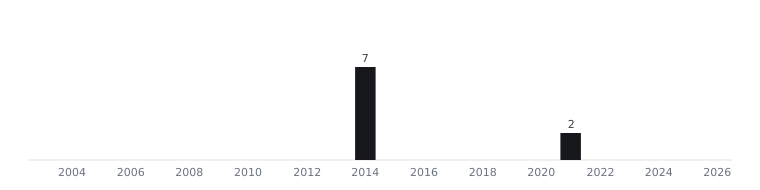
OSHA has inspected Buddy Bar Casting Corporation 7 times in California since 1995.
The latest one began on Feb 5, 2021 after an accident, in South Gate.
Those inspections ended with 31 citation items: 5 serious and 26 other-than-serious.
Penalties were first proposed at $73,155 and now stand at $35,245, 52% lower after settlements or reviews.
comes up most often in these citations: 2 items under 2340.23.
How that compares: the median penalty per cited inspection for manufacturing employers since 2015 is $3,600, and Buddy Bar Casting Corporation averages $20,700 (1 cited inspection).
Buddy Bar Casting Corporation also files yearly injury logs with OSHA, summarized below.
Citation items per year, by inspection date.
California · latest 90 days of OSHA records
1,130employers cited
Get notified the morning OSHA posts each new citation in California: the employer, the site address, the rules broken and the penalty.
Checking a subcontractor, a client or your own company? Watch Buddy Bar Casting Corporation and get notified the morning OSHA posts a new citation for it.
Incident on Feb 3, 2021: Employee sustains left arm fracture while adjusting mold
At 11:50 a.m. on February 3, 2021, Employee #1, a pour off worker employed by a company manufacturing high-quality precision aluminum castings, was adjusting the top mold/cope on the automatic line after finishing the pouring operation. The employee used his left hand to pull the mold into position instead of using the required extension tool (hook). The supervisor witnessed the incident, and Cal/OSHA initiated an investigation into the accident, identifying multiple causal factors, including failure to follow safety procedures and lack of machine guarding. The employee sustained a fracture to his left lower arm and was hospitalized for two days.
Citation and rule
Type
Proposed
Current
Issued
Status
Citation 1, item 1
29 CFR 4002(A)
Serious
$6,750
$2,700
Jun 14, 2021
Final
Citation 2, item 1
29 CFR 3314(C)(1)
Serious
$18,000
$18,000
Jun 14, 2021
Final
Inspection 317381333 OPENED MAR 4, 2014Closed
Planned · Complete · Safety · 130 employees at the site · Closed Feb 20, 2016
Incident on Jan 4, 2002: Employee hospitalized when heavy object pinches his finger
At approximately 1:15 p.m. on January 4, 2002, an accident occurred to an employ ee working as a molder/machine operator at a foundry that produces aluminum engi ne components. At the time of the accident, the employee was working at the "Wes tbrook" line in the molding area of the facility. At this point in the process, the top portion of empty foundry flasks, called the "cope" (measuring 22-inches wide by 32-inches deep by 8-inches high), are placed over a mold and filled with sand. This sand is then compacted, and the cope, which weighs approximately 100 pounds, is manually pushed by employees along a roller conveyor to a point wher e it is lifted by a 0.5-ton hoist. A lip on the rollers prevents the cope from s traying off, but the space between the rollers is large enough to allow the cope to fall through. It was at this point, where the cope is manually pushed that t he accident occurred. The employee began pushing the cope with both hands placed on the top portion. When he had proceeded with the cope approximately half way down the roller conveyor, he stated that he felt the cope "jiggle" just before i t fell through the open space between the rollers pinching the little finger of his left hand in between the top of the cope and the rollers nearest him. The in jured employee was taken to Santa Fe Springs Industrial Clinic where he was trea ted for a fracture to his left little finger. He was subsequently treated at Wes tern Hand Center where the injured finger was amputated between the first and se cond knuckle on January 18, due to necrosis that had developed. The roller conve yor was not of adequate design to prevent the cope from falling through the spac ing between the rollers.
Incident on Dec 7, 2000: Employee injured when eye lacerated by casting chip
At 6:00 a.m. on December 7, 2000, Employee #1, a machine operator with Buddy Bar Casting, was preparing to work. Buddy Bar Casting produces aluminum engine and exhaust castings using foundry, cutting, welding and core knockout operations. E mployee #1 was retrieving his safety glasses from a pneumatic United States Indu stries core knockout machine, where he had been working the previous day. In the same area there was a second core knockout machine located directly to the left of the one that Employee #1 had been using. Employee #1 was not assigned to wor k on the core knockout machine at the time of the accident, and was on his way t o load parts onto pallets. A witness was present at the work platform with Emplo yee #1 and was preparing to work with the United States Industries core knockout machine on the left side. Actuation of the core knockout machine is accomplishe d with a rocking of the foot pedal. Depressing one side of the rocking arm activ ates the machine, while depressing the opposite side stops it. At the time of th e accident, the actuating foot pedals of the two adjacent core knockout machines were placed so that the direction of activation was reversed. Because Employee #1 had only worked on the knockout machine located on the right side, he did not realize that the operation of the foot pedal of the left machine was reversed. In order to clear an air leak of the left side machine's foot pedal, Employee #1 tapped it in the direction that he believed was the off position, although it w as actually in the direction of actuation. The core machine consequently activat ed, causing the anvils to collide and a chip from one of the anvils to fly off, striking Employee #1 in the right eye. No guard or shield was in place on the ma chine and Employee #1 was cleaning his safety glasses and had not yet put them o n. Employee #1 suffered a corneal laceration in the right eye and was taken to H ealth First Medical Clinic where he remained for a few hours until being transfe rred to Downey Community Hospital.
Citation and rule
Type
Proposed
Current
Issued
Status
Citation 1, item 1
29 CFR 342 A
Other-than-serious
$375
$300
Feb 15, 2002
Final
Citation 1, item 2
29 CFR 3203 B
Other-than-serious
$375
$300
Feb 15, 2002
Final
Citation 1, item 3
29 CFR 3203 A
Other-than-serious
$375
$150
Feb 15, 2002
Final
Citation 1, item 4
29 CFR 4650 E
Other-than-serious
$375
$150
Feb 15, 2002
Final
Citation 1, item 5
29 CFR 3210 A
Other-than-serious
$375
$150
Feb 15, 2002
Final
Citation 2, item 1
29 CFR 4185
Serious
$4,500
$2,700
Feb 15, 2002
Final
Citation 3, item 1
29 CFR 3303
Other-than-serious
$18,000
$600
Feb 15, 2002
Final
Inspection 119872356 OPENED AUG 1, 1995Closed
Complaint · Complete · Safety · 115 employees at the site · Closed Feb 22, 1996
From the Form 300A summaries employers file with OSHA each year. Rate = recordable cases per 100 full-time workers.
In 2025, the South Gate site logged 15 recordable injuries or illnesses among about 110 workers: 16.4 per 100 full-time workers, against a median of 5.4 for its industry. Those cases cost 266 days away from work.
Site and year
Workers
Cases
Days-away cases
Rate
Industry median
Buddy Bar Casting, LLC
South Gate · 2025
110
15
2
16.4
5.4
Buddy Bar Casting Corporation
South Gate · 2023
93
7
3
8.8
5.4
Buddy Bar Casting
South Gate · 2022
131
9
6
7.4
5.4
Included with any plan: 5 more yearly logs from these sites, back to 2017, with each site's average rate over its latest three years. Already a subscriber? Sign in.
Alert subscribers get notified of each newly cited employer in California the morning it is posted. See the alert plans.
Source: U.S. Department of Labor, OSHA enforcement data. A citation is OSHA's allegation; employers can contest it, and the status column shows where each item stands. Something wrong on this page? Tell us.