BWX Technologies, Inc.: OSHA inspections and violations
Lynchburg, Virginia · Power Boiler and Heat Exchanger Manufacturing · NAICS 332410
4inspections
5citation items
$20,451current penalties
Mar 28, 2019last inspection
OSHA has inspected BWX Technologies, Inc. 4 times in Virginia since 1999.
The latest one began on Mar 28, 2019 after a complaint, in Lynchburg.
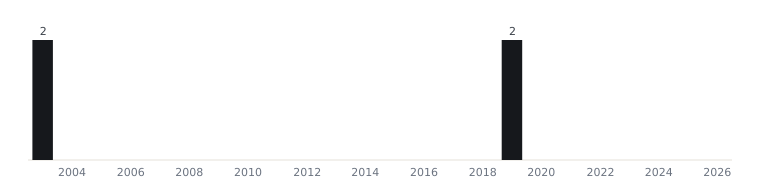
Those inspections ended with 5 citation items: 5 other-than-serious.
Penalties were first proposed at $21,551 and now stand at $20,451, 5% lower after settlements or reviews.
How that compares: the median penalty per cited inspection for manufacturing employers since 2015 is $3,600, and BWX Technologies, Inc. averages $8,051 (1 cited inspection).
2 inspections on this page followed a fatal incident.
BWX Technologies, Inc. also files yearly injury logs with OSHA, summarized below.
Citation items per year, by inspection date.
Virginia · latest 90 days of OSHA records
253employers cited
Get notified the morning OSHA posts each new citation in Virginia: the employer, the site address, the rules broken and the penalty.
Incident on Jan 2, 2003 (fatal): Employee suffers scalding and died from complications
Employee #1, a final clean specialist, was scalded by water that suddenly erupte d from a vertical-rise tank in his area of operation. Employee #1 lifted the lid of the tank to observe the compressed air agitation that he believed to be too high. Employee #1 began to reduce the air agitation by turning the valve supplyi ng the air to the tank. Employee #1 turned the valve the wrong way increasing th e air agitation causing the eruption of scalding water. Employee #1 suffered sec ond-degree burns over 30 percent of his body. Employee #1 was hospitalized and w as being treated for his injuries. On January 14, 2003, Employee #1 developed in testinal problems that caused him to suffer a cardiac arrest. Employee #1 underw ent emergency surgery for the intestinal problems but died on January 15, 2003, from complications.
Incident on Jun 15, 1999 (fatal): Employee killed when struck by hydraulic cylinders
Employee #1, an electronic technician, was performing routine maintenance on the electronic sensor of some production equipment. The equipment cycled automatica lly and he was struck by the elevator's hydraulic cylinders. Employee #1 suffere d blunt force trauma and puncture injuries to his chest and was killed. There we re no barrier guards or other means of guarding to protect workers from the haza rds posed by the machine.
From the Form 300A summaries employers file with OSHA each year. Rate = recordable cases per 100 full-time workers.
In 2021, the Lynchburg site logged 39 recordable injuries or illnesses among about 2,200 workers: 1.5 per 100 full-time workers, against a median of 3.6 for its industry. Those cases cost 487 days away from work.
Site and year
Workers
Cases
Days-away cases
Rate
Industry median
BWXT Nuclear Operations Group, Inc. - Lynchbur
Lynchburg · 2021
2,200
39
32
1.5
3.6
BWXT Nuclear Operations Group, Inc. - Lynchburg
Lynchburg · 2020
2,200
37
17
1.4
3.6
The rules behind these citations
Current text from the Code of Federal Regulations. Some citations were issued under older wording.
29 CFR 1910.132 · Personal protective equipment, general requirements
29 CFR 1910.132(d)(1)
(d) Hazard assessment and equipment selection. (1) The employer shall assess the workplace to determine if hazards are present, or are likely to be present, which necessitate the use of personal protective equipment (PPE). If such hazards are present, or likely to be present, the employer shall:
29 CFR 1910.145 · Specifications for accident prevention signs and tags
29 CFR 1910.145(f)(3)
(3) Use. Tags shall be used as a means to prevent accidental injury or illness to employees who are exposed to hazardous or potentially hazardous conditions, equipment or operations which are out of the ordinary, unexpected or not readily apparent. Tags shall be used until such time as the identified hazard is eliminated or the hazardous operation is completed. Tags need not be used where signs, guarding or other positive means of protection are being used.
(a) Machine guarding—(1) Types of guarding. One or more methods of machine guarding shall be provided to protect the operator and other employees in the machine area from hazards such as those created by point of operation, ingoing nip points, rotating parts, flying chips and sparks. Examples of guarding methods are—barrier guards, two-hand tripping devices, electronic safety devices, etc.
Alert subscribers get notified of each newly cited employer in Virginia the morning it is posted. See the alert plans.
Source: U.S. Department of Labor, OSHA enforcement data. A citation is OSHA's allegation; employers can contest it, and the status column shows where each item stands. Something wrong on this page? Tell us.