Chevron Products Company has 57 OSHA inspections on record in California, the first in 1990.
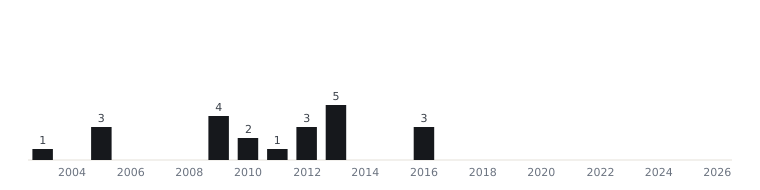
OSHA's last visit started on Apr 7, 2016 as a planned inspection, in El Segundo.
Across those inspections OSHA issued 56 citation items: 13 serious and 43 other-than-serious.
OSHA proposed $183,465 in penalties. After settlements and reviews the total is $63,805, down 65%.
Most often, OSHA cited 2473.2, (2 items).
For context, across all manufacturing employers the median penalty per cited inspection since 2015 is $4,500. Chevron Products Company averages $8,435 over 1 cited inspection in that time.
Chevron Products Company also files yearly injury logs with OSHA, summarized below.
Citation items per year, by inspection date.
California · latest 90 days of OSHA records
1,134employers cited
7 of them in the same industry
Get notified the morning OSHA posts each new citation in California: the employer, the site address, the rules broken and the penalty.
Incident on Apr 3, 2013: Oil refinery worker crushes hand on slide valve
At approximately 1:00 p.m. on April 3, 2013, Employee #1, a 25-year-old male wit h Chevron Refinery was working on the first deck of the FCC unit at Chevron Refi nery in El Segundo, California. Employee #1 attempted to manually test the two l imit switches located near the stroke limit stop inside the FCC Regent slide val ve housing. Employee #1 reached up with his arms from the underside of the Regen t slide valve housing to get to the two limit switches located inside the Regent slide valve housing. The underside of the Regent FCC slide valve housing was no t guarded. As Employee #1 touched the two limit switches with his left and right hands, the Regent slide valve suddenly moved to shut. Employee #1 could not get his right hand out of the slide valve housing in time before his right hand was pinched between the slide valve stroke limit stop and the slide valve split nut assembly when the slide valve moved to close. The FCC slide valve was pressuriz ed and was not de-energized at the time of the incident. Multiple bones in Emplo yee #1's right hand were broken. The manufacturer of the Regent Slide valve was MEA, model number 2-6.4K-36, serial number 1135/8603. The approximate dimensions of the split nut assembly housing external to the FCC was 8 ft. long, 3 ft. wid e and 2 ft. high and stands about 4 ft. off the deck floor. Employee #1 was a fu ll time employee of Chevron. The incident was caused due to the fact that the Re gent slide valve was not de-pressurized or blocked out by the employer. Employee #1's contact with the limit switches caused the Regent FCC slide valve to go in to a safe mode which in turn caused the slide valve to move. Employee #1's right hand was injured from being pinched between the slide valve split nut assembly and the slide valve stroke limit stop. Chevron Refinery refines crude oil into d ifferent petroleum products.
Citation and rule
Type
Proposed
Current
Issued
Status
Citation 2, item 1
29 CFR 3314 C
Other-than-serious
$22,500
$2,000
Oct 2, 2013
Final
Inspection 313647398 OPENED FEB 25, 2013Closed
Complaint · Partial · Safety · 1,100 employees at the site · Closed May 16, 2016
Incident on Jan 5, 2011: Employee finger is amputated when caught between pipes
At approximately 1:00 pm, Employee #1, a metals mechanic, was moving a load of p ipe with a bridge crane. Employee #1 was holding the tag line, for bundles of pi pe that were held in a choke hitch. As the load was being moved across the shop at about waist height, Employee #1 stopped to move some grates that needed to be moved; however, the load started to swing. Employee #1 then reached out to stop the swing, but the load shifted. Employee #1's middle right and ring finger tip s were caught between the pipes and were amputated. Employee #1 was treated for his injuries at a local clinic.
Citation and rule
Type
Proposed
Current
Issued
Status
Citation 1, item 1
29 CFR 5042 A09
Other-than-serious
$185
$185
May 20, 2011
Closed
Inspection 300874963 OPENED SEP 16, 2010Closed
Accident · Partial · Safety · 1,000 employees at the site · Closed Nov 15, 2010
Incident on Mar 2, 2010: Employee suffers burns from steam condensate
At 8:00 p.m. on March 2, 2010, Employee # 1, an oil refinery operator, was assig ned to the co-gen unit. While blowing down the co-gen unit 'A', upstream steam c ondensate struck Employee #1 on the right shoulder and body above the waist. Emp loyee #1 was hospitalized for more than 24 hours for treatment of second degree thermal burns to 40 percent of the body. The incident was reported to DOSH, Los Angeles District Office at 11:55 p.m. on March 2, 2010, and forwarded to the DOS H, Torrance Process Safety Management Office March 9, 2010. DOSH arrived on scen e at 8:00 a.m. on March 10, 2010.
Citation and rule
Type
Proposed
Current
Issued
Status
Citation 1, item 1
29 CFR 3328 G
Other-than-serious
$18,000
$635
Jul 1, 2010
Final
Citation 2, item 1
29 CFR 6778
Other-than-serious
$18,000
$635
Jul 1, 2010
Final
Inspection 311074876 OPENED NOV 9, 2009Closed
Complaint · Partial · Safety · 1,200 employees at the site · Closed Apr 1, 2010
Incident on Feb 18, 2003: Employee sustains burns when steam releases
At approximately 2:00 p.m. on February 18, 2003, Employee #1 and a coworker were starting up the steam system to the 1391 Exchanger in the Steam Naphtha Reforme r (SNR) Unit at the Chevron Refinery in El Segundo, California. While Employee # 1 and the coworker were attempting to open a 10-in. rising stem gate valve isola ting steam Number 150 from the 5 H2S Unit to the SNR Unit, the steam burst from the bonnet gasket of the valve, striking Employee #1 in the lower legs. Employee #1 sustained first to fourth degree burns to the full length of his left lower leg and first to third degree burns on a 5-in. by 5-in. section of his right shi n. Employee #1 was initially treated at RFK Hospital and released the same day. The following day, Employee #1 was admitted to the Burn Ward of the Grossmont Ho spital and received skin grafts.
Citation and rule
Type
Proposed
Current
Issued
Status
Citation 1, item 1
29 CFR 5189 J01 A
Other-than-serious
$18,000
$425
Apr 29, 2003
Final
Inspection 120222757 OPENED AUG 22, 2002Closed
Accident · Partial · Safety · 1,050 employees at the site · Closed Jun 6, 2008
Incident on Mar 19, 2000: Employee sustained chemical burns to skin, throat, lungs
At approximately 9:00 a.m. on March 19, 2000, two employees were loading a railc ar with aqueous ammonia. Employee #1 checked on the rail car periodically to see when the loading operation was complete. When it was complete, he closed the li quid and vapor valves on the rack, but left the both hoses connected to the rail car and the valves on the rail car open. Employee #2 returned to the rack alone and started disconnecting the hose valves from the rail car. Employee #2 was exp osed to aqueous ammonia as the liquid was shooting upward. Employee #2 had his u pper body drenched with the hazardous substance. Employee #2 recalled removing t he respirator and went directly to the safety shower which was 4 to 5 steps away . Employee #2 passed out and remembered waking up as he was being assisted to th e ground safety shower by a coworker. Paramedics were summoned and the injured e mployee was transported to Robert F. Kennedy Memorial Hospital for inpatient hos pitalization.
Citation and rule
Type
Proposed
Current
Issued
Status
Citation 1, item 1
29 CFR 3203 A06 A
Other-than-serious
$18,000
$375
Sep 14, 2000
Final
Inspection 126145952 OPENED JAN 6, 2000Closed
Complaint · Partial · Safety · 1,150 employees at the site · Closed Feb 1, 2000
Incident on Jul 25, 1998: Employee injured when splashed with aqueous ammonia
At 7:50 a.m. on July 25, 1998, Employee #1 was preparing a rail car for loading of aqueous ammonia. He attached the vapor/vent line to the rail car and the caml ock fitting to the rail car fill nozzle. As the liquid was being transferred, th e camlock fitting disengaged and Employee #1 was sprayed with aqueous ammonia. F rom a safe distance, a coworker directed Employee #1 into one of the safety show ers on the loading platform, and he was able to flush his eyes and body with wat er. Paramedics were summoned and Employee #1 was transported to Robert F. Kenned y Memorial Hospital for treatment of chemical burns. At the time of the accident , he was wearing a helmet, face shield, steel-toed shoes, Nomax coveralls, and s afety glasses.
No citations from this inspection.
Inspection 126052679 OPENED MAY 13, 1997Closed
Complaint · Partial · Health · 1,200 employees at the site · Closed Aug 7, 1997
Incident on Jan 15, 1995: Employee burned by hot water in uncovered drain
At approximately 4:40 a.m. on January 15, 1995, Employee #1, of Chevron U.S.A. P roducts Co., was walking through the #4 crude unit to open valves that were stuc k and to pick up some lubricant he had left in the area. He stepped into an unco vered drain that was filled with hot water from a steam lance. A laborer had ear lier that night removed the grating from the storm drain in order to unplug it. The laborer had introduced steam lance into the drain. The laborer did not guard or barricade the drain. Employee #1 sustained first-, second-, and third-degree burns. He was admitted to the hospital. The employer was cited for a serious sa fety violation.
Citation and rule
Type
Proposed
Current
Issued
Status
Citation 1, item 1
29 CFR 3212 A01
Other-than-serious
$1,875
$500
Jun 29, 1995
Final
Inspection 120047592 OPENED JAN 19, 1995Closed
Accident · Partial · Safety · 1,350 employees at the site · Closed Jul 7, 1995
Incident on Dec 7, 1994: Burn - electrical fault in motor control center
An electrical trainer was asked to help troubleshoot a 480-volt circuit breaker at a motor control center at a coker unit. The circuit breaker was in the test p osition, and the cubicle door was open when the trainer arrived. He tried to clo se the door, but was not able to do so since some components were in the way. Ch ecking to ensure that the circuit breaker was in the open position, the trainer started to rack in the breaker. An electrical fault occurred, and the trainer wa s burned by the ensuing electric arc. He was hospitalized with second and third degree burns to his hands and second degree burns to his face.
Citation and rule
Type
Proposed
Current
Issued
Status
Citation 2, item 1
29 CFR 3328 G
Serious
$2,500
$2,000
Jun 5, 1995
Final
Inspection 120045349 OPENED OCT 26, 1994Closed
Complaint · Partial · Health · 1,370 employees at the site · Closed May 12, 1995
Incident on Jul 18, 1994: Employee's leg burned by hot water
At approximately 9:30 p.m. on July 8, 1994, Employee #1, of Chevron U.S.A., was assisting a coworker who had removed the bolts from the bottom head and associat ed inlet flange of a D-drum at a coker unit. Employee #1 was to remove the air l ine hose for the air gun that was used to take out bolts. As he moved toward the D-drum to remove the air line hose from the air gun, hot water burped out of th e inlet flange and hit him in the leg. Employee #1 sustained a second-degree bur n to his right lower leg. He was initially treated by the company physician, but his injury worsened and he was later admitted to a local hospital. The employer was cited for a serious violation.
Citation and rule
Type
Proposed
Current
Issued
Status
Citation 1, item 1
29 CFR 6786
Other-than-serious
$3,750
$1,000
Dec 20, 1994
Closed
Inspection 120040993 OPENED MAY 17, 1994Closed
Unprogrammed related · Partial · Health · 1,370 employees at the site · Closed Jan 24, 1995
Incident on May 13, 1994: Employees suffer ammonia exposure and heat stress
At approximately 3:30 p.m. on May 13, 1994, Employees #1, #2, and #3 sustained s erious discomfort attributed to ammonia exposure combined with heat stress. At t he time of the accident, the employees were in a permit-required confined space, the hot box of a precipitator at a refinery, where the employer was doing contr act work. Employee #1, a helper, was standing outside the hot box in a nonpermit -required confined space and wearing a self-contained breathing apparatus escape pack. Employee #2, a structural welder, was welding inside the hot box, along w ith two other uninjured welders. Employee #3, an ironworker and lead worker, was overseeing the operations inside the hot box. After the accident, the employees were transported to the hospital and released the same day.
Citation and rule
Type
Proposed
Current
Issued
Status
Citation 1, item 1
29 CFR 5157 F
Other-than-serious
$375
$375
Nov 9, 1994
Closed
Inspection 120050109 OPENED FEB 2, 1994Closed
Accident · Partial · Safety · 1,370 employees at the site · Closed Jun 15, 1994
Incident on Jan 19, 1994: Employee burned by steam from open valve
Employee #1 was bleeding (blowing down) a steam system under gravity pressure. F our valves were in place between the vessel and drain pipe. Employee #1 opened t hree valves, thinking the last in line at the drain was closed. He walked to the last valve, which was partially open and discharging hot steam and condensate a s he arrived. He sustained first- and second-degree burns to his left leg and le ft arm.
Citation and rule
Type
Proposed
Current
Issued
Status
Citation 1, item 1
29 CFR 3329 D
Serious
$750
$750
Apr 18, 1994
Closed
Inspection 120029061 OPENED JUN 14, 1993Closed
Complaint · Complete · Safety · 1,200 employees at the site · Closed Jul 1, 1994
Incident on Feb 18, 1993: Employee injured while working on cooling tower
EMPLOYEE #1, A CRANE RIGGER IN CHEVRON'S TRANSPORTATION DEPARTMENT, WAS WALKING ACROSS THE ROOF OF A WATER COOLING TOWER THAT HAD 5-FOOT HIGH SHROUDS AROUND 12- FOOT DIAMETER HORIZONTAL ROTATING FAN BLADES. EMPLOYEE #1 SUFFERED A FRACTURED A RM AND A BRAIN CONCUSSION. THERE WERE NO WITNESSES AND EMPLOYEE #1 DOES NOT REME MBER THE INCIDENT. CONJECTURE INDICATES THAT HE WAS STRUCK ON THE ARM BY THE FAN BLADE AND STRUCK HIS HEAD ON AN ANGLE IRON WHEN HE FELL. ONE SERIOUS VIOLATION WAS ESTABLISHED AS A RESULT OF THIS ACCIDENT.
No citations from this inspection.
Inspection 111872149 OPENED JUN 15, 1992Closed
Referral · Partial · Health · 1,200 employees at the site · Closed Jul 1, 1994
Incident on Mar 21, 1992: Employee's legs burned by hot water and coke
At approximately 11:15 a.m. on March 21, 1992, Employee #1 of Chevron sustained 2nd- and 3rd-degree burns/scalds to both legs when splashed with hot water and c oke from a 10 in. pipe. He separated the flange without waiting for the vessel t o drain as much as possible. Employee #1 was transported to Robert F. Kennedy Me morial Hospital, where he was treated and released. On March 24, 1992, he report ed to the Chevron clinic and was referred to Torrance Memorial Hospital for trea tment of the extensive leg burns. Employee #1 was not protected by a slicker sui t or rain coat.
Citation and rule
Type
Proposed
Current
Issued
Status
Citation 1, item 1
29 CFR 5194 D01
Other-than-serious
$185
$185
Aug 5, 1992
Closed
Citation 2, item 1
29 CFR 3203 A03
Serious
$2,500
$2,500
Aug 5, 1992
Closed
Citation 3, item 1
29 CFR 6786 B
Serious
$2,000
$2,000
Aug 5, 1992
Closed
Citation 4, item 1
29 CFR 6815 A
Serious
$1,500
$1,500
Aug 5, 1992
Closed
Citation 5, item 1
29 CFR 6845 A
Serious
$2,000
$2,000
Aug 5, 1992
Closed
Inspection 111989976 OPENED JAN 24, 1992Closed
Unprogrammed related · Partial · Safety · 1,200 employees at the site · Closed Jul 29, 1992
Incident on May 23, 1991: Electric shock - ground fault in attachment plug
An electrician was splicing a 3-meter-long section of cable supplied by his empl oyer to a 305-meter-long cable supplied by a contractor. Both cables were new. T he employee had followed the prescribed splicing procedures. He plugged one end of the spliced cable into a secondary power source, and then turned on the main and secondary disconnects to energize the cable. From a crouched position, he pi cked up the free plug, intending to check the phase-to-phase voltage. He lifted the cable with his left hand and a meter with his right hand. The employee recei ved an electric shock when he shifted the plug in his hand. He was hospitalized overnight in a medical clinic for observation. He was treated for blisters on hi s left thumb and index finger. A detailed examination of the plugs found that th e plug on the contractor-supplied cable was not grounded.
Incident on Mar 17, 1991: Electric shock - contact with energized parts thru tool
An employee was working with an oxy-fuel igniter for a sulfur furnace in a refin ery. The employee, who was wearing leather work gloves, was standing on a metal grating work surface. He contacted an uninsulated 10-kilovolt feed conductor for a spark plug with a crescent wrench he was holding in his right hand. His left hand was touching the grating. He received an electric shock and burns on his ri ght index finger and on the tip of his left little finger. He was hospitalized f or his injuries.
From the Form 300A summaries employers file with OSHA each year. Rate = recordable cases per 100 full-time workers.
In 2025, the El Segundo site logged 1 recordable injury or illness among about 1,198 workers: 0.1 per 100 full-time workers, against a median of 0.6 for its industry.
Site and year
Workers
Cases
Days-away cases
Rate
Industry median
Chevron Products Company
El Segundo · 2025
1,198
1
0
0.1
0.6
Downstream & Chemicals - Richmond, CA Lubricants Plant
Richmond · 2025
49
1
1
2.0
0.6
Downstream & Chemicals - Richmond, CA Terminal
Richmond · 2025
6
0
0
0.0
1.0
Chevron El Segundo
El Segundo · 2019
1,194
1
1
0.1
0.6
Included with any plan: 10 more yearly logs from these sites, back to 2017, with each site's average rate over its latest three years. Already a subscriber? Sign in.
Alert subscribers get notified of each newly cited employer in California the morning it is posted. See the alert plans.
Source: U.S. Department of Labor, OSHA enforcement data. A citation is OSHA's allegation; employers can contest it, and the status column shows where each item stands. Something wrong on this page? Tell us.