Chicago Transit Authority: OSHA inspections and violations
Chicago, Illinois · All Other Transit and Ground Passenger Transportation · NAICS 485999
7inspections
8citation items
$0current penalties
Jul 18, 2022last inspection
Since 1991, OSHA inspectors have visited Chicago Transit Authority in Illinois 7 times.
The most recent inspection opened on Jul 18, 2022 after a fatality or catastrophe, in Chicago.
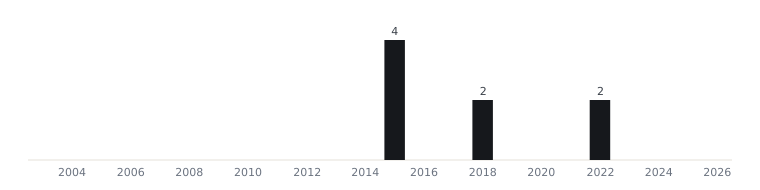
In all, OSHA issued 8 citation items: 7 serious and 1 other-than-serious.
The proposed penalties came to $6,600; today they stand at $0, 100% less.
The rule cited most here is 1910.147 (lockout/tagout), 2 times.
Among transportation and warehousing employers, the typical cited inspection since 2015 ends with a $2,405 penalty. Chicago Transit Authority averages $0 across 4 cited inspections.
2 inspections on this page followed a fatal incident.
Chicago Transit Authority also files yearly injury logs with OSHA, summarized below.
The Wage and Hour Division has 2 cases on it since 2015, with $344 in back wages owed to workers.
Citation items per year, by inspection date.
Illinois · latest 90 days of OSHA records
421employers cited
Get notified the morning OSHA posts each new citation in Illinois: the employer, the site address, the rules broken and the penalty.
Incident on Jul 16, 2022 (fatal): Employee is electrocuted and killed after contacting electri
At 1:45 a.m. on July 16, 2022, an employee was walking on the platform at the LaSalle Station of the Chicago Transit Authority (CTA). The employee was a CTA customer service assistant and was walking on the south-inner platform towards the south-end steps. The employee was observed was observed walking down the steps and onto the right-of-way, and then crossing from the inner track towards the center. When the employee stepped over the rails, he stumbled and fell, landing on the foot walk between the third rails. The employee attempted to get up from the foot walk but stumbled and fell a second time, contacting the third rail of the outer track and running rail with a 600 volt direct current. The employee remained in the position in which he fell, and approximately 5 minutes later a southbound train struck the employee when it entered the station. The coworker driving the train stopped, and activated the bakes and yellow outside signal lights, with the employee positioned beneath the head car. The coworker opened the left side motor cab window of the train and looked out before returning to the right-side operating position and proceeding, starting and stopping the train four more times. When the trainer reaches the marker on the outer track platform of the station, the coworker exited the head car and went back to observe the employee. The employee was killed by electrocution when he contacted the 600 volt third and running rails. The employee sustained secondary trauma post mortem from contacting the train, receiving multiple fractures to the skull, face, ribs, and left humerus.
Citation and rule
Type
Proposed
Current
Issued
Status
Citation 1, item 1
29 CFR 820 ILCS 219/20(A)
Serious
$6,600
$0
Nov 30, 2022
Final
Citation 2, item 1
29 CFR 820 ILCS 219/20(A)
Serious
$0
$0
Nov 30, 2022
Final
Inspection 344528278 OPENED DEC 13, 2019Closed
Fatality or catastrophe · Partial · Safety · Local government · 100 employees at the site · Closed Apr 21, 2020
Incident on Dec 10, 2019: Employee's fingertip is amputated when load shifts on pallet
At 8:30 a.m. on December 10, 2019, an employee was working as a stock and inventory clerk for a large metropolitan transit authority. He was pulling inventory for an order that he needed to fill. He was helping a truck driver move a pallet and unload his truck. There were filters on the pallet that were quite heavy. The driver and the employee were moving the pallet into a better position for a forklift driver to gain access to the pallet and unload it. The pallet became stuck on an obstruction. As the two workers attempted to free the pallet, the material on the pallet shifted and caught the employee's finger. One of the employee's fingertips was amputated. He was treated without hospitalization.
No citations from this inspection.
Inspection 343530556 OPENED OCT 15, 2018Closed
Fatality or catastrophe · Partial · Safety · Local government · 40 employees at the site · Closed Feb 26, 2019
Incident on Oct 14, 2018 (fatal): Employee falls from elevated work platform and is killed
At 8:00 a.m. on October 14, 2018, an employee was cutting the fiberglass walkway materials beside the rail track that had failed while on an elevated structure and fell. The employee struck his head against the concrete slab and was killed.
From the Form 300A summaries employers file with OSHA each year. Rate = recordable cases per 100 full-time workers.
In 2022, the Chicago site logged 601 recordable injuries or illnesses among about 9,233 workers: 6.8 per 100 full-time workers, against a median of 4.3 for its industry. Those cases cost 53,669 days away from work.
Site and year
Workers
Cases
Days-away cases
Rate
Industry median
Chicago Transit Authority
Chicago · 2022
9,233
601
530
6.8
4.3
74th & Wood Scheduled Transit Operations
Chicago · 2019
630
47
45
8.3
4.3
77th Street Scheduled Operations
Chicago · 2019
580
47
44
9.2
4.3
North Park Scheduled Operations
Chicago · 2019
554
27
26
5.3
4.3
Chicago Scheduled Transit Operations
Chicago · 2019
555
42
37
8.4
4.3
Forest Glen Scheduled Transit Operations
Chicago · 2019
523
35
34
7.2
4.3
103rd Street Scheduled Transit Operations
Chicago · 2019
529
43
40
9.0
4.3
Kedzie Scheduled Transit Operations
Chicago · 2019
510
36
32
8.2
4.3
Included with any plan: 113 more yearly logs from these sites, back to 2016. Already a subscriber? Sign in.
(e) Written hazard communication program. (1) Employers shall develop, implement, and maintain at each workplace, a written hazard communication program which at least describes how the criteria specified in paragraphs (f), (g), and (h) of this section for labels and other forms of warning, safety data sheets, and employee information and training will be met, and which also includes the following:
(4) Energy control procedure. (i) Procedures shall be developed, documented and utilized for the control of potentially hazardous energy when employees are engaged in the activities covered by this section.
29 CFR 1910.147(c)(7)(i)
(7) Training and communication. (i) The employer shall provide training to ensure that the purpose and function of the energy control program are understood by employees and that the knowledge and skills required for the safe application, usage, and removal of the energy controls are acquired by employees. The training shall include the following:
29 CFR 1910.23 · Guarding floor and wall openings and holes
Source: U.S. Department of Labor, OSHA enforcement data. A citation is OSHA's allegation; employers can contest it, and the status column shows where each item stands. Something wrong on this page? Tell us.