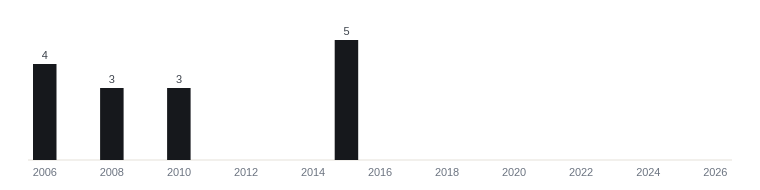
Consolidated Container Company, LP has 4 OSHA inspections on record in Tennessee, the first in 2006.
OSHA's last visit started on Aug 19, 2015 as a planned inspection, in Memphis.
Across those inspections OSHA issued 15 citation items: 5 serious and 10 other-than-serious.
OSHA proposed $7,825 in penalties. After settlements and reviews the total is $4,895, down 37%.
Most often, OSHA cited 1910.305, electrical wiring methods (2 items).
For context, across all manufacturing employers the median penalty per cited inspection since 2015 is $4,500. Consolidated Container Company, LP averages $3,220 over 1 cited inspection in that time.
Consolidated Container Company, LP also files yearly injury logs with OSHA, summarized below.
Citation items per year, by inspection date.
Tennessee · latest 90 days of OSHA records
323employers cited
Get notified the morning OSHA posts each new citation in Tennessee: the employer, the site address, the rules broken and the penalty.
Checking a subcontractor, a client or your own company? Watch Consolidated Container Company, LP and get notified the morning OSHA posts a new citation for it.
OSHA records show Consolidated Container Company, LP at 21 sites in 8 states. Together they've had 50 inspections and $123,400 in current penalties.
We match records by employer name and industry, so these sites are likely the same company, not certainly. Franchises and subsidiaries can file under one name.
Included with any plan: the site-by-site record for all 21 sites, with repeat and willful violations and citations per year for the whole company. Already a subscriber? Sign in.
From the Form 300A summaries employers file with OSHA each year. Rate = recordable cases per 100 full-time workers.
In 2019, the Memphis site logged 1 recordable injury or illness among about 87 workers: 1.2 per 100 full-time workers, against a median of 2.6 for its industry. Those cases cost 78 days away from work.
Site and year
Workers
Cases
Days-away cases
Rate
Industry median
Consolidated Container Co. - Memphis
Memphis · 2019
87
1
1
1.2
2.6
Memphis site
Memphis · 2016
86
2
0
2.4
2.6
The rules behind these citations
Current text from the Code of Federal Regulations. Some citations were issued under older wording.
29 CFR 1910.110 · Storage and handling of liquefied petroleum gases
29 CFR 1910.110(e)(4)(iii)
(iii) Permanent and removable fuel containers shall be securely mounted to prevent jarring loose, slipping, or rotating, and the fastenings shall be designed and constructed to withstand static loading in any direction equal to twice the weight of the tank and attachments when filled with fuel using a safety factor of not less than four based on the ultimate strength of the material to be used. Field welding, when necessary, shall be made only on saddle plates, lugs or brackets, originally attached to the container by the tank manufacturer.
(8) The employer shall maintain in the workplace copies of the required safety data sheets for each hazardous chemical, and shall ensure that they are readily accessible during each work shift to employees when they are in their work area(s). (Electronic access and other alternatives to maintaining paper copies of the safety data sheets are permitted as long as no barriers to immediate employee access in each workplace are created by such options.)
29 CFR 1910.1200(h)(1)
(h) Employee information and training. (1) Employers shall provide employees with effective information and training on hazardous chemicals in their work area at the time of their initial assignment, and whenever a new chemical hazard the employees have not previously been trained about is introduced into their work area. Information and training may be designed to cover categories of hazards (e.g., flammability, carcinogenicity) or specific chemicals. Chemical-specific information must always be available through labels and safety data sheets.
Alert subscribers get notified of each newly cited employer in Tennessee the morning it is posted. See the alert plans.
Source: U.S. Department of Labor, OSHA enforcement data. A citation is OSHA's allegation; employers can contest it, and the status column shows where each item stands. Something wrong on this page? Tell us.