OSHA has inspected D. D. Wire Co., Inc. 3 times in California since 1987.
The latest one began on Jun 29, 2017 as a planned inspection, in Temple City.
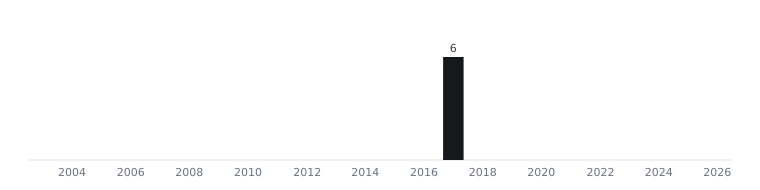
Those inspections ended with 14 citation items: 6 serious and 8 other-than-serious.
Penalties were first proposed at $6,100 and now stand at $4,400, 28% lower after settlements or reviews.
Electrical wiring methods comes up most often in these citations: 2 items under 1910.305.
How that compares: the median penalty per cited inspection for manufacturing employers since 2015 is $3,600, and D. D. Wire Co., Inc. averages $4,000 (1 cited inspection).
D. D. Wire Co., Inc. also files yearly injury logs with OSHA, summarized below.
Citation items per year, by inspection date.
California · latest 90 days of OSHA records
1,111employers cited
Get notified the morning OSHA posts each new citation in California: the employer, the site address, the rules broken and the penalty.
Incident on Aug 2, 1996: Employee's thumb amputated in punch press
At approximately 7:20 a.m. on August 2, 1996, Employee #1, of D. D. Wire Company , Inc., was operating a 20-ton Diamond punch press, #31, serial #1057, when the internal safety dog broke. The press was released when Employee #1 had his hand under the die, and his left thumb was amputated. The machine was equipped with a ll required safety devices, was well maintained, and had been inspected on July 26, 1996. The employer immediately secured the machine and planned to option it out for salvage so it would never be used again as a punch press.
Citation and rule
Type
Proposed
Current
Issued
Status
Citation 1, item 1
29 CFR 3203 A04
Other-than-serious
$100
$100
Sep 17, 1996
Closed
Inspection 100549120 OPENED OCT 28, 1987Closed
Planned · Complete · Safety · 20 employees at the site · Closed Jan 11, 1988
From the Form 300A summaries employers file with OSHA each year. Rate = recordable cases per 100 full-time workers.
In 2021, the Temple City site logged 3 recordable injuries or illnesses among about 22 workers: 13.3 per 100 full-time workers, against a median of 3.6 for its industry. Those cases cost 37 days away from work.
Site and year
Workers
Cases
Days-away cases
Rate
Industry median
D.D. Wire Company
Temple City · 2021
22
3
2
13.3
3.6
Included with any plan: 3 more yearly logs from these sites, back to 2017, with each site's average rate over its latest three years. Already a subscriber? Sign in.
(4) Work rests. On offhand grinding machines, work rests shall be used to support the work. They shall be of rigid construction and designed to be adjustable to compensate for wheel wear. Work rests shall be kept adjusted closely to the wheel with a maximum opening of one-eighth inch to prevent the work from being jammed between the wheel and the rest, which may cause wheel breakage. The work rest shall be securely clamped after each adjustment. The adjustment shall not be made with the wheel in motion.
29 CFR 1910.215(b)(9)
(9) Exposure adjustment. Safety guards of the types described in subparagraphs (3) and (4) of this paragraph, where the operator stands in front of the opening, shall be constructed so that the peripheral protecting member can be adjusted to the constantly decreasing diameter of the wheel. The maximum angular exposure above the horizontal plane of the wheel spindle as specified in paragraphs (b) (3) and (4) of this section shall never be exceeded, and the distance between the wheel periphery and the adjustable tongue or the end of the peripheral member at the top shall never exceed one-fourth inch. (See Figures O-18, O-19, O-20, O-21, O-22, and O-23.)
(b) Compressed air used for cleaning. Compressed air shall not be used for cleaning purposes except where reduced to less than 30 p.s.i. and then only with effective chip guarding and personal protective equipment.
29 CFR 1910.303 · Electrical equipment, general requirements
Alert subscribers get notified of each newly cited employer in California the morning it is posted. See the alert plans.
Source: U.S. Department of Labor, OSHA enforcement data. A citation is OSHA's allegation; employers can contest it, and the status column shows where each item stands. Something wrong on this page? Tell us.