OSHA SearchOSHA records by employer

Daniel Marmolejo: OSHA inspections and violations

Dallas, Texas · Structural Steel and Precast Concrete Contractors · NAICS 238120

3inspections
3citation items
$5,963current penalties
Feb 15, 2017last inspection

Since 2005, OSHA inspectors have visited Daniel Marmolejo in Texas 3 times.

The most recent inspection opened on Feb 15, 2017 as a planned inspection, in Katy.

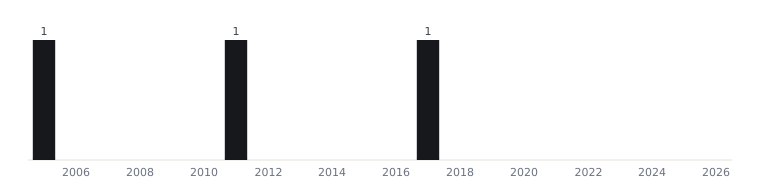
In all, OSHA issued 3 citation items: 3 serious.

The proposed penalties came to $7,103; today they stand at $5,963, 16% less.

Among construction employers, the typical cited inspection since 2015 ends with a $3,079 penalty. Daniel Marmolejo averages $3,803 across 1 cited inspection.

Daniel Marmolejo: OSHA citation items per year, 2005 to 2017
Citation items per year, by inspection date.

Want to know if OSHA cites Daniel Marmolejo again? Add it to a watchlist and we will email you the morning the citation shows up.

Watch this company

Inspection history

Inspection 342105194 OPENED FEB 15, 2017Closed

Planned · Partial · Safety · 5 employees at the site · Closed Jan 2, 2019

23903 Katy Freeway, Katy, TX 77494 · Commercial and Institutional Building Construction · OSHA's record · Phone and website on Google Maps

Citation and ruleTypeProposedCurrentIssuedStatus
Citation 1, item 1
29 CFR 1926.451(g)(1) · Scaffolds, general requirements
Serious$3,803$3,803Mar 30, 2017Final

Inspection 314307463 OPENED MAY 13, 2011Closed

Planned · Partial · Safety · 4 employees at the site · Closed Jun 4, 2012

14900 Avery Ranch Blvd., Austin, TX 78717 · Structural Steel and Precast Concrete Contractors · OSHA's record · Phone and website on Google Maps

Citation and ruleTypeProposedCurrentIssuedStatus
Citation 1, item 1
29 CFR 1926.1053(b)(1) · Ladders in construction
Serious$1,800$1,260Jun 7, 2011Closed

Inspection 307491316 OPENED JUL 29, 2005Closed

Unprogrammed other · Partial · Safety · 2 employees at the site · Closed Jan 10, 2006

2215 Ross Avenue, Dallas, TX 75201 · Structural Steel and Precast Concrete Contractors · OSHA's record · Phone and website on Google Maps

Citation and ruleTypeProposedCurrentIssuedStatus
Citation 1, item 1
29 CFR 1926.501(b)(1) · Fall protection in construction
Serious$1,500$900Oct 24, 2005Closed

The rules behind these citations

Current text from the Code of Federal Regulations. Some citations were issued under older wording.

29 CFR 1926.1053 · Ladders in construction

29 CFR 1926.1053(b)(1)

(1) When portable ladders are used for access to an upper landing surface, the ladder side rails shall extend at least 3 feet (.9 m) above the upper landing surface to which the ladder is used to gain access; or, when such an extension is not possible because of the ladder's length, then the ladder shall be secured at its top to a rigid support that will not deflect, and a grasping device, such as a grabrail, shall be provided to assist employees in mounting and dismounting the ladder. In no case shall the extension be such that ladder deflection under a load would, by itself, cause the ladder to slip off its support.

29 CFR 1926.451 · Scaffolds, general requirements

29 CFR 1926.451(g)(1)

(g) Fall protection. (1) Each employee on a scaffold more than 10 feet (3.1 m) above a lower level shall be protected from falling to that lower level. Paragraphs (g)(1) (i) through (vii) of this section establish the types of fall protection to be provided to the employees on each type of scaffold. Paragraph (g)(2) of this section addresses fall protection for scaffold erectors and dismantlers.

29 CFR 1926.501 · Fall protection in construction

29 CFR 1926.501(b)(1)

(b)(1) Unprotected sides and edges. Each employee on a walking/working surface (horizontal and vertical surface) with an unprotected side or edge which is 6 feet (1.8 m) or more above a lower level shall be protected from falling by the use of guardrail systems, safety net systems, or personal fall arrest systems.

Other structural steel and precast concrete contractors employers in Texas

Source: U.S. Department of Labor, OSHA enforcement data. A citation is OSHA's allegation; employers can contest it, and the status column shows where each item stands. Something wrong on this page? Tell us.