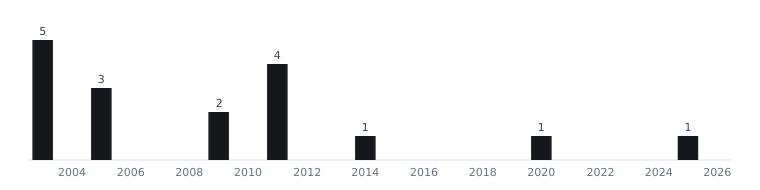
OSHA has inspected Denver-Elek, Inc. 10 times in Maryland since 1992.
The latest one began on Aug 19, 2025, in Reisterstown.
Those inspections ended with 18 citation items: 9 serious, 2 repeat and 7 other-than-serious.
Penalties were first proposed at $11,087 and now stand at $7,310, 34% lower after settlements or reviews.
Hazard communication comes up most often in these citations: 3 items under 1910.1200.
How that compares: the median penalty per cited inspection for construction employers since 2015 is $3,080, and Denver-Elek, Inc. averages $938 (2 cited inspections).
Denver-Elek, Inc. also files yearly injury logs with OSHA, summarized below.
Citation items per year, by inspection date.
Maryland · latest 90 days of OSHA records
194employers cited
8 of them in the same industry
Get notified the morning OSHA posts each new citation in Maryland: the employer, the site address, the rules broken and the penalty.
Incident on Jan 13, 2005: Employee is injured in fall from scaffold
On January 13, 2005, Employee #1, a plumber, was on a fabricated frame scaffold to adjust plumbing pipes. The scaffold work platform was 6 ft 5 in. above the co ncrete floor, not fully planked and there was no ladder access. Rebar was instal led adjacent to the scaffold and was not capped. While climbing down the scaffol d cross-braces, Employee #1 lost his grip and fell onto a piece of the exposed r ebar. After extrication, he was hospitalized for a puncture to his right buttock s.
From the Form 300A summaries employers file with OSHA each year. Rate = recordable cases per 100 full-time workers.
In 2025, the Baltimore site logged 5 recordable injuries or illnesses among about 141 workers: 3.5 per 100 full-time workers, against a median of 1.8 for its industry. Those cases cost 132 days away from work.
Site and year
Workers
Cases
Days-away cases
Rate
Industry median
Denver-Elek, Inc.
Baltimore · 2025
141
5
3
3.5
1.8
Included with any plan: 2 more yearly logs from these sites, back to 2023, with each site's average rate over its latest three years. Already a subscriber? Sign in.
(e) Written hazard communication program. (1) Employers shall develop, implement, and maintain at each workplace, a written hazard communication program which at least describes how the criteria specified in paragraphs (f), (g), and (h) of this section for labels and other forms of warning, safety data sheets, and employee information and training will be met, and which also includes the following:
29 CFR 1910.1200(f)(5)(i)
(5) Transportation. (i) Chemical manufacturers, importers, or distributors shall ensure that each container of hazardous chemicals leaving the workplace is labeled, tagged, or marked in accordance with this section in a manner which does not conflict with the requirements of the Hazardous Materials Transportation Act (49 U.S.C. 5101 et seq.) and regulations issued under that Act by the Department of Transportation (49 CFR subtitle B).
29 CFR 1910.1200(h)(1)
(h) Employee information and training. (1) Employers shall provide employees with effective information and training on hazardous chemicals in their work area at the time of their initial assignment, and whenever a new chemical hazard the employees have not previously been trained about is introduced into their work area. Information and training may be designed to cover categories of hazards (e.g., flammability, carcinogenicity) or specific chemicals. Chemical-specific information must always be available through labels and safety data sheets.
Alert subscribers get notified of each newly cited employer in Maryland the morning it is posted. See the alert plans.
Source: U.S. Department of Labor, OSHA enforcement data. A citation is OSHA's allegation; employers can contest it, and the status column shows where each item stands. Something wrong on this page? Tell us.