Dynalectric Company: OSHA inspections and violations
San Diego, California · Electrical Contractors and Other Wiring Installation Contractors · NAICS 238210
20inspections
15citation items
$1,600current penalties
May 19, 2022last inspection
Dynalectric Company has 20 OSHA inspections on record in California, the first in 1987.
OSHA's last visit started on May 19, 2022 after an accident, in San Diego, and the case has not closed yet.
Across those inspections OSHA issued 15 citation items: 15 other-than-serious.
OSHA proposed $2,715 in penalties. After settlements and reviews the total is $1,600, down 41%.
For context, across all construction employers the median penalty per cited inspection since 2015 is $3,080. Dynalectric Company averages $335 over 1 cited inspection in that time.
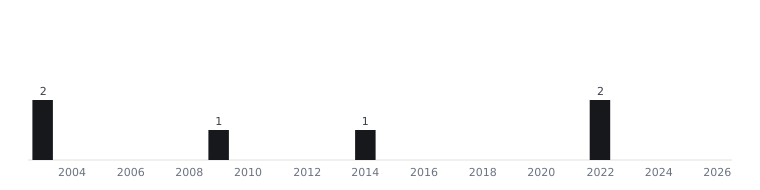
Citation items per year, by inspection date.
California · latest 90 days of OSHA records
1,120employers cited
15 of them in the same industry
Get notified the morning OSHA posts each new citation in California: the employer, the site address, the rules broken and the penalty.
OSHA records show Dynalectric Company at 63 sites in 4 states. Together they've had 149 inspections and $63,475 in current penalties.
We match records by employer name and industry, so these sites are likely the same company, not certainly. Franchises and subsidiaries can file under one name.
Included with any plan: the site-by-site record for all 63 sites, with repeat and willful violations and citations per year for the whole company. Already a subscriber? Sign in.
Incident on Jun 11, 2017: Employee installing electrical lines falls and fractures hip
At 12:00 p.m. on June 11, 2017, Employee #1 and Coworker #1, employed by an electrical design and construction company, were installing electrical lines at a retail store as part of a multi-employer construction project. They were using an 8-foot ladder to reach an opening in the ceiling that provided access to the electrical junction boxes. The space above the ceiling was approximately 6 feet tall, but the ceiling, composed of drywall, was not designed to be walked on. As Coworker #1 performed a work activity elsewhere, Employee #1 set up the ladder, climbed up, and crawled through the access opening and into the space above the ceiling. Coworker #1 returned to the ladder location but did not see Employee #1. Employee #1, above the ceiling and approximately 60 feet away from the access opening. Employee #1 fell through the drywall to the concrete floor, a fall height of 10 feet. Emergency services were called, and Employee #1 was transported to the hospital. He was admitted and treated for a fractured hip. hospital. He was admitted and treated for a fractured hip.
No citations from this inspection.
Inspection 341281376 OPENED FEB 24, 2016Closed
Planned · Complete · Safety · 13 employees at the site · Closed Feb 24, 2016
Incident on May 19, 2008: Employee is injured in fall due to gas explosion
On May 19, 2008, an explosion occurred in the fifth floor mechanical room of a 3 1-story Hilton Hotel under construction. Pipe unions had been left open followin g the purging of gas lines, allowing natural gas to escape and fuel the explosio n. Employee #1, with Dynalectric Company, was working approximately 8 ft up a 12 ft ladder when the explosion occurred. He fell from the ladder, and was hospita lized for a fractured left heel.
No citations from this inspection.
Inspection 300841301 OPENED JUN 18, 2004Closed
Unprogrammed related · Complete · Safety · 12 employees at the site · Closed Dec 6, 2004
Incident on Jul 9, 2001: Employee injured after falling into a trench
At approximately 8:30 a.m., on July 9, 2001, Employee #1 was pulling a cart with electrical supplies at a construction job site. Another worker was assisting Em ployee #1 by pushing the cart. There was a short trench in the area 30 ft or mor e from the building being worked on. The trench varied in depth from 0 ft to 5 o r 6 ft. The trench bottom sloped from the deep end to the 0-ft end. The cart was between the building and the trench being moved about parallel to the trench. T he tongue used for pulling the cart was approximately 7 ft long. The cart got st uck in dirt approximately 5 ft from the trench. The end of the tongue of the car t whipped toward the trench. Employee #1 slipped or fell onto the soft dirt at t he bottom of the 4-ft by 5-ft section of the trench. He exited the trench unassi sted. Employee #1 was seen by his doctor who previously had in the past had trea ted the employee for a back problem.
No citations from this inspection.
Inspection 119689842 OPENED NOV 28, 2000Closed
Unprogrammed related · Partial · Safety · 8 employees at the site · Closed Aug 2, 2002
(a) General requirements. (1) Only approved containers and portable tanks shall be used for storage and handling of flammable liquids. Approved safety cans or Department of Transportation approved containers shall be used for the handling and use of flammable liquids in quantities of 5 gallons or less, except that this shall not apply to those flammable liquid materials which are highly viscid (extremely hard to pour), which may be used and handled in original shipping containers. For quantities of one gallon or less, the original container may be used, for storage, use and handling of flammable liquids.
(j) Additional rules. For additional details not covered in this subpart, applicable technical portions of American National Standards Institute, Z49.1-1967, Safety in Welding and Cutting, shall apply.
(b) Branch circuits—(1) Ground-fault protection—(i) General. The employer shall use either ground fault circuit interrupters as specified in paragraph (b)(1)(ii) of this section or an assured equipment grounding conductor program as specified in paragraph (b)(1)(iii) of this section to protect employees on construction sites. These requirements are in addition to any other requirements for equipment grounding conductors.
Alert subscribers get notified of each newly cited employer in California the morning it is posted. See the alert plans.
Source: U.S. Department of Labor, OSHA enforcement data. A citation is OSHA's allegation; employers can contest it, and the status column shows where each item stands. Something wrong on this page? Tell us.