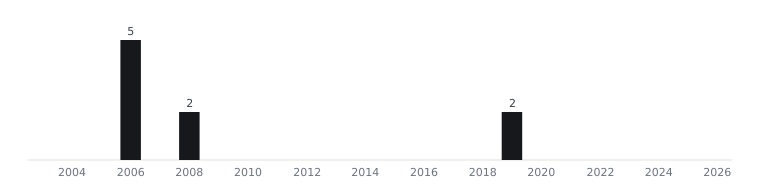
OSHA has inspected Ehmcke Sheet Metal 8 times in California since 1989.
The latest one began on Feb 26, 2019 as a planned inspection, in El Cajon.
Those inspections ended with 12 citation items: 2 serious and 10 other-than-serious.
Penalties were first proposed at $43,784 and now stand at $10,410, 76% lower after settlements or reviews.
How that compares: the median penalty per cited inspection for manufacturing employers since 2015 is $3,600, and Ehmcke Sheet Metal averages $6,000 (1 cited inspection).
Ehmcke Sheet Metal also files yearly injury logs with OSHA, summarized below.
Citation items per year, by inspection date.
California · latest 90 days of OSHA records
1,130employers cited
3 of them in the same industry
Get notified the morning OSHA posts each new citation in California: the employer, the site address, the rules broken and the penalty.
Incident on Aug 27, 2009: Worker's finger is amputated while bending copper sheeting
On August 27, 2009, Employee #1 of Ehmcke Sheet Metal Corp., was bending copper sheet metal parts. He was using 10-foot Chicago Hand Operated Steel Bending Brak e (Dries & Krump Manufacturing Company, Model: S01016, Serial Number: 320968) to bend the sheeting. Helper #1 was operating the controls while Employee #1 was p lacing copper sheet in between the top and bottom leafs of the machine. His righ t index finger was crushed as the top leaf was being lowered. Employee #1 was no t hospitalized by sustained an amputation to the distal tip of his right index f inger.
No citations from this inspection.
Inspection 310816475 OPENED MAY 14, 2008Closed
Accident · Partial · Safety · 65 employees at the site · Closed Feb 25, 2009
Incident on May 12, 2008: Press brake operator amputates three fingers when ram lowers
At approximately 2:30 p.m. on May 12, 2008, an employee was working for the Ehmc ke Sheet Metal Corporation. His employer had been in business since 1998, supply ing architectural, worked metals. It specialized in stainless steel applications and structural stair rails and railings. The employee was a journeyman sheet me tal worker with eight years of experience working for his employer. With his glo ved hand, he was removing a band of "worked" metal approximately two inches wide by six feet long from a 65-ton Vernon mechanical press brake, with Serial Numbe r 16341, at the completion of the press brake's downward stroke. The press brake was operated by a foot pedal. According to the employee, the ram descended unex pectedly when he reached in to remove the stock. The ram caught three fingers on his right hand within the point of operation. The fingers were amputated.
Citation and rule
Type
Proposed
Current
Issued
Status
Citation 1, item 1
29 CFR 4202 C
Other-than-serious
$350
$350
May 23, 2008
Final
Citation 2, item 1
29 CFR 4206 A
Other-than-serious
$18,900
$1,750
May 23, 2008
Final
Inspection 311109003 OPENED JUN 26, 2007Closed
Planned · Complete · Safety · 70 employees at the site · Closed Jun 26, 2007
Incident on Jun 8, 2006: Employee lacerates hand while using a circular saw
On June 8, 2006, Employee #1, a sheet metal worker, was putting a circular saw d own, and was not paying attention to the moving blade while lowering the tool. E mployee #1 reached down and cut his left hand. Employee #1 suffered a partial am putation to his left small finger and was hospitalized.
No citations from this inspection.
Inspection 309145761 OPENED APR 13, 2006Closed
Planned · Complete · Safety · 68 employees at the site · Closed May 18, 2011
Incident on Oct 27, 1998: Employee's finger fractured when caught between dies
At approximately 9:45 a.m. on October 27, 1998, Employee #1, an apprentice sheet metal worker, was assisting in the handling of a 4 foot by 7.5 foot sheet of st ainless steel during a fluting operation. The employee's left little finger was crushed between the dies of a press brake while performing this task. Employee # 1 and another employee, an operator, completed the fluting of three sheets, each requiring 28 hits, earlier that morning without incident. The following is a de scription of the incident. After completing half the hits required, the metal sh eet was removed from the machine, rotated, and reinserted to complete the other half. The ram was lowered until the manual stop prevented movement without react ivating the foot switch. A light curtain guard prevented further ram travel sinc e hands holding the sheet metal interrupted the light beams. At that point, each employee positioned their fingers near the die so as to minimize light beam tra vel. A verbal command from the operator was given asking if it was clear to comp lete the ram travel. When Employee #1 answered in the affirmative to the request for a clearance to proceed, the operator began to lower the ram. Upon hearing a cry from Employee #1, the operator stopped lowering the ram and discovered that Employee #1's left little finger was caught between the dies. The operator imme diately raised the ram, which freed the finger. First aid was given and Employee #1 was transported to a local trauma center. The finger was saved and Employee #1 returned to work four months later.
Citation and rule
Type
Proposed
Current
Issued
Status
Citation 1, item 1
29 CFR 4202 C
Other-than-serious
$100
$100
Apr 22, 1999
Closed
Citation 2, item 1
29 CFR 4186 B
Serious
$4,000
$750
Apr 22, 1999
Final
Inspection 102378478 OPENED JAN 26, 1989Closed
Planned · Complete · Safety · 3 employees at the site · Closed Mar 20, 1989
From the Form 300A summaries employers file with OSHA each year. Rate = recordable cases per 100 full-time workers.
In 2020, the National City site logged 14 recordable injuries or illnesses among about 84 workers: 16.3 per 100 full-time workers, against a median of 3.6 for its industry. Those cases cost 581 days away from work.
Site and year
Workers
Cases
Days-away cases
Rate
Industry median
Ehmcke Sheet Metal Corp.
National City · 2020
84
14
8
16.3
3.6
The rules behind these citations
Current text from the Code of Federal Regulations. Some citations were issued under older wording.
(a) Safety nets shall be provided when workplaces are more than 25 feet above the ground or water surface, or other surfaces where the use of ladders, scaffolds, catch platforms, temporary floors, safety lines, or safety belts is impractical.
(10) Roofing work on Low-slope roofs. Except as otherwise provided in paragraph (b) of this section, each employee engaged in roofing activities on low-slope roofs, with unprotected sides and edges 6 feet (1.8 m) or more above lower levels shall be protected from falling by guardrail systems, safety net systems, personal fall arrest systems, or a combination of warning line system and guardrail system, warning line system and safety net system, or warning line system and personal fall arrest system, or warning line system and safety monitoring system. Or, on roofs 50-feet (15.25 m) or less in width (see appendix A to subpart M of this part), the use of a safety monitoring system alone [i.e. without the warning line system] is permitted.
Alert subscribers get notified of each newly cited employer in California the morning it is posted. See the alert plans.
Source: U.S. Department of Labor, OSHA enforcement data. A citation is OSHA's allegation; employers can contest it, and the status column shows where each item stands. Something wrong on this page? Tell us.