Perry, Iowa · Commercial and Institutional Building Construction · NAICS 236220
22inspections
48citation items
$45,372current penalties
Jan 3, 2022last inspection
Since 1989, OSHA inspectors have visited Fagen, Inc. in Iowa 22 times.
The most recent inspection opened on Jan 3, 2022 on a referral, in Shell Rock.
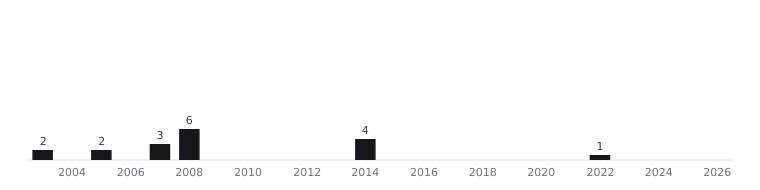
In all, OSHA issued 48 citation items: 31 serious, 2 repeat and 15 other-than-serious.
The proposed penalties came to $75,479; today they stand at $45,372, 40% less.
The rule cited most here is 1926.550 ([reserved]), 11 times.
Among construction employers, the typical cited inspection since 2015 ends with a $3,080 penalty. Fagen, Inc. averages $8,000 across 1 cited inspection.
1 inspection on this page followed a fatal incident.
Fagen, Inc. also files yearly injury logs with OSHA, summarized below.
Citation items per year, by inspection date.
Iowa · latest 90 days of OSHA records
69employers cited
Get notified the morning OSHA posts each new citation in Iowa: the employer, the site address, the rules broken and the penalty.
OSHA records show Fagen, Inc. at 31 sites in 3 states. Together they've had 44 inspections and $86,038 in current penalties.
We match records by employer name and industry, so these sites are likely the same company, not certainly. Franchises and subsidiaries can file under one name.
Included with any plan: the site-by-site record for all 31 sites, with repeat and willful violations and citations per year for the whole company. Already a subscriber? Sign in.
Incident on Dec 27, 2021: Employee receives thumb amputation from portable drill
At 1:30 p.m. on December 27, 2021, an employee drilled one half inch holes in an extractor conveyer using a portable drill (DeWalt DWE 1622 mag drill with a 9/16-inch by 2-inch DOC 12,000 series cutter drill bit). The employee wore gloves while operating the drill and at some point, the employee's left hand became entangled in the drill bit. The employee was hospitalized to treat the amputation injury received.
Incident on Feb 10, 2008 (fatal): Employee is killed when crushed by hydraulic lift
At approximately 9:30 a.m. on February10, 2008, Employee #1, an electrician's he lper, was operating a self-propelled hydraulic lift to visually inspect electric al connections. The operator's platform was rotated 180 degrees from the primary station. Employee #1 moved the lift forward, which could be driven from the pla tform, while the boom was extended 14 feet in the air. Employee #1 was facing in the opposite direction of the movement of the lift, and in this position, the p latform controls moved the lift in the opposite direction of the machine motion. Employee #1 was struck and caught between an I-beam and the top rail of the pla tform at neck level. He was found in this position by two coworkers. One of the coworkers accessed the platform, but was unable to move the equipment due to the position of Employee #1. The other coworker found a key to override the platfor m controls and lowered the platform. Employee #1 was given CPR, but was pronounc ed dead at the site by the county examiner.
Incident on Jun 23, 1989: Eleven employees hospitalized when overcome by organic vapor
At about 5:00 a.m. on June 23,1989, a floor surfacing contractor applied three b arrels (about 1,500 lbs) of Corve 8521, a polyester resin containing 33 percent styrene, to the IBP meat processing plant undergoing re-construction The fast-cu ring resin produced about 500 lbs of styrene vapors in the fourth cooler (420 by 60). The floor contractor placed two small (21-in.) box fans outside the fourth cooler in the box room, an adjacent room measuring 40-ft by 28-ft by 15-ft. Emp loyees reporting for work in the box room at 7:00 a.m. complained of a strong "p lastic" odor, nausea, and irritation to the eyes and nose. About 30 minutes afte r starting work, eleven employees working in the box room were overcome by the s tyrene vapor and left the building to get fresh air. Employees #1 through #11 we re instructed to report to IBP's company nurse and then were transported to the Dallas County Hospital. Employees #1 through #11 were hospitalized and four empl oyees were diagnosed with chemical pneumonia. The suspected cause of the acciden t was an accumulation of styrene vapor in the box room due to improper fan place ment (i.e., not exhausting to the exterior) and insufficient air handling capaci ty.
Incident on Jun 23, 1989: Twenty-three employees overcome by co2 and welding fumes
At about 7:00 a.m. on June 23, 1989, construction employees began complaining of headache & nausea (symptoms similar to metal fume fever) in the meat cutting ro om and box room of the IBP meat processing plant. The meat processing plant was undergoing re-construction. Various construction trades were working inside at t he close of the second shift (scheduled from 6:00 p.m. to 6:00 a.m.) Operations involving welding and the use of resins were occurring at the time of the accide nt. About 1,500 lbs. of Corve 8521, a polyester resin containing 33 percent styr ene, was being used. The fast curing resin produced about 500 lbs. of styrene va pors in the fourth cooler (420-ft by 60-ft). The floor contractor placed two 21- in. box fans outside fourth cooler in the adjacent room, the box room (40-ft by 280-ft by 15-ft). The fans did not exhaust to the exterior of the building. To e xpedite the welding work, additional welders using gas-powered generating units, were added to the existing electric-arc welders. The gas-powered units were pla ced outside the building near the shipping doors. Negative pressure inside the b uilding drew the gas exhaust (carbon monoxide) into the plant. Welders (estimate d at 8 to 10) were generating fumes from various welding processes (i.e., tungst en arc for gas welding of stainless metal, inert gas welding, and possibly oxy-f uel cutting of hot-dipped galvanized steel; however, this could not be substanti ated). The gas-powered generating units where emitting carbon monoxide. Eleven e mployees working in the box room were overcome by the styrene vapor and left the building to get fresh air. Eleven employees were instructed to report to the co mpany nurse (IBP) and then were transported to the Dallas County Hospital where four employees were diagnosed with chemical pneumonia.
No citations from this inspection.
Injury and illness logs
From the Form 300A summaries employers file with OSHA each year. Rate = recordable cases per 100 full-time workers.
In 2016, the Denison site logged 1 recordable injury or illness among about 11 workers: 34.2 per 100 full-time workers, against a median of 0.6 for its industry.
Site and year
Workers
Cases
Days-away cases
Rate
Industry median
The Andersons Inc.
Denison · 2016
11
1
0
34.2
0.6
The rules behind these citations
Current text from the Code of Federal Regulations. Some citations were issued under older wording.
(5) Transportation. (i) Chemical manufacturers, importers, or distributors shall ensure that each container of hazardous chemicals leaving the workplace is labeled, tagged, or marked in accordance with this section in a manner which does not conflict with the requirements of the Hazardous Materials Transportation Act (49 U.S.C. 5101 et seq.) and regulations issued under that Act by the Department of Transportation (49 CFR subtitle B).
29 CFR 1910.1200(f)(6)(ii)
(ii) Product identifier and words, pictures, symbols, or combination thereof, which provide at least general information regarding the hazards of the chemicals, and which, in conjunction with the other information immediately available to employees under the hazard communication program, will provide employees with the specific information regarding the physical and health hazards of the hazardous chemical.
29 CFR 1910.1200(g)(1)
(g) Safety data sheets. (1) Chemical manufacturers and importers shall obtain or develop a safety data sheet for each hazardous chemical they produce or import. Employers shall have a safety data sheet in the workplace for each hazardous chemical which they use.
Alert subscribers get notified of each newly cited employer in Iowa the morning it is posted. See the alert plans.
Source: U.S. Department of Labor, OSHA enforcement data. A citation is OSHA's allegation; employers can contest it, and the status column shows where each item stands. Something wrong on this page? Tell us.