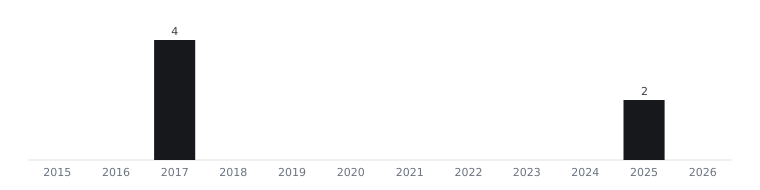
OSHA has inspected Intertech Mechanical Services Inc 2 times in Kentucky since 2017.
The latest one began on Jun 17, 2025 on a referral, in Louisville; the case is still open.
Those inspections ended with 6 citation items: 2 serious and 4 other-than-serious.
Penalties were first proposed at $48,200 and now stand at $15,000, 69% lower after settlements or reviews.
Asbestos in general industry comes up most often in these citations: 4 items under 1910.1001.
How that compares: the median penalty per cited inspection for construction employers since 2015 is $3,079, and Intertech Mechanical Services Inc averages $7,500 (2 cited inspections).
Intertech Mechanical Services Inc also files yearly injury logs with OSHA, summarized below.
From the Form 300A summaries employers file with OSHA each year. Rate = recordable cases per 100 full-time workers.
In 2018, the Louisville site logged 2 recordable injuries or illnesses among about 144 workers: 1.4 per 100 full-time workers, against a median of 1.8 for its industry.
Current text from the Code of Federal Regulations. Some citations were issued under older wording.
29 CFR 1910.1001(d)(2)(i)
(2) Initial monitoring. (i) Each employer who has a workplace or work operation covered by this standard, except as provided for in paragraphs (d)(2)(ii) and (d)(2)(iii) of this section, shall perform initial monitoring of employees who are, or may reasonably be expected to be exposed to airborne concentrations at or above the TWA permissible exposure limit and/or excursion limit.
29 CFR 1910.1001(f)(1)(v)
(v) Particular tools. All hand-operated and power-operated tools which would produce or release fibers of asbestos, such as, but not limited to, saws, scorers, abrasive wheels, and drills, shall be provided with local exhaust ventilation systems which comply with paragraph (f)(1)(iv) of this section.
29 CFR 1910.1001(f)(1)(vi)
(vi) Wet methods. Insofar as practicable, asbestos shall be handled, mixed, applied, removed, cut, scored, or otherwise worked in a wet state sufficient to prevent the emission of airborne fibers so as to expose employees to levels in excess of the TWA and/or excursion limit, prescribed in paragraph (c) of this section, unless the usefulness of the product would be diminished thereby.
Source: U.S. Department of Labor, OSHA enforcement data. A citation is OSHA's allegation; employers can contest it, and the status column shows where each item stands. Something wrong on this page? Tell us.