Manson Construction Co.: OSHA inspections and violations
Long Beach, California · Other Heavy and Civil Engineering Construction · NAICS 237990
16inspections
14citation items
$4,048current penalties
May 18, 2026last inspection
Since 1997, OSHA inspectors have visited Manson Construction Co. in California 16 times.
The most recent inspection opened on May 18, 2026 after an accident, in San Francisco and is still open.
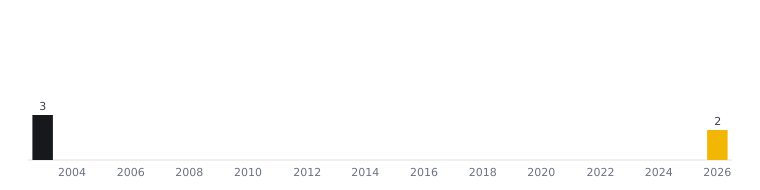
In all, OSHA issued 14 citation items: 9 serious and 5 other-than-serious.
The proposed penalties came to $6,510; today they stand at $4,048, 38% less.
The rule cited most here is 1910.95 (noise), 3 times.
Among construction employers, the typical cited inspection since 2015 ends with a $3,080 penalty. Manson Construction Co. averages $560 across 1 cited inspection.
Manson Construction Co. also files yearly injury logs with OSHA, summarized below.
It reported 2 severe injuries to OSHA since 2015.
Citation items per year, by inspection date.
Want to know if OSHA cites Manson Construction Co. again? Add it to a watchlist and we will email you the morning the citation shows up.
Incident on May 10, 2001: Employee's finger amputated when caught by hoist
A construction company was setting piles for a bridge on a new berth of a large metropolitan port. The 120-ft pile had been jetted into the ground while the ham mer rested atop it. Piles were set by jetting into place while the hammer rested on them. The hammer was used to strike the pile when jetting alone was unable t o move the pile further. The hammer had struck the pile once and the pile was ap proximately 70 ft in the ground when the shackle removal was attempted. During t he attempt, the hammer remained resting on the top of the pile, and the flow of water through the jet outlet on the bottom of the pile was continued. Employee # 1 was removing a shackle from the hoist line when the pile slid about 3 ft furth er into the hole. When the pile dropped, Employee #1's little finger on his righ t hand was pinched between the shackle and the pile. One in. of Employee #1's fi nger was amputated. Employee #1 was hospitalized. Employee #1 had set about 40 p iles in another location prior to the accident. The accident involved the first pile set at the new location, other than the indicator pile.
No citations from this inspection.
Inspection 109352567 OPENED MAY 3, 2001Closed
Referral · Complete · Health · 50 employees at the site · Closed Jul 19, 2001
Incident on Mar 21, 2000: Employee injured when struck by concrete placement boom
At 2:55 p.m. on March 21, 2000, Employee #1 and coworkers were helping to build a dock for a new marine terminal in a large city. They worked for the general co ntractor and were finishing the concrete as it was being poured. A subcontractor had supplied a Thomsen concrete pump and placement boom, model TSS 50.14, pedes tal serial #2185030732, boom serial #1785030607, along with an operator and assi stant. During the course of normal operation, the articulating boom broke at the third section from the pedestal. The discharge end struck Employee #1 as it fel l to the deck and came to rest upon his chest. He suffered a fractured hip, pelv is, and left arm; fractured fingers on his left hand and the ribs on his left si de; a punctured lung; and a concussion. In April 1993, a crack had been found in the boom's top plate, extending into one of the side plates. Documentation indi cated that this crack was very close to, if not in the same spot, where the boom 's failure occurred. After the crack was discovered, the subcontractor, who owne d the unit, consulted with the manufacturer. The manufacturer issued instruction s for repair, provided a doubler plate to be welded to the side of the beam, and designated a weld shop to make the repair, which was completed in May 1993. On February 24, 2000, workers for the subcontractor visually examined the boom and found no problems in the area that ultimately failed. The manufacturer's written procedure for annual inspections of the boom called for visual inspection. Wher e visual inspection revealed questionable conditions, dye penetrants, mag partic les, or x-rays were to be used to confirm any potential problems. One of the two workers who conducted the examination had attended the manufacturer's inspectio n class. No metallurgical examination of the failure area was made. Visual exami nation of the upper portion of the failed area revealed rust along the entire up per plate, extending down the side plates and including the doubler plate. A vis ual inspection alone would have indicated no sign of the previous repair of the crack on the inside of the rectangular boom section.
No citations from this inspection.
Inspection 113540181 OPENED MAR 25, 1999Closed
Referral · Complete · Health · 50 employees at the site · Closed Dec 7, 1999
From the Form 300A summaries employers file with OSHA each year. Rate = recordable cases per 100 full-time workers.
In 2025, the Long Beach site logged 0 recordable injuries or illnesses among about 89 workers: 0.0 per 100 full-time workers, against a median of 0.0 for its industry.
Site and year
Workers
Cases
Days-away cases
Rate
Industry median
West Coast Dredging
Long Beach · 2025
89
0
0
0.0
0.0
Southern California Division
Long Beach · 2025
50
0
0
0.0
0.0
Northern California
Richmond · 2025
36
1
0
3.0
0.0
Manson Construction Co. Richmond CA Office
Richmond · 2017
61
2
0
3.9
0.0
Severe injury reports
Employers must report any work-related amputation, in-patient hospitalization or loss of an eye to OSHA within 24 hours. 2 reports on file.
An employee's foot was caught in a hydraulic steering component on board a docked vessel, crushing it.
Mar 20, 2016, San Diego: Hospitalization · chemical burns and corrosions, unspecified · leg(s), unspecified
On or about March 20, 2016, an employee was operating a track excavator when his leg contacted equipment that contained hydrated lime. He suffered a chemical burn.
The rules behind these citations
Current text from the Code of Federal Regulations. Some citations were issued under older wording.
(c) Hearing conservation program. (1) The employer shall administer a continuing, effective hearing conservation program, as described in paragraphs (c) through (o) of this section, whenever employee noise exposures equal or exceed an 8-hour time-weighted average sound level (TWA) of 85 decibels measured on the A scale (slow response) or, equivalently, a dose of fifty percent. For purposes of the hearing conservation program, employee noise exposures shall be computed in accordance with appendix A and Table G-16a, and without regard to any attenuation provided by the use of personal protective equipment.
29 CFR 1910.95(d)(1)
(d) Monitoring. (1) When information indicates that any employee's exposure may equal or exceed an 8-hour time-weighted average of 85 decibels, the employer shall develop and implement a monitoring program.
29 CFR 1910.95(g)(1)
(g) Audiometric testing program. (1) The employer shall establish and maintain an audiometric testing program as provided in this paragraph by making audiometric testing available to all employees whose exposures equal or exceed an 8-hour time-weighted average of 85 decibels.
Source: U.S. Department of Labor, OSHA enforcement data. A citation is OSHA's allegation; employers can contest it, and the status column shows where each item stands. Something wrong on this page? Tell us.