Salt Lake City, Utah · Jewelry and Silverware Manufacturing · NAICS 339911
18inspections
14citation items
$10,400current penalties
Jan 5, 2018last inspection
Since 1973, OSHA inspectors have visited O C Tanner Co in Utah 18 times.
The most recent inspection opened on Jan 5, 2018 as a planned inspection, in Park City.
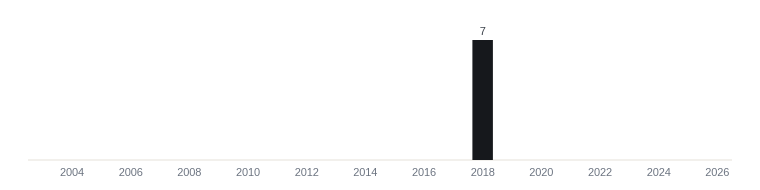
In all, OSHA issued 14 citation items: 9 serious and 5 other-than-serious.
The proposed penalties came to $10,900; today they stand at $10,400, 5% less.
The rule cited most here is 1910.1200 (hazard communication), 3 times.
Among manufacturing employers, the typical cited inspection since 2015 ends with a $3,600 penalty. O C Tanner Co averages $9,000 across 1 cited inspection.
O C Tanner Co also files yearly injury logs with OSHA, summarized below.
Citation items per year, by inspection date.
Utah · latest 90 days of OSHA records
73employers cited
Get notified the morning OSHA posts each new citation in Utah: the employer, the site address, the rules broken and the penalty.
Incident on May 31, 2002: Employee's arm fractured when caught in pneumatic press
On May 31, 2002, Employee #1 was working on a pneumatic press when his right arm became caught in the machine. He suffered a fracture just below the elbow and m ultiple lacerations to his forearm. Employee #1 was hospitalized.
Incident on Apr 17, 2001: Six employees injured by steam from ruptured tank
Six employees were injured when a drum became pressurized to the point it ruptur ed. The system is an open system and is designed to not ever become pressurized. The exact method that the drum became pressurized is unclear. The normal lid of the drum was replaced with a lid that has a blower attached that direct the ste am through the condenser. Even with the blower lid on the drum there are still o penings around the blower unit as is not sealed. In addition, there was a door o n the lid that had an opening. The blower did not work when checked after the ac cident, but it is unknown when it failed. Even if the blower unit failed, the sy stem would not be closed and should not have pressurized. The blower was maintai ned on a regular preventive maintenance schedule. The drum was new and appeared to be the correct type of drum for the process. There is a possibility that a st eam pocket formed under the old sludge in the drum and built up sufficient press ure to rupture the drum. The drum goes through many heating and cooling cycles u ntil the drum is full enough to be sent for disposal. The process is carried out once or twice a week depending on how much wastewater there is to dispose. All six employees were hospitalized for burns.
No citations from this inspection.
Inspection 303614564 OPENED FEB 12, 2001Closed
Accident · Partial · Safety · 1,600 employees at the site · Closed Feb 12, 2001
Incident on Feb 12, 2001: Employee's fingers amputated in machine
Employee #1 was operating a Ranpak Machine. She circumvented the guard in front of the cutting head and stuck her right hand into the machine. She stepped on th e foot control and activated the blade, amputating the tips of the second, third , and fourth fingers of her right hand.
No citations from this inspection.
Inspection 301170619 OPENED MAY 17, 2000Closed
Complaint · Partial · Safety · 900 employees at the site · Closed May 17, 2000
From the Form 300A summaries employers file with OSHA each year. Rate = recordable cases per 100 full-time workers.
In 2021, the Salt Lake City site logged 1 recordable injury or illness among about 496 workers: 0.2 per 100 full-time workers, against a median of 0.6 for its industry.
Site and year
Workers
Cases
Days-away cases
Rate
Industry median
O.C.Tanner Company
Salt Lake City · 2021
496
1
0
0.2
0.6
O.C. Tanner Manufacturing Company
Salt Lake City · 2021
376
3
1
0.9
2.5
O.C.Tanner Recognition Company
Salt Lake City · 2021
113
0
0
0.0
2.3
O.C. Tanner Manufacturing
Salt Lake City · 2017
1,292
16
2
1.4
1.9
Included with any plan: 4 more yearly logs from these sites, back to 2017, with each site's average rate over its latest three years. Already a subscriber? Sign in.
(e) Written hazard communication program. (1) Employers shall develop, implement, and maintain at each workplace, a written hazard communication program which at least describes how the criteria specified in paragraphs (f), (g), and (h) of this section for labels and other forms of warning, safety data sheets, and employee information and training will be met, and which also includes the following:
29 CFR 1910.1200(g)(8)
(8) The employer shall maintain in the workplace copies of the required safety data sheets for each hazardous chemical, and shall ensure that they are readily accessible during each work shift to employees when they are in their work area(s). (Electronic access and other alternatives to maintaining paper copies of the safety data sheets are permitted as long as no barriers to immediate employee access in each workplace are created by such options.)
29 CFR 1910.1200(h)(1)
(h) Employee information and training. (1) Employers shall provide employees with effective information and training on hazardous chemicals in their work area at the time of their initial assignment, and whenever a new chemical hazard the employees have not previously been trained about is introduced into their work area. Information and training may be designed to cover categories of hazards (e.g., flammability, carcinogenicity) or specific chemicals. Chemical-specific information must always be available through labels and safety data sheets.
29 CFR 1910.132 · Personal protective equipment, general requirements
Alert subscribers get notified of each newly cited employer in Utah the morning it is posted. See the alert plans.
Source: U.S. Department of Labor, OSHA enforcement data. A citation is OSHA's allegation; employers can contest it, and the status column shows where each item stands. Something wrong on this page? Tell us.