Oceaneering International, Inc.: OSHA inspections and violations
Hanover, Maryland · Commercial and Service Industry Machinery Manufacturing · NAICS 333319
1inspections
2citation items
$5,150current penalties
May 17, 2019last inspection
OSHA inspectors have visited Oceaneering International, Inc. in Maryland one time.
It opened on May 17, 2019 after a fatality or catastrophe, in Hanover.
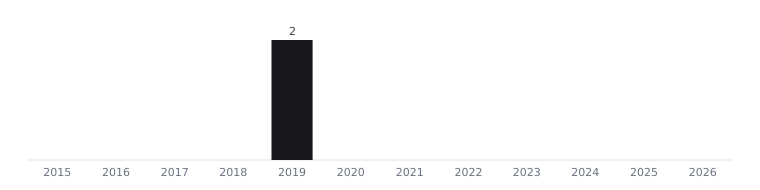
In all, OSHA issued 2 citation items: 2 serious.
The proposed penalties came to $10,300; today they stand at $5,150, 50% less.
The rule cited most here is 1910.147 (lockout/tagout), 2 times.
Among manufacturing employers, the typical cited inspection since 2015 ends with a $3,600 penalty. Oceaneering International, Inc. averages $5,150 across 1 cited inspection.
1 inspection on this page followed a fatal incident.
Oceaneering International, Inc. also files yearly injury logs with OSHA, summarized below.
Citation items per year, by inspection date.
Maryland · latest 90 days of OSHA records
185employers cited
Get notified the morning OSHA posts each new citation in Maryland: the employer, the site address, the rules broken and the penalty.
Checking a subcontractor, a client or your own company? Watch Oceaneering International, Inc. and get notified the morning OSHA posts a new citation for it.
OSHA records show Oceaneering International, Inc. at 2 sites in 2 states. Together they've had 4 inspections and $21,125 in current penalties.
We match records by employer name and industry, so these sites are likely the same company, not certainly. Franchises and subsidiaries can file under one name.
Included with any plan: the site-by-site record for all 2 sites, with repeat and willful violations and citations per year for the whole company. Already a subscriber? Sign in.
Incident on May 17, 2019 (fatal): Employee is crushed and killed by amusement ride
At 5:15 a.m. on May 17, 2019, a coworker, a Lead Technician and Employee #1, a Mechanical Technician, were performing maintenance on an amusement park ride. The 12,500 pound vehicle consists of the chassis assembly, which rides on a track, and a twelve passenger cabin assembly, which weighs 4,500 pounds. These two components are connected by a motion system assembly that is comprised of various mechanisms including, six electro-mechanical DOF actuators, and a yaw ring. The yaw ring provides rotation to the cabin and the DOF actuators control the vertical height of the cabin as well as other motions such as tilting and rolling. Under normal operation, the vehicle is controlled by a computer system and is programmed to complete a cycle of specific motions. While maintenance is being performed, the main power provided by the track is locked out and tagged out of service at the 240-volt panel and only certain functions are still accessible, and controlled only by a 24-volt battery backup. The coworker locked out and tagged out the electrical panel. Employee #1 climbed under the raised cabin assembly to access the grease fitting and connect the grease gun on the underside of the yaw ring. The coworker was adjacent to the vehicle while operating the controls via battery backup. He engaged two switches required to release the yaw brake, including a motion system override switch and a yaw brake release switch, allowing the cabin assembly to rotate freely to grease the yaw ring. When the coworker disengaged the brakes for the yaw, the brakes for the DOF actuators also unexpectedly released. The 4,500 pounds cabin assembly immediately lowered onto Employee #1, while he was laying on his side. Employee #1 was caught between the cabin assembly and the chassis assembly and was unresponsive. The coworker was limited on how quickly he could attempt to raise the cabin assembly off of Employee #1 because he had to unlock the track power at the electrical panel and boot up the computer system that fully controls the vehicle. While waiting for the computer to boot for several minutes, the coworker attempted to use a floor jack to lift the cabin assembly off of Employee #1, but to no avail. The computer system indicated a fault so Employee #1 had to control and raise each DOF actuator individually until there was enough space to release Employee #1, but he was still unresponsive. Employee #1 was killed from compressional asphyxia and chest injuries. Employee #1 was killed from compressional asphyxia and chest injuries.
From the Form 300A summaries employers file with OSHA each year. Rate = recordable cases per 100 full-time workers.
In 2025, the Hanover site logged 6 recordable injuries or illnesses among about 965 workers: 0.6 per 100 full-time workers, against a median of 0.0 for its industry.
Site and year
Workers
Cases
Days-away cases
Rate
Industry median
Oceaneering International - Advanced Technologies Hanover
Hanover · 2025
965
6
0
0.6
0.0
Oceaneering International - Advanced Technolog
Hanover · 2021
674
7
1
1.0
0.0
Included with any plan: 8 more yearly logs from these sites, back to 2016, with each site's average rate over its latest three years. Already a subscriber? Sign in.
(ii) The procedures shall clearly and specifically outline the scope, purpose, authorization, rules, and techniques to be utilized for the control of hazardous energy, and the means to enforce compliance including, but not limited to, the following:
29 CFR 1910.147(c)(5)(i)
(5) Protective materials and hardware. (i) Locks, tags, chains, wedges, key blocks, adapter pins, self-locking fasteners, or other hardware shall be provided by the employer for isolating, securing or blocking of machines or equipment from energy sources.
Other commercial and service industry machinery manufacturing employers in Maryland
Alert subscribers get notified of each newly cited employer in Maryland the morning it is posted. See the alert plans.
Source: U.S. Department of Labor, OSHA enforcement data. A citation is OSHA's allegation; employers can contest it, and the status column shows where each item stands. Something wrong on this page? Tell us.