Since 1990, OSHA inspectors have visited Tabc Inc in California 17 times.
The most recent inspection opened on Sep 16, 2015 after an accident, in Long Beach.
In all, OSHA issued 29 citation items: 7 serious and 22 other-than-serious.
The proposed penalties came to $113,055; today they stand at $46,865, 59% less.
Among manufacturing employers, the typical cited inspection since 2015 ends with a $3,600 penalty. Tabc Inc averages $25,000 across 1 cited inspection.
1 inspection on this page followed a fatal incident.
Tabc Inc also files yearly injury logs with OSHA, summarized below.
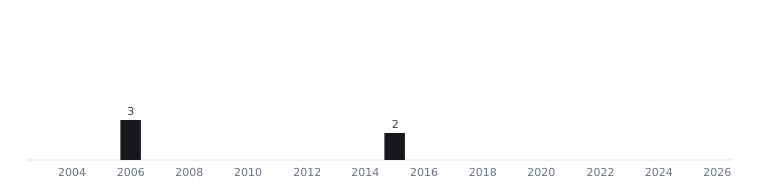
Citation items per year, by inspection date.
Want to know if OSHA cites Tabc Inc again? Add it to a watchlist and we will email you the morning the citation shows up.
Incident on Oct 21, 2008: Employee's finger is amputated when crushed between dies
At approximately 10:30 a.m. on October 21, 2008, Employee #1 was working for a t ruck body manufacturer that employed different manufacturing operations includin g press operations utilizing large metal dies. The dies were carried from the st orage area to the machines by using bridge cranes that were on hooks controlled by pendants. At the time of the accident, Employee #1 was lifting a die for a di e change on a production line. Employee #1 attached the straps of the crane to t he die and hit the pendent to move the die upwards to confirm that the die was c entered on the straps. As the crane moved, the chute of the suspended die hit th e chute of the die next to it and caused the die to rotate. Employee #1 tried to stop the die from rotating by holding on to the die lug. When the die lug hit t he die lug of the stationary die, Employee #1's left index finger tip was crushe d. Employee #1 was hospitalized and treated for his injuries.
No citations from this inspection.
Inspection 309912194 OPENED JAN 12, 2009Closed
Unprogrammed related · Partial · Safety · 550 employees at the site · Closed Mar 10, 2009
Incident on Dec 3, 2005: Employee suffers amputation in machine roller
On December 3, 2005, Employee #1 was working on a steel roll-forming machine whi ch makes side frames for trucks. The machine set up includes a series of rollers (placed one below the other in the same vertical plane) with nip point contact between the two. The diameter of one roller along the longitudinal axis varies. This diameter variation is used to form the parts which travel in between the tw o roller gaps from one set of rollers to other. (The idea is similar to a progre ssive die used for metal forming). The manufacturer of the machine is Taiho Seik i Co. Ltd. The model number and serial number are not available. The diameter an d length of the two rollers were 34 centimeters and 50 centimeters, respectively . The vertical distance between the center of the bottom roller and the brush on the top roller was approximately 55 centimeters. The accident happened in betwe en the top and bottom Number 4 rollers. The cleaning of the rollers is done ever y Saturday when there is no production work. The injured Employee #1 and a cowor ker were working as a team to clean the Number 4 top and bottom rollers on the d ay of the accident. According to the supervisor, one person cleans the roller su rfaces (by using a rug held in his hand) and the other person actuates the porta ble hand-held control box to start or stop the machine. That person starts the m achine to expose the un-cleaned roller surface. Prior to this, Employee #1 worke d with the control box. On the day of the accident no lockout or tag out procedu re was used. Employee #1 was cleaning the roller for the first time. Employee #1 was cleaning the bottom roller with rug and extended his left hand (with rug) a pproximately 20 in. down to reach and clean the bottom roller. The visibility wa s not good at that point. The coworker started the rollers and Employee #1's lef t hand was dragged inside the nip point between the two rollers. Employee #1 suf fered serious hand injuries to include his mid finger being split, a ring finger amputation and his little finger was twisted and was amputated later. Employee #1 was hospitalized for eight days.
Incident on Aug 15, 2003: Employees fingers amputated by mechanical press
At approximately 8:55 a.m. on August 15, 2003, Employee #1, a press operator wor king for a truck body part manufacturer, was hand feeding a right hand quarter p anel into a 500-ton Komatsu mechanical part revolution press. The press was acti vated by a pedestal mounted two-hand control device located next to the press. W hile the materials were laid out on top of a conveyor in several stacks, the ope rator would manually feed them into the die piece by piece, activate the control and the finished product would automatically eject out of the die and into anot her conveyor system where it was further processed. While standing in front of t he control pedestal, Employee #1 fed the part into the press and activated the c ontrols. When he noticed that the part did not fit correctly, he reached into th e press to properly align it. As he did this, the ram closed on the die and crus hed four fingers on his right hand. His ring and middle finger were amputated an d he was hospitalized.
No citations from this inspection.
9 older inspections
Inspection 305472219 OPENED JAN 23, 2003Closed
Unprogrammed related · Partial · Safety · 600 employees at the site · Closed Feb 25, 2003
Incident on Feb 26, 2002: Employee injured when a punch press actuated
At approximately 5:00 p.m. on February 26, 2002, Employee #1 was working as an o perator in Punch Press No. 3C-3, locaed in the stamping shop of the facility. Th e shop uses punch presses for forming Toyota truck body parts. The machine under consideration is a 300-ton capacity press with 12 to 16 strokes per minute, man ufactured by Shimomura Press Manufacturing Company of Japan, machine model numbe r DCLP-300-22E. The punch press is a part revolution machine with emergency stop pushbuttons installed at five locations including at both hand pushbutton panel s. Pressing one of these buttons causes the slide to stop immediately. In order to ensure the safety of the operator during the downward movement of the slide, the machine is designed to require the use of both hands to press the pushbutton s continuously until the slide reaches the lower dead point. The machine works t wo shifts every working day and it makes about 12 different Toyota truck body pa rts. At the time of the accident, Employee #1 was working by himself. The employ ee had been working in this machine for four years. While changing die for stamp ing fuel tank upper part number 7711102100, Employee #1 pressed the two (hand) p ushbuttons and the slide went down. As he released his hands, the slide/die even tually went up. Employee #1 leaned forward (across) to reach the air ejector val ve for making some adjustments. At that time, the slide came down (for the secon d time) and struck his right elbow. This amounted to 'double cycling' without ac tuating the hand push buttons. According to Employee #1, this feature happened a few times in the past. Employee #1 was a regular employee of TABC, Inc. Employe e #1 was hospitalized in the Long Beach Memorial Medical Center where he was tre ated for an avulsion fracture of his right elbow, soft tissue loss, and nerve da mage. The investigation determined that no lockout/tag out procedure was followe d while adjusting the air ejector valve (during the die change procedure).
Citation and rule
Type
Proposed
Current
Issued
Status
Citation 1, item 1
29 CFR 3314 A
Other-than-serious
$18,000
$750
Jun 25, 2002
Final
Inspection 120307418 OPENED APR 20, 2001Closed
Complaint · Partial · Safety · 540 employees at the site · Closed Sep 4, 2006
Incident on Nov 5, 1999: Employee's hand injured when caught in lamination rolls
At approximately 2:40 a.m. on November 5, 1999, Employee #1 was part of a crew o f mechanics cleaning a large lamination machine, known as the BL9 straightener, in the stamping department of a large car manufacturer. The crew leader was at t he controls operating the machine in the jog mode. Employee #1 was cleaning at t he front of the lamination rolls when his glove became caught and his right hand was pulled into the revolving rolls. The crew leader froze, unable to stop the machine or reverse the direction of the rollers. A nearby coworker stopped the m achine and changed the rolls' direction of movement, freeing Employee #1's hand from the pressing area. He sustained crushed fingers, nerves, and veins, and was transported to Long Beach Medical Center. The machine was not locked out or mec hanically blocked to prevent inadvertent movement during the cleaning operation. The employer was cited for an accident-related violation, serious, of T8CCR 332 8(b).
Citation and rule
Type
Proposed
Current
Issued
Status
Citation 1, item 1
29 CFR 3203 A
Other-than-serious
$375
$375
Dec 9, 1999
Final
Citation 2, item 1
29 CFR 3210 B
Serious
$935
$935
Dec 9, 1999
Final
Citation 3, item 1
29 CFR 3314 A
Serious
$6,250
$6,250
Dec 9, 1999
Final
Inspection 300754975 OPENED AUG 28, 1997Closed
Accident · Partial · Safety · 480 employees at the site · Closed May 11, 1999
Incident on Aug 28, 1997 (fatal): Employee killed when struck by falling stack of dies
At approximately 12:15 a.m. on August 28, 1997, Employee #1, a production/crane operator at a truck bed production facility, was standing outside the locker roo m reading the bulletin board at the end of his shift. The bulletin board was in the southwest corner of the hydraulic power press building #2, and dies for the presses were stored in the west end of the building. The dies were stacked on tw o wooden planks that were 3.5 in. by 2.75 in. in cross section and ranged from 3 .8 to 5.2 tons. A stack of four dies fell over and struck Employee #1, resulting in crushing injuries to his lower abdomen and pelvis and an abdominal laceratio n. He died on September 14, 1997. The dies had been placed in the storage area 3 hours earlier by an overhead crane, and the arrangement and placement of the pr ess dies in the stack was done with the crane operator using his best judgment. The bottom die had two large cut outs along its lower edge, facing the direction in which the dies eventually fell. The two wooden planks were located in such a s way as to intersect those cut-outs. Chutes extending out from the side of the bottom die obscured the view of the cut outs when looking down at the side of th e die. There was a lot of vibration in the building at the time of the accident.
Citation and rule
Type
Proposed
Current
Issued
Status
Citation 1, item 1
29 CFR 3203 A
Other-than-serious
$375
$375
Oct 28, 1997
Final
Citation 2, item 1
29 CFR 3241 C
Serious
$5,000
$5,000
Oct 28, 1997
Final
Inspection 120120274 OPENED NOV 1, 1994Closed
Unprogrammed related · Complete · Safety · 400 employees at the site · Closed Jan 19, 1995
Incident on Nov 12, 1990: Employee's head injured in multi-welder machine
At about 9:20 p.m. on November 12, 1990, Employee #1 was in Building #8, changin g a welding tip on the multi-welder machine while it was operating. He had his h ead in line with the welding gun arm and the vertical metal machine column when it became caught between them. He suffered a contusion to his head and multiple lacerations on his head, ears, and face. He was transported to Doctors' Hospital of Lakewood for treatment.
Citation and rule
Type
Proposed
Current
Issued
Status
Citation 1, item 1
29 CFR 3203 A01
Other-than-serious
$0
$0
Nov 29, 1990
Closed
Citation 1, item 2
29 CFR 3203 A01
Other-than-serious
$0
$0
Nov 21, 1990
Closed
Citation 2, item 1
29 CFR 3314 A
Serious
$2,000
$2,000
Nov 29, 1990
Closed
Injury and illness logs
From the Form 300A summaries employers file with OSHA each year. Rate = recordable cases per 100 full-time workers.
In 2025, the Long Beach site logged 16 recordable injuries or illnesses among about 375 workers: 5.2 per 100 full-time workers, against a median of 3.2 for its industry. Those cases cost 512 days away from work.
Site and year
Workers
Cases
Days-away cases
Rate
Industry median
TABC, Inc.
Long Beach · 2025
375
16
7
5.2
3.2
TABC, Inc
Long Beach · 2023
390
20
6
5.6
3.2
The rules behind these citations
Current text from the Code of Federal Regulations. Some citations were issued under older wording.
Source: U.S. Department of Labor, OSHA enforcement data. A citation is OSHA's allegation; employers can contest it, and the status column shows where each item stands. Something wrong on this page? Tell us.