Van Wert, Ohio · Railroad Rolling Stock Manufacturing · NAICS 336510
5inspections
4citation items
$17,453current penalties
Dec 8, 2020last inspection
Since 1984, OSHA inspectors have visited Tenneco Inc. in Ohio 5 times.
The most recent inspection opened on Dec 8, 2020 on a referral, in Van Wert.
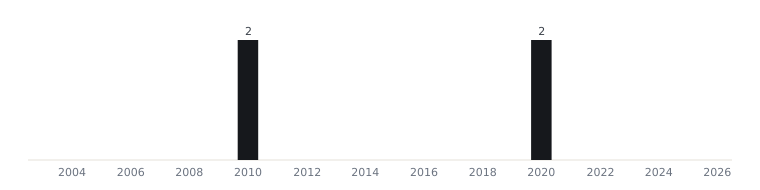
In all, OSHA issued 4 citation items: 3 serious and 1 other-than-serious.
The proposed penalties came to $33,306; today they stand at $17,453, 48% less.
The rule cited most here is 1910.147 (lockout/tagout), 2 times.
Among manufacturing employers, the typical cited inspection since 2015 ends with a $3,600 penalty. Tenneco Inc. averages $13,653 across 1 cited inspection.
Tenneco Inc. also files yearly injury logs with OSHA, summarized below.
It reported 7 severe injuries to OSHA since 2015.
Citation items per year, by inspection date.
Ohio · latest 90 days of OSHA records
267employers cited
Get notified the morning OSHA posts each new citation in Ohio: the employer, the site address, the rules broken and the penalty.
OSHA records show Tenneco Inc. at 17 sites in 8 states. Together they've had 48 inspections and $141,600 in current penalties.
We match records by employer name and industry, so these sites are likely the same company, not certainly. Franchises and subsidiaries can file under one name.
Included with any plan: the site-by-site record for all 17 sites, with repeat and willful violations and citations per year for the whole company. Already a subscriber? Sign in.
Incident on Dec 2, 2020: Employee sustains fingertip amputation while troubleshooting
At approximately 6:00 a.m. on December 2, 2020, an employee was troubleshooting a conveyor that is part of a foam oiler machine. The guard for the sprocket and chain was removed, and the employee noticed that the chain was repeatedly coming off the sprocket, causing the conveyor to stop functioning. While the machine was running without the guard, the employee observed the chain buckling off the sprocket. In an attempt to realign the chain, the employee used a flathead screwdriver to wedge the chain back onto the sprocket. During this action, the employee's left index finger was caught between the chain and the sprocket, resulting in the amputation of the fingertip. The employee was treated without hospitalization.
From the Form 300A summaries employers file with OSHA each year. Rate = recordable cases per 100 full-time workers.
In 2025, the Van Wert site logged 4 recordable injuries or illnesses among about 314 workers: 1.3 per 100 full-time workers, against a median of 2.5 for its industry. Those cases cost 88 days away from work.
Site and year
Workers
Cases
Days-away cases
Rate
Industry median
Tenneco
Van Wert · 2025
314
4
3
1.3
2.5
Tenneco, Inc.
Napoleon · 2025
236
8
1
3.3
2.7
Federal-Mogul Powertrain LLC
Van Wert · 2024
360
6
4
1.8
2.5
Tenneco Napoleon
Napoleon · 2024
200
8
1
3.8
2.7
DRiV
Kettering · 2020
974
21
10
2.2
2.7
Included with any plan: 3 more yearly logs from these sites, back to 2020, with each site's average rate over its latest three years. Already a subscriber? Sign in.
Employers must report any work-related amputation, in-patient hospitalization or loss of an eye to OSHA within 24 hours. 7 reports on file, the 6 most recent shown.
During a training session, an employee was tearing down parts on a strut machine when they amputated their right index finger.
Dec 2, 2020, Van Wert: Amputation · amputations · fingertip(s)
An employee had just replaced a broken sprocket and put in a new chain on a high-volume oil conveyor. The chain seized up. As he tried to free it, it took off and his left index finger was caught between the chain and the sprocket. The fingertip was amputated halfway up the nail.
Jan 14, 2020, Napoleon: Hospitalization · heat (thermal) burns, unspecified · multiple body parts, n.e.c.
On January 14, 2020, an employee was clearing a blockage in the gate valve of the deaerator tank located in the boiler room. As the employee was getting the gate valve fully nested, the blockage cleared and the employee was sprayed with hot water (225 F). The employee was hospitalized with burns to the face, neck and shoulders.
Aug 30, 2019, Napoleon: Hospitalization · fractures · leg(s), unspecified
An employee fell off a 4-foot ladder to the ground and broke his leg.
Mar 8, 2017, Napoleon: Hospitalization · fractures · pelvis
On March 08, 2017, an employee was hoisting a steel coil via an underhung crane for placement in the cradle of a coil feeding machine. As the operator began to hoist and position the coil over the cradle, the lower button on the crane's control pendant was pressed before the coil was appropriately aligned between the cradle walls. The coil landed on the top edge of the cradle creating slack on…
An employee was performing maintenance on a broach machine. The machine cycled while his hand was inside, amputating his three right-hand middle fingers. The machine guard was not in place at the time of the incident.
The rules behind these citations
Current text from the Code of Federal Regulations. Some citations were issued under older wording.
(6) Periodic inspection. (i) The employer shall conduct a periodic inspection of the energy control procedure at least annually to ensure that the procedure and the requirements of this standard are being followed.
29 CFR 1910.147(d)
(d) Application of control. The established procedures for the application of energy control (the lockout or tagout procedures) shall cover the following elements and actions and shall be done in the following sequence:
(a) Machine guarding—(1) Types of guarding. One or more methods of machine guarding shall be provided to protect the operator and other employees in the machine area from hazards such as those created by point of operation, ingoing nip points, rotating parts, flying chips and sparks. Examples of guarding methods are—barrier guards, two-hand tripping devices, electronic safety devices, etc.
Alert subscribers get notified of each newly cited employer in Ohio the morning it is posted. See the alert plans.
Source: U.S. Department of Labor, OSHA enforcement data. A citation is OSHA's allegation; employers can contest it, and the status column shows where each item stands. Something wrong on this page? Tell us.