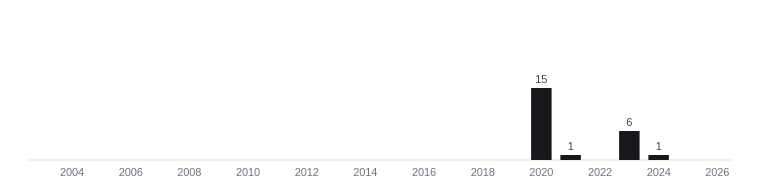
Since 1974, OSHA inspectors have visited The Ohio Art Company in Ohio 15 times.
The most recent inspection opened on Jan 3, 2024 to follow up on an earlier case, in Bryan.
In all, OSHA issued 63 citation items: 23 serious, 7 repeat and 33 other-than-serious.
The proposed penalties came to $175,326; today they stand at $95,803, 45% less.
The rule cited most here is 1910.212 (machine guarding), 8 times.
Among manufacturing employers, the typical cited inspection since 2015 ends with a $4,500 penalty. The Ohio Art Company averages $22,077 across 4 cited inspections.
1 inspection on this page followed a fatal incident.
The Ohio Art Company also files yearly injury logs with OSHA, summarized below.
It reported 1 severe injury to OSHA since 2015.
Citation items per year, by inspection date.
Ohio · latest 90 days of OSHA records
257employers cited
2 of them in the same industry
Get notified the morning OSHA posts each new citation in Ohio: the employer, the site address, the rules broken and the penalty.
Incident on Oct 20, 2021 (fatal): Employee degloves hand when caught in machine rollers, later
On October 7, 2021, an employee (Coater/Stacker) was running a UV4 line on a Hebenstreit Metal Decorators (HMD) Sheet Coating Machine (MDC8000, #MDC818) in a Lithography room. The UV4 line is composed of a sheet feeding system that transitions to the coating unit with an operating panel via a feed table. After the 34 inch by 34 inch sheet metal piece passes through the coating unit, the sheet metal is transferred to the dryer via a folding table/intermediate transport. Three coworkers (UV4 Line Operators) were assisting the employee in the UV4 line start-up which incorporates a procedure called "run down" where UV4 line is in normal operation but the HMD Sheet Coating Machine is not applying coating. During the "run down" process, "run off" sheets (previously coated sheets that did not pass quality control) are used to run through the UV4 line during the "run down" to ensure that the coating machine's rollers are clean and ready to run new product. The employee was running the "run offs" through the line when the last sheet did not transfer into the "gripper" properly which faulted and shut the machine down, however the coating machine was still in operation at "idle" mode (approximately 3,000 rpm). While the coworkers were jogging the "stuck" sheets out, the employee was stationed at the "curing" section (located approximately 2/3 way down the 34-foot long UV4 line). The employee noticed a blemish or quality control issue on the lacquer cylinder of the coating machine and he attempted to us a balled up rag in his right hand to wipe the blemish from the lacquer cylinder. The rag became caught in a groove of the cylinder pulling the employee's hand and arm into the nip point of the anilox roller and the lacquer cylinder. The employee was hospitalized with degloving injuries to lower right arm and hand, including the amputation of the first three fingers, and later died on October 20, 2021.
From the Form 300A summaries employers file with OSHA each year. Rate = recordable cases per 100 full-time workers.
In 2025, the Bryan site logged 4 recordable injuries or illnesses among about 64 workers: 7.3 per 100 full-time workers, against a median of 2.0 for its industry. Those cases cost 180 days away from work.
Site and year
Workers
Cases
Days-away cases
Rate
Industry median
The Ohio Art Company
Bryan · 2025
64
4
1
7.3
2.0
Included with any plan: 5 more yearly logs from these sites, back to 2020, with each site's average rate over its latest three years. Already a subscriber? Sign in.
On August 8, 2024, an employee was manually re-stacking large metal sheets on a table. Some of the metal sheets fell from the table onto the employee's right foot causing crushing injuries.
The rules behind these citations
Current text from the Code of Federal Regulations. Some citations were issued under older wording.
(4) Design and construction of inside storage rooms—(i) Construction. Inside storage rooms shall be constructed to meet the required fire-resistive rating for their use. Such construction shall comply with the test specifications set forth in Standard Methods of Fire Tests of Building Construction and Materials, NFPA 251-1969. Where an automatic sprinkler system is provided, the system shall be designed and installed in an acceptable manner. Openings to other rooms or buildings shall be provided with noncombustible liquid-tight raised sills or ramps at least 4 inches in height, or the floor in the storage area shall be at least 4 inches below the surrounding floor. Openings shall be provided with approved self-closing fire doors. The room shall be liquid-tight where the walls join the floor. A permissible alternate to the sill or ramp is an open-grated trench inside of the room which dra
29 CFR 1910.106(d)(4)(v)
(v) Storage in inside storage rooms. In every inside storage room there shall be maintained one clear aisle at least 3 feet wide. Containers over 30 gallons capacity shall not be stacked one upon the other. Dispensing shall be by approved pump or self-closing faucet only.
29 CFR 1910.106(d)(5)(i)
(5) Storage inside building—(i) Egress. Flammable liquids, including stock for sale, shall not be stored so as to limit use of exits, stairways, or areas normally used for the safe egress of people.
29 CFR 1910.120 · Hazardous waste operations and emergency response
29 CFR 1910.132 · Personal protective equipment, general requirements
Alert subscribers get notified of each newly cited employer in Ohio the morning it is posted. See the alert plans.
Source: U.S. Department of Labor, OSHA enforcement data. A citation is OSHA's allegation; employers can contest it, and the status column shows where each item stands. Something wrong on this page? Tell us.