Traffic Control Devices, LLC.: OSHA inspections and violations
Orlando, Florida · Electrical Contractors and Other Wiring Installation Contractors · NAICS 238210
14inspections
14citation items
$23,855current penalties
Jun 4, 2024last inspection
Since 1990, OSHA inspectors have visited Traffic Control Devices, LLC. in Florida 14 times.
The most recent inspection opened on Jun 4, 2024 on a referral, in Orlando.
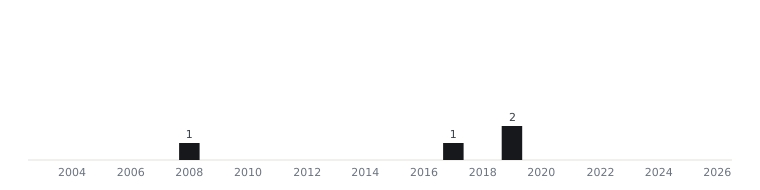
In all, OSHA issued 14 citation items: 13 serious and 1 other-than-serious.
The proposed penalties came to $31,032; today they stand at $23,855, 23% less.
The rule cited most here is 1926.651 (excavations), 3 times.
Among construction employers, the typical cited inspection since 2015 ends with a $3,080 penalty. Traffic Control Devices, LLC. averages $3,365 across 2 cited inspections.
2 inspections on this page followed a fatal incident.
It reported 2 severe injuries to OSHA since 2015.
The Wage and Hour Division has 1 case on it since 2015, with $111,644 in back wages owed to workers.
Citation items per year, by inspection date.
Florida · latest 90 days of OSHA records
338employers cited
3 of them in the same industry
Get notified the morning OSHA posts each new citation in Florida: the employer, the site address, the rules broken and the penalty.
Checking a subcontractor, a client or your own company? Watch Traffic Control Devices, LLC. and get notified the morning OSHA posts a new citation for it.
Referral · Partial · Safety · 5 employees at the site · Closed Aug 2, 2024
Interstate I-4 John Young Parkway Interchange, Orlando, FL 32801 · Electrical Contractors and Other Wiring Installation Contractors · OSHA's record · Phone and website on Google Maps
No citations from this inspection.
Inspection 346359482 OPENED NOV 28, 2022Closed
Fatality or catastrophe · Complete · Safety · 300 employees at the site · Closed May 19, 2023
Incident on Nov 21, 2022 (fatal): Employee is caught between bucket and box, later dies
At 11:30 a.m. on November 21, 2022, an employee and three coworkers were lifting a quazite box off of a truck with a 303E CR Mini Hydraulic Excavator. Coworker #1, the foreman, got into the cab of the excavator and drove it up to the truck with the bucket centered on the bed and the blade pointing toward the sidewall, 3 feet above the bed to give them room to work. The crew conducted a group huddle to communicate plans on how they were going to lift the box off of the truck. After the huddle, Coworker #2 went into the back of the truck to hook up the cable when he noticed that the truck needed to be pulled forward to be able to hook the straps up to the excavator. Coworker #2 got out of the back of the truck and told Coworker #1 that he was going to move the truck forward and walked toward the cab. As Coworker #2 was walking to the cab, Coworker #1 said that he could get the box from there but Coworker #2 did not hear it. When the Coworker #2 had gotten into the cab, he looked through the rear-view mirror and saw the employee standing on the rear wheel of the truck to get into the back. Coworker #2 thought that the employee was getting into the back of the truck to hold up the straps to see how much further he needed to move the truck forward and that Coworker #1 was going to honk the excavator horn to let him know that the truck was in the right spot. But the employee was actually going in the back of the truck to take the lid off of the box. Coworker #1 asked the employee what size ratchet he needed and went to grab the ratchet. While Coworker #1 was getting the ratchet, Coworker #2 moved the truck but did not hear the excavator horn, so he looked back and saw the employee caught between the bucket and the box. Coworker #2 then backed the vehicle up and the employee fell on a pile of dirt in the back of the truck. The employee was hospitalized and on November 27, 2022, he died due multisystem failure from the crushing of his abdomen.
Incident on Jun 29, 2000 (fatal): Employee killed when crane boom collapses on operator
Employee #1, the 20-year-old foreman of a crew installing traffic control signs along a secondary road, was using a National Crane Company truck-mounted crane, model 800B, to pour concrete for the base of a highway sign. A large funnel or c hute had been set up to transport and deposit the concrete. Two coworkers had in serted a wooden plug in the bottom of the chute so that it could be filled with concrete. When the chute was full, the crane lifted it into position and the cre w used a hammer to knock out the plug. When the plug was free and the concrete w as flowing, one of the coworkers then manually guided the chute. At the time of the accident, the coworker felt the chute begin to drop and he yelled to the oth er coworker to run. When they were clear, they found that the boom had broken fr ee, catching Employee #1's head against the safety rails of the crane operator's station. He died of crushing injuries. The boom had come loose because the pede stal mounting bolts had failed.
Employers must report any work-related amputation, in-patient hospitalization or loss of an eye to OSHA within 24 hours. 2 reports on file.
May 30, 2024, Orlando: Hospitalization · fractures · lower leg(s)
Employees were working on an overhead sign on an interstate when a car entered the closed lane and struck a bucket truck. At the time of the incident, an employee was getting tools from the back of the truck. The car pinned his leg against the bucket truck causing a compound fracture to the lower leg.
Oct 17, 2018, Orlando: Hospitalization · fractures · leg(s), unspecified
An employee was struck by a wire reel that was being dragged by a pick-up truck, suffering two fractured legs.
Wage and hour cases
Cases by the Labor Department's Wage and Hour Division since 2015: unpaid minimum wage or overtime, child labor, family leave and more.
Period reviewed
Violations
Workers owed
Back wages
Penalties
Apr 7, 2017 to Apr 6, 2019
Altamonte Springs
166
88
$111,644
$0
The rules behind these citations
Current text from the Code of Federal Regulations. Some citations were issued under older wording.
(a) Employees working in areas where there is a possible danger of head injury from impact, or from falling or flying objects, or from electrical shock and burns, shall be protected by protective helmets.
(d) The employer must maintain training records to show that the training required by paragraphs (a) through (c) of this section has been accomplished. The training records must contain each employee's name, the name of the trainers, and the dates of training. The documentation must be available for inspection by employees and their authorized representatives, for the period of time the employee is employed by that employer.
Alert subscribers get notified of each newly cited employer in Florida the morning it is posted. See the alert plans.
Source: U.S. Department of Labor, OSHA enforcement data. A citation is OSHA's allegation; employers can contest it, and the status column shows where each item stands. Something wrong on this page? Tell us.