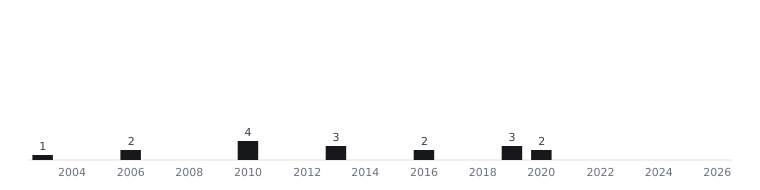
Uss Posco Industries has 53 OSHA inspections on record in California, the first in 1987.
OSHA's last visit started on Oct 27, 2020 after an accident, in Pittsburg.
Across those inspections OSHA issued 59 citation items: 22 serious and 37 other-than-serious.
OSHA proposed $171,165 in penalties. After settlements and reviews the total is $112,175, down 34%.
Most often, OSHA cited 5154.1, (3 items).
For context, across all manufacturing employers the median penalty per cited inspection since 2015 is $3,600. Uss Posco Industries averages $12,950 over 4 cited inspections in that time.
1 inspection on this page followed a fatal incident.
Uss Posco Industries also files yearly injury logs with OSHA, summarized below.
The Wage and Hour Division has 1 case on it since 2015, with $0 in back wages owed to workers.
Citation items per year, by inspection date.
California · latest 90 days of OSHA records
1,130employers cited
Get notified the morning OSHA posts each new citation in California: the employer, the site address, the rules broken and the penalty.
Incident on Oct 22, 2020: Employee crushes foot when caught between metal coil and sad
At 5:30 p.m. on October 22, 2020, an employee was working as an operating engineer for a company that manufactures sheet materials for canning purposes. The employee was in the process of banding and labeling a coil in the Kmcal area, which is the final process. The coil was lifted approximately four to six inches above the saddle where the coil normally rests. According to a coworker, the process takes about 7 minutes to finish as the coil moves to the south at a slow rate. The employee caught his right foot between the coil and the saddle. The employee said that he had excess banding material that he cut and threw it in the garbage when he saw and heard the employee screaming. According to the employer, the coil weighs 10 tons. There is an emergency stop at least two feet away from the site of the incident which the coworker activated. The employee broke his foot and tore his ligaments, requiring hospitalization.
Citation and rule
Type
Proposed
Current
Issued
Status
Citation 1, item 1
29 CFR 4002(A)
Other-than-serious
$6,300
$1,050
Mar 29, 2021
Final
Citation 2, item 1
29 CFR 3999(H)
Serious
$18,000
$18,000
Mar 29, 2021
Final
Inspection 344123708 OPENED JUL 1, 2019Closed
Accident · Partial · Safety · 500 employees at the site · Closed Jul 26, 2021
Incident on Jun 26, 2019: Employee suffers back fracture in fall
At 10:50 a.m. on June 26, 2019, an employee, a utility technician, was performing the tasks of the exit desk role. The exit section of the line is where finished coils of steel are tested, banded, and labeled before being removed from the line and transported to storage. The employee was assisting a coworker by strapping the completed steel coils when he inadvertently kicked a piece of metal strapping that fell through a gap in the walking beam to the walking beam basement. The employee walked towards the area where you can access both the basement and the sample testing room. The employee walked around the coil and noticed that two straps previously placed in another coil had also fallen to the basement below. The employee wanted to remove the straps to avoid any potential process disruption. The employee accessed the stairway to the basement and descended to a point where he could access the walking beam basement to retrieve the metal straps. To reach one of the fallen straps, the employee stepped onto the first follower plate then stepped onto the second follower plate which moved and caused him to lose his balance and fall. When the second follower plate moved it created an open gap between the first and second plates which the employee fell through and fell approximately 8 feet 6 inches to the concrete floor below. The employee was hospitalized to treat a fracture of the third lumbar vertebrae and a large hematoma to the right hip.
Citation and rule
Type
Proposed
Current
Issued
Status
Citation 1, item 1
29 CFR 342(A)
Other-than-serious
$5,000
$3,500
Dec 24, 2019
Final
Citation 1, item 2
29 CFR 3314(C)
Other-than-serious
$850
$0
Dec 24, 2019
Final
Citation 2, item 1
29 CFR 3203(A)
Serious
$18,000
$10,800
Dec 24, 2019
Final
Inspection 341683993 OPENED AUG 9, 2016Closed
Accident · Partial · Safety · 650 employees at the site · Closed Feb 14, 2017
Incident on Dec 10, 2010: Employee's fingertip is crushed by sling cable
At approximately 5:50 a.m. on December 10, 2010, Employee #1 was working with a coworker to move a large bridal roll, 4-ft by 3-ft, and weighing 2,960-lbs, from a staging area to be installed in Bridal Station Number 5. After they finished rigging a cable sling on the bridal roll, Employee #1 began operating the contro ls for the electric overhead crane. The crane was being used to lift the bridal roll, and while putting tension on the sling during the lift, Employee #1's righ t index fingertip was crushed between the sling cable and the edge of the bridal roll. An onsite Emergency Medical Team responded, and Employee #1 was treated a nd then transported to John Muir Hospital in Walnut Creek. His finger tip was am putated, and he was released later that same day.
Citation and rule
Type
Proposed
Current
Issued
Status
Citation 1, item 1
29 CFR 342 A
Other-than-serious
$5,000
$5,000
Jun 13, 2011
Final
Inspection 314325671 OPENED DEC 13, 2010Closed
Unprogrammed related · Partial · Safety · 670 employees at the site · Closed Jun 10, 2011
Incident on May 5, 2008: Employee creates arc flash, suffers burns
On May 5, 2008, Employee #1 was working with two coworkers troubleshooting a fai led status light on a pump electrical circuit. The electrical disconnect, bucket , for the circuit was located in a Motor Control Center, MCC, in the basement wh ich controlled a light on an operator panel located on the first floor. The trou bleshooting process was initiated with the power turned off at the bucket; durin g the process, the bucket was occasionally re-energized to assist in the trouble shooting operation. The employees moved between the bucket and the operator pane l several times during the course of the troubleshooting operation. The troubles hooting required the use of a "jumper", at the bucket, to create a conductive pa th across the suspect relay. Employee #1's tools were located at the remote Oper ator's Panel. In lieu of using a typical jumper, a coworker configured a red vol t/ohm (VOM) meter lead into a jumper by attaching "alligator" leads to both ends of the red lead. The red lead remained in the jumper configuration after being removed from the suspect relay. When returning to the bucket during the troubles hooting, Employee #1 intended to check the voltage to ensure the circuit was non -energized prior to working in the bucket. Employee #1 failed to realize that th e lead was still configured as a jumper. Employee #1 touched the tips to the cir cuit, creating a direct short between two phases, and creating an arc flash. Emp loyee #1 suffered first and second degree burns.
No citations from this inspection.
Inspection 301125571 OPENED AUG 16, 2006Closed
Accident · Partial · Safety · 820 employees at the site · Closed Apr 15, 2010
Incident on Apr 1, 2006: Employee burns leg in hot water after stepping in hole
On April 1, 2006, Employee #1 and a coworker were assigned to change out a sump pump located in the Continuous Annealing Line basement. The old sump pump had be en removed and the new sump pump was on a cart on top of the grated metal floor. At approximately 2:38 a.m., while walking around the cart, Employee #1 stepped through a hole in the floor grating and his right leg went through the hole into hot water to a point above the knee. The water beneath the floor is approximate ly 185 degrees Fahrenheit. Employee #1 suffered third-degree burns to the right leg and lesser burns to the right arm where he was splashed by hot water. Employ ee #1 was hospitalized.
Citation and rule
Type
Proposed
Current
Issued
Status
Citation 1, item 1
29 CFR 3212 A05
Serious
$18,000
$7,000
Sep 21, 2006
Final
Inspection 301124418 OPENED FEB 22, 2006Closed
Accident · Partial · Safety · 850 employees at the site · Closed Jul 22, 2008
Incident on Feb 8, 2006: Employee fractures shoulders when caught in lathe machine
On February 8, 2006, Employee #1 was forming a metal shaft, 7 ft long and 7 in. in diameter. Employee #1 took a measurement with calipers, while shaft was rotat ing on a lathe machine. Employee #1's sweater was caught by a rotating shaft, pu lling him into the lathe machine. He fractured his right leg and both shoulders. Employee #1 was treated by the emergency medical personnel, transported to the hospital, and hospitalized for 3 weeks.
Citation and rule
Type
Proposed
Current
Issued
Status
Citation 2, item 1
29 CFR 3383 B
Other-than-serious
$5,850
$560
May 18, 2006
Final
Inspection 301122578 OPENED JAN 31, 2005Closed
Accident · Partial · Safety · 850 employees at the site · Closed Apr 5, 2005
Incident on Jan 12, 2005: Employee is burned in arc flash
On January 12, 2005, Employee #1 was assigned to remove stab plates from an exis ting circuit. He disconnected one phase of load size and the phase sprung upward , striking the energized circuit, causing an arc flash. Employee #1 sustained bu rns to face and left hand and wrist, and was hospitalized.
No citations from this inspection.
Inspection 125757591 OPENED NOV 23, 2004Closed
Complaint · Partial · Safety · 850 employees at the site · Closed Feb 1, 2005
Incident on Jun 11, 2003: Employee injured by acid burns while cleaning strainer
At 9:30 a.m. on June 10, 2003, Employee #2 requested help to unclog the strainer on Tank Number 1 on the pickling line. Employee #1 met Employee #2 at the tank. Employee #1 said he turned off the pump to stop liquid from being pumped throug h the system. Employee #1 said that he asked Employee #2 if all of the valves we re closed, which meant that Employee #2 had drained, flushed, and blocked the sy stem. Employee #1 thought Employee #2 answered yes. Employee #1 said that they w ere having trouble removing the sight glass to access the strainer. Employee #1 requested assistance from another worker, Employee #3. Employee #3 assisted and they removed the sight glass. Employee #3 discovered that the pump was not off a s it should have been. Energy control procedures were not performed. A negative pressure had built up in the system. That is why it was so difficult to remove t he sight glass. At that time Employee #2 proceeded to turn the pump off. The sol ution inside of the system reversed, due to loss of pressure when the pump was t urned off, and sprayed out onto Employee #1 and Employee #2. Employee #2 immedia tely began to hose himself off and proceeded to the shower. Employee #1 did not shower immediately. Instead, he began to try and contain the spill. Employee #1 closed off valves and pumps. Employee #1 said that he did not realize how badly he was burned until about 30 minutes after the acid solution sprayed out of the tank onto his body. Employee #1 was hospitalized with acid burns.
Citation and rule
Type
Proposed
Current
Issued
Status
Citation 1, item 1
29 CFR 3314 A
Other-than-serious
$22,500
$5,000
Sep 16, 2003
Final
Inspection 120337126 OPENED JUN 11, 2003Closed
Complaint · Partial · Safety · 950 employees at the site · Closed Aug 5, 2003
Incident on Sep 11, 2002: Employee receives injuries when caught by machine
On September 11, 2002, Employee #1 was working in the black plate area of a stee l finishing plant. He was short on work and was given permission to help a cowor ker, who was operating the Number 3 side trimmer. Employee #1 was removing a coi l butt from the recoiler mandrel when the feed-up table activated and he was pus hed against the rotating cable. He was lifted before the feed-up table retracted , causing him to fall. He sustained back and abdominal injuries in the accident.
Citation and rule
Type
Proposed
Current
Issued
Status
Citation 1, item 1
29 CFR 3203 A07 C
Serious
$18,000
$7,000
Mar 11, 2003
Final
Inspection 125750679 OPENED NOV 9, 2001Closed
Accident · Partial · Safety · 900 employees at the site · Closed Jun 8, 2005
Incident on Sep 27, 2001: Employe struck by an energized strip guide table
On September 27, 2001, Employee #1, a mechanic, was struck by a strip guide tabl e, while adjusting the Side Trim Recoiler in a steel finishing plant. The equpim ent had not been locked out. Employee #1 was hospitalized for 4 days with multip le facial injuries.
Citation and rule
Type
Proposed
Current
Issued
Status
Citation 1, item 1
29 CFR 3314 A
Serious
$18,000
$6,300
Jan 30, 2002
Final
Inspection 125750505 OPENED JUN 26, 2001Closed
Unprogrammed related · Partial · Safety · 650 employees at the site · Closed Mar 4, 2002
Incident on Nov 28, 1998: Employee's finger is amputated when caught in bearing
On November 28, 1998, Employee #1, a machinist, along with a coworker, was insta lling the outer race of a bearing on a mandrel approximately 20 inches in diamet er. While pushing the outer race with the overhead crane and supporting it with a sling, the bearing slid too fast, pinching Employee #1's right little finger b etween the bearing and the seal. His finger tip was crushed and amputated. He wa s hospitalized for his injury.
Citation and rule
Type
Proposed
Current
Issued
Status
Citation 1, item 1
29 CFR 3203 A07 D
Other-than-serious
$450
$450
May 17, 1999
Closed
Inspection 125867325 OPENED DEC 23, 1998Closed
Complaint · Partial · Safety · 970 employees at the site · Closed Apr 2, 1999
Incident on Aug 2, 1998 (fatal): Employee killed when struck by flying chuck
At approximately 2:30 p.m., on August 2, 1998, Employee #1 was removing a bearin g chock from a metal roller at a cold steel processing company, The roller becam e unbalanced, causing the chock to slip off its neck. As Employee #1 attempted t o get away from the chock, it bounced off the chocking machine and landed on her throat. She was killed. On the day of the accident, Employee #1 was officially classified as a handler; before that time she was classified as a helper, which meant she was on probation. Her duties as a handler were to remove the chocks fr om the unfinished metal rolls and to install them onto the finished rolls. The r olls would then be taken to various mills within the facility for use during ste el finishing processes. The causes of the accident were lack of training and the poor engineering design of the racks used to support the rolls and bearing choc ks during the de-chocking operation.
Citation and rule
Type
Proposed
Current
Issued
Status
Citation 1, item 1
29 CFR 3203 A04
Serious
$5,000
$5,000
Oct 23, 1998
Final
Citation 3, item 1
29 CFR 3328 A
Serious
$7,500
$5,000
Oct 23, 1998
Final
Inspection 301119160 OPENED FEB 19, 1998Closed
Accident · Partial · Health · 975 employees at the site · Closed Jan 13, 2000
Incident on Jan 12, 1996: Employee exposed to sulfur dioxide
Employee #1 and coworkers were working in the chrome recovery unit of a steel mi ll. The addition of a "slug" of chrome resulted in the automatic addition of sod ium bisulfate and in the release of an unknown quantity of sulfur dioxide. At th e time of this discharge, Employee #1 and nine coworkers were approximately 100 ft away on a mezzanine of electro-tinning line #3. Employee #1 was kept overnigh t at the hospital for observation; the coworkers were treated and released.
No citations from this inspection.
Inspection 125864116 OPENED DEC 20, 1995Closed
Complaint · Partial · Safety · 1,000 employees at the site · Closed Feb 23, 1996
Incident on Oct 11, 1995: Employee's arm amputated when caught in steel roll
Employee #1 slipped or tripped on an uneven surface and became caught in a tinni ng line roll. His left arm was amputated and his right arm sustained serious inj uries.
Citation and rule
Type
Proposed
Current
Issued
Status
Citation 2, item 1
29 CFR 4002 A
Serious
$1,760
$1,750
Apr 9, 1996
Final
Inspection 120195581 OPENED AUG 11, 1995Closed
Complaint · Partial · Safety · 1,300 employees at the site · Closed Dec 11, 1995
Incident on Jan 7, 1994: Employee fractures toe in a confined space fall
During a strip repair operation Employee #1 held his breath and entered a confin ed space which had been purged with nitrogen. While descending a ladder Employee #1 lost consciousness and fell three feet. The fall resulted in contusions to t he knee and a fractured toe. Employee #1 regained consciousness without assistan ce. A confined space tag had been posted and initial air monitoring indicated an acceptable entry environment. Following the incident, monitoring indicated an o xygen-deficient atmosphere.
Citation and rule
Type
Proposed
Current
Issued
Status
Citation 1, item 1
29 CFR 5144 D05
Other-than-serious
$175
$0
Aug 4, 1994
Closed
Citation 1, item 2
29 CFR 5157 F
Other-than-serious
$175
$175
Aug 4, 1994
Closed
Citation 2, item 1
29 CFR 3328 B
Other-than-serious
$1,750
$175
Aug 4, 1994
Closed
Citation 3, item 1
29 CFR 5157 D05 B
Serious
$1,310
$1,310
Aug 4, 1994
Closed
Inspection 111895231 OPENED AUG 31, 1993Closed
Complaint · Partial · Safety · 1,100 employees at the site · Closed Aug 31, 1993
From the Form 300A summaries employers file with OSHA each year. Rate = recordable cases per 100 full-time workers.
In 2019, the Pittsburg site logged 8 recordable injuries or illnesses among about 583 workers: 1.3 per 100 full-time workers, against a median of 3.6 for its industry. Those cases cost 294 days away from work.
Site and year
Workers
Cases
Days-away cases
Rate
Industry median
Uss Posco Industries, Inc
Pittsburg · 2019
583
8
4
1.3
3.6
Included with any plan: 2 more yearly logs from these sites, back to 2017, with each site's average rate over its latest three years. Already a subscriber? Sign in.
Cases by the Labor Department's Wage and Hour Division since 2015: unpaid minimum wage or overtime, child labor, family leave and more.
Period reviewed
Violations
Workers owed
Back wages
Penalties
Jun 20, 2016 to Jun 19, 2018
Pittsburg
1
0
$0
$0
The rules behind these citations
Current text from the Code of Federal Regulations. Some citations were issued under older wording.
29 CFR 1910.219 · Belts, pulleys and power-transmission parts
29 CFR 1910.219(c)(2)(i)
(2) Guarding horizontal shafting. (i) All exposed parts of horizontal shafting seven (7) feet or less from floor or working platform, excepting runways used exclusively for oiling, or running adjustments, shall be protected by a stationary casing enclosing shafting completely or by a trough enclosing sides and top or sides and bottom of shafting as location requires.
Alert subscribers get notified of each newly cited employer in California the morning it is posted. See the alert plans.
Source: U.S. Department of Labor, OSHA enforcement data. A citation is OSHA's allegation; employers can contest it, and the status column shows where each item stands. Something wrong on this page? Tell us.