Blommer Chocolate Company has 13 OSHA inspections on record in Illinois, the first in 1977.
OSHA's last visit started on Nov 15, 2019 on a referral, in Chicago.
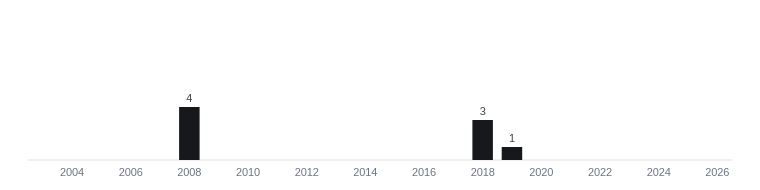
Across those inspections OSHA issued 21 citation items: 12 serious and 9 other-than-serious.
OSHA proposed $170,697 in penalties. After settlements and reviews the total is $83,149, down 51%.
Most often, OSHA cited 1910.147, lockout/tagout (6 items).
For context, across all manufacturing employers the median penalty per cited inspection since 2015 is $4,870. Blommer Chocolate Company averages $7,494 over 2 cited inspections in that time.
1 inspection on this page followed a fatal incident.
Blommer Chocolate Company also files yearly injury logs with OSHA, summarized below.
It reported 3 severe injuries to OSHA since 2015.
Citation items per year, by inspection date.
Illinois · latest 90 days of OSHA records
421employers cited
Get notified the morning OSHA posts each new citation in Illinois: the employer, the site address, the rules broken and the penalty.
Incident on Nov 11, 2019: Employee is injured in slip and fall from tank truck
At 12:00 noon on November 11, 2019, an employee, a liquid shipment operator, was on top of a tanker truck at the liquid filling dock and was attempting to retrieve and connect a service hose when he stepped onto the shell of the tanker, slipped, and fell approximately eleven feet to the concrete floor. The employee was hospitalized to treat fractures, a concussion, and lacerations.
Incident on Jan 29, 2018: Employee's fingertip is amputated when caught between magnet
At 6:30 a.m. on January 29, 2018, Employee #1 was cleaning a work area. During cleaning, he moved two large magnets next to one another. While one of his fingers was in the vicinity of the magnets, the two magnets came together. The employee's fingertip was amputated, requiring hospitalization for treatment.
Incident on Jun 8, 2008 (fatal): One is killed, two are injured from nitrogen exposure
At approximately 7:00 a.m. on June 8, 2008, Employee #1 started a cooling proces s for a ribbon blender containing black cocoa powder. The cooling process utiliz ed large quantities of compressed liquid nitrogen to lower the temperature of th e black cocoa powder. The ribbon blender had a ventilation system designed to re move excess nitrogen from the blender safely. However, on that particular day, t he ventilation system became compromised. The nitrogen, which entered into the r ibbon blender, exceeded the blender capacity and backed up into an attached, uns ealed screw conveyor. The nitrogen leaked out of the screw conveyor and into the black cocoa control room, causing an oxygen deficient atmosphere. At approximat ely 9:00 a.m. on June 8, 2009, Employee #1 entered the black cocoa control room. A surveillance video of the area showed that within minutes of entering the con trol room, Employee #1 became unconscious. At approximately 10:00 a.m. on June 8 , 2008, Employee #2 entered the control room and quickly became unconscious. Emp loyee #2 remained unconscious for approximately one hour after entering the cont rol room. For unknown reasons, Employee #2 became semiconscious and used a phone to report Employee #1 as deceased and report their location. A supervisor quick ly called 911, and employees quickly responded to the black cocoa control room. The employees who responded were unaware of the asphyxiation hazard and briefly entered the black cocoa control room. The responding employees told Employee #2 to remain in the control room, while they left to meet the outside emergency res ponders. Meanwhile, Employee #2 left the control room. Employee #2 was eventuall y located in a nearby stairwell, semiconscious. Employee #3, who was one of the first employees to reach the accident scene, became winded from running up and d own stairs and was prompted by the Fire Department to seek medical attention at the hospital. Employee #1 was pronounced dead at the hospital. Employees #2 and #3 were admitted to the hospital for observation.
From the Form 300A summaries employers file with OSHA each year. Rate = recordable cases per 100 full-time workers.
In 2025, the Chicago site logged 0 recordable injuries or illnesses among about 153 workers: 0.0 per 100 full-time workers, against a median of 3.4 for its industry.
Site and year
Workers
Cases
Days-away cases
Rate
Industry median
Blommer Chocolate
Chicago · 2025
153
0
0
0.0
3.4
Blommer Chocolate Company
Chicago · 2023
323
7
5
2.4
3.4
Severe injury reports
Employers must report any work-related amputation, in-patient hospitalization or loss of an eye to OSHA within 24 hours. 3 reports on file.
Nov 11, 2019, Chicago: Hospitalization · concussions · brain
An employee was preparing to load a tanker truck. The employee slipped and fell from the top of the truck to the concrete floor and suffered a concussion, fractures and cuts/lacerations.
Jan 29, 2018, Chicago: Amputation · amputations · fingertip(s)
An employee was cleaning an area when the employee's fingertip was caught and amputated between two product safety magnets.
Jan 17, 2016, Chicago: Amputation · amputations · fingertip(s)
An employee amputated the tip of his right hand ring finger while clearing a jam in the black cocoa line.
The rules behind these citations
Current text from the Code of Federal Regulations. Some citations were issued under older wording.
(c) Table Z-3. An employee's exposure to any substance listed in Table Z-3, in any 8-hour work shift of a 40-hour work week, shall not exceed the 8-hour time weighted average limit given for that substance in the table.
29 CFR 1910.1000(e)
(e) To achieve compliance with paragraphs (a) through (d) of this section, administrative or engineering controls must first be determined and implemented whenever feasible. When such controls are not feasible to achieve full compliance, protective equipment or any other protective measures shall be used to keep the exposure of employees to air contaminants within the limits prescribed in this section. Any equipment and/or technical measures used for this purpose must be approved for each particular use by a competent industrial hygienist or other technically qualified person. Whenever respirators are used, their use shall comply with 1910.134.
29 CFR 1910.110 · Storage and handling of liquefied petroleum gases
29 CFR 1910.110(e)(4)(iii)
(iii) Permanent and removable fuel containers shall be securely mounted to prevent jarring loose, slipping, or rotating, and the fastenings shall be designed and constructed to withstand static loading in any direction equal to twice the weight of the tank and attachments when filled with fuel using a safety factor of not less than four based on the ultimate strength of the material to be used. Field welding, when necessary, shall be made only on saddle plates, lugs or brackets, originally attached to the container by the tank manufacturer.
29 CFR 1910.132 · Personal protective equipment, general requirements
Alert subscribers get notified of each newly cited employer in Illinois the morning it is posted. See the alert plans.
Source: U.S. Department of Labor, OSHA enforcement data. A citation is OSHA's allegation; employers can contest it, and the status column shows where each item stands. Something wrong on this page? Tell us.