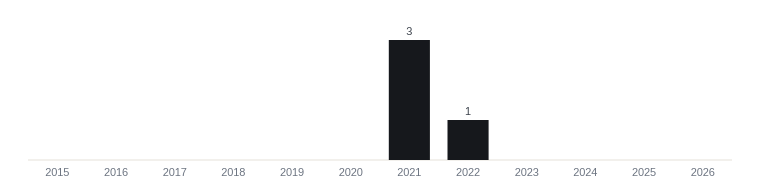
Since 2021, OSHA inspectors have visited Concrete Pipe & Precast, LLC in West Virginia 2 times.
The most recent inspection opened on May 11, 2022 on a referral, in Martinsburg.
In all, OSHA issued 4 citation items: 3 serious and 1 other-than-serious.
The penalties, $11,348 in total, stand where OSHA first set them.
The rule cited most here is 1910.215 (grinders and abrasive wheels), 2 times.
Among manufacturing employers, the typical cited inspection since 2015 ends with a $4,500 penalty. Concrete Pipe & Precast, LLC averages $5,674 across 2 cited inspections.
Concrete Pipe & Precast, LLC also files yearly injury logs with OSHA, summarized below.
It reported 3 severe injuries to OSHA since 2015.
Citation items per year, by inspection date.
West Virginia · latest 90 days of OSHA records
30employers cited
Get notified the morning OSHA posts each new citation in West Virginia: the employer, the site address, the rules broken and the penalty.
Checking a subcontractor, a client or your own company? Watch Concrete Pipe & Precast, LLC and get notified the morning OSHA posts a new citation for it.
From the Form 300A summaries employers file with OSHA each year. Rate = recordable cases per 100 full-time workers.
In 2024, the Martinsburg site logged 0 recordable injuries or illnesses among about 50 workers: 0.0 per 100 full-time workers, against a median of 3.4 for its industry.
Site and year
Workers
Cases
Days-away cases
Rate
Industry median
CP&P Martinsburg Precast
Martinsburg · 2024
50
0
0
0.0
3.4
Included with any plan: 8 more yearly logs from these sites, back to 2016, with each site's average rate over its latest three years. Already a subscriber? Sign in.
An employee was moving a 4x4 box jacket with an overhead crane. The employee hooked a chain to the jacket and put tension on it. It spun awkwardly, striking the employee and knocking him over. The employee fell on the same level and sustained a fractured rib and lacerations to his lower left abdomen and backside.
May 9, 2022, Martinsburg: Hospitalization · fractures · hand(s), unspecified
An employee was working to re-feed a wire rolling machine with wire mesh that had retracted through its roller. The employee's hand got caught between two steel rollers on the rolling machine resulting in a severe laceration and two broken bones. The employee was hospitalized.
May 21, 2021, Martinsburg: Amputation · amputations · fingertip(s)
On May 21, 2021, an employee was using an overhead crane to lift a cured precast concrete piece. The employee had connected the crane's lifting hook to the lifting hook on the concrete piece. As the piece was lifted, the chain tightened and pinched the employee's right index fingertip. The fingertip was amputated.
The rules behind these citations
Current text from the Code of Federal Regulations. Some citations were issued under older wording.
(a) Machine guarding—(1) Types of guarding. One or more methods of machine guarding shall be provided to protect the operator and other employees in the machine area from hazards such as those created by point of operation, ingoing nip points, rotating parts, flying chips and sparks. Examples of guarding methods are—barrier guards, two-hand tripping devices, electronic safety devices, etc.
(4) Work rests. On offhand grinding machines, work rests shall be used to support the work. They shall be of rigid construction and designed to be adjustable to compensate for wheel wear. Work rests shall be kept adjusted closely to the wheel with a maximum opening of one-eighth inch to prevent the work from being jammed between the wheel and the rest, which may cause wheel breakage. The work rest shall be securely clamped after each adjustment. The adjustment shall not be made with the wheel in motion.
29 CFR 1910.215(b)(9)
(9) Exposure adjustment. Safety guards of the types described in subparagraphs (3) and (4) of this paragraph, where the operator stands in front of the opening, shall be constructed so that the peripheral protecting member can be adjusted to the constantly decreasing diameter of the wheel. The maximum angular exposure above the horizontal plane of the wheel spindle as specified in paragraphs (b) (3) and (4) of this section shall never be exceeded, and the distance between the wheel periphery and the adjustable tongue or the end of the peripheral member at the top shall never exceed one-fourth inch. (See Figures O-18, O-19, O-20, O-21, O-22, and O-23.)
29 CFR 1910.29 · Fall protection systems in general industry
Other concrete pipe manufacturing employers in West Virginia
Alert subscribers get notified of each newly cited employer in West Virginia the morning it is posted. See the alert plans.
Source: U.S. Department of Labor, OSHA enforcement data. A citation is OSHA's allegation; employers can contest it, and the status column shows where each item stands. Something wrong on this page? Tell us.