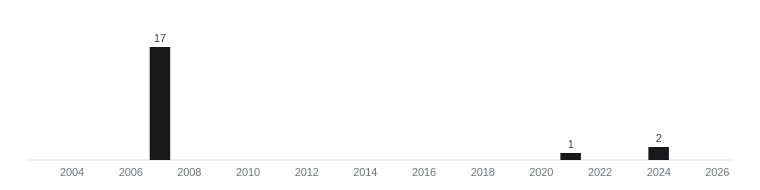
Cottrell Paper Company, Inc. has 16 OSHA inspections on record in New York, the first in 1977.
OSHA's last visit started on Sep 18, 2024 after a fatality or catastrophe, in Rock City Falls.
Across those inspections OSHA issued 54 citation items: 24 serious and 30 other-than-serious.
OSHA proposed $38,103 in penalties. After settlements and reviews the total is $25,063, down 34%.
Most often, OSHA cited 1910.261, pulp, paper, and paperboard mills (11 items).
For context, across all manufacturing employers the median penalty per cited inspection since 2015 is $4,500. Cottrell Paper Company, Inc. averages $9,217 over 2 cited inspections in that time.
1 inspection on this page followed a fatal incident.
Cottrell Paper Company, Inc. also files yearly injury logs with OSHA, summarized below.
It reported 1 severe injury to OSHA since 2015.
Citation items per year, by inspection date.
New York · latest 90 days of OSHA records
360employers cited
Get notified the morning OSHA posts each new citation in New York: the employer, the site address, the rules broken and the penalty.
Checking a subcontractor, a client or your own company? Watch Cottrell Paper Company, Inc. and get notified the morning OSHA posts a new citation for it.
Incident on Sep 18, 2024 (fatal): Employee is killed when caught and crushed by paper machine
At 12:19 p.m. on September 18, 2024, Employee #1 was cleaning the paper machine rollers with an air hose. While performing the task, the employee was caught between the top roller and the mat. The employee was crushed by the rollers, resulting in fatal injuries.
Incident on May 7, 1997: Employee's fingers amputated in paster machine
Employee #1 and coworkers were working on the calender press of a 30-year-old, c ustom-made paster machine designed to merge together two sheets of cotton fiber paper by passing them through a series of calender rolls. The first set of calen der rolls applied polyvinyl alcohol paste between the sheets of paper; the secon d set pressed the two sheets together to form a strong cotton paper that was use d for electrical insulation. According to the machine operator and previous help ers, Employee #1's job was to stand at the back of the press calender, at the ou t-going nip point, and take hold of the paper as the machine operator passed it through the press rolls. This occurred while the calender rolls were in the open position and the machine was in jog mode. Employee #1 was then to wrap the pape r around a take-up roll while the operator put the machine in regular cycle. Aft er about 15 minutes, the take-up roll would be full. The operator would stop the machine, and Employee #1 would wrap the paper roll in brown paper, tape it, and put it on a pallet. The next sheets of paper were then threaded through and the process was started again. The width of the two sheets of paper was not always equal, creating an overlap edge. When this occurred, the overlap sometimes stuck to the roll and tore when it was just threaded and the machine was still in jog mode. Employee #1 was to tear this off and rip off the edge of the paper so it would wrap smoothly. This sticking/tearing of the paper often left a paste resid ue next to the width of the paper roll on the rubber calender. It was the operat or's job at the end of the day to hose down the calender with hot water to remov e it. When Employee #1 first started working at the machine five months before t he accident, the operator caught him near the in-running nip side of the press c alender. He was trying to scrape away the paste residue from the rubber calender while the machine was in full speed and the calendars were closed, creating a d angerous nip point. The operator told Employee #1 to stop, explained about the d angerous nip point in that area, and clarified that he cleaned away the residue at the end of each day. On the morning of the accident, the operator again caugh t Employee #1 cleaning while standing at the in-running nip point and warned him of the danger. Employee #1 complained that he disliked the sticky material on t he calender. Later that morning, while a roll of paper was processing through th e machine at full speed, the machine operator and a coworker heard Employee #1 s creaming from the press area at the middle of the machine. The operator pressed the emergency STOP button at the control box as he approached the press area. An other coworker, approaching from the opposite end of the machine, pushed a butto n to open the calender rolls. Employee #1's fingers were amputated when they pas sed through the nip point of the calender.
From the Form 300A summaries employers file with OSHA each year. Rate = recordable cases per 100 full-time workers.
In 2025, the Rock City Falls site logged 4 recordable injuries or illnesses among about 45 workers: 8.6 per 100 full-time workers, against a median of 1.9 for its industry. Those cases cost 198 days away from work.
Site and year
Workers
Cases
Days-away cases
Rate
Industry median
Cottrell Paper Company, Inc.
Rock City Falls · 2025
45
4
2
8.6
1.9
Included with any plan: 6 more yearly logs from these sites, back to 2018, with each site's average rate over its latest three years. Already a subscriber? Sign in.
(ii) Containers. Flammable liquids shall be stored in tanks or closed containers.
29 CFR 1910.106(e)(2)(ivd)
(iv) Handling liquids at point of final use. (a) Category 1 or 2 flammable liquids, or Category 3 flammable liquids with a flashpoint below 100 °F (37.8 °C), shall be kept in covered containers when not actually in use.
29 CFR 1910.106(e)(6)(i)
(6) Sources of ignition—(i) General. Adequate precautions shall be taken to prevent the ignition of flammable vapors. Sources of ignition include but are not limited to open flames; lightning; smoking; cutting and welding; hot surfaces; frictional heat; static, electrical, and mechanical sparks; spontaneous ignition, including heat-producing chemical reactions; and radiant heat.
Alert subscribers get notified of each newly cited employer in New York the morning it is posted. See the alert plans.
Source: U.S. Department of Labor, OSHA enforcement data. A citation is OSHA's allegation; employers can contest it, and the status column shows where each item stands. Something wrong on this page? Tell us.