Expanded Solutions, LLC: OSHA inspections and violations
Wewoka, Oklahoma · Metal Crown, Closure, and Other Metal Stamping (except Automotive) · NAICS 332119
8inspections
10citation items
$38,860current penalties
Sep 5, 2024last inspection
Since 2009, OSHA inspectors have visited Expanded Solutions, LLC in Oklahoma 8 times.
The most recent inspection opened on Sep 5, 2024 on a referral, in Wewoka.
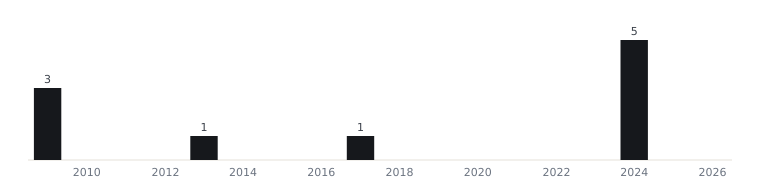
In all, OSHA issued 10 citation items: 10 serious.
The proposed penalties came to $41,597; today they stand at $38,860, 7% less.
The rule cited most here is 1910.212 (machine guarding), 3 times.
Among manufacturing employers, the typical cited inspection since 2015 ends with a $3,600 penalty. Expanded Solutions, LLC averages $18,425 across 2 cited inspections.
Expanded Solutions, LLC also files yearly injury logs with OSHA, summarized below.
It reported 4 severe injuries to OSHA since 2015.
Citation items per year, by inspection date.
Want to know if OSHA cites Expanded Solutions, LLC again? Add it to a watchlist and we will email you the morning the citation shows up.
Incident on Sep 18, 2017: Employee's arm is caught between the centering blocks of an
At 5:30 a.m. on September 18, 2017, an employee who was operating a 10-foot extruder, walked to the rear of the machine to remove the scrap from the conveyor. The employee's right forearm was caught between the centering blocks of the automatic sheet lifter and the conveyor where the load was placed.
From the Form 300A summaries employers file with OSHA each year. Rate = recordable cases per 100 full-time workers.
In 2019, the Wewoka site logged 12 recordable injuries or illnesses among about 52 workers: 32.7 per 100 full-time workers, against a median of 3.6 for its industry. Those cases cost 9 days away from work.
Site and year
Workers
Cases
Days-away cases
Rate
Industry median
Wewoka site
Wewoka · 2019
52
12
7
32.7
3.6
Oklahoma City site
Oklahoma City · 2019
11
0
0
0.0
3.6
Severe injury reports
Employers must report any work-related amputation, in-patient hospitalization or loss of an eye to OSHA within 24 hours. 4 reports on file.
Sep 3, 2024, Wewoka: Amputation · amputations involving bone loss · hand(s) and finger(s)
An employee was operating a "structure leveler" machine with rollers that flattens expanded metal when their glove became caught in the expanded metal and their hand was pulled into the point of operation. The employee sustained a right hand amputation. The machine was guarded at the time.
An employee operating an expanded metal manufacturing machine had his arm caught and fractured in the machine while trying to align it. The machine was guarded at the time.
Mar 1, 2017, Wewoka: Hospitalization · fractures and other injuries, n.e.c. · finger(s), fingernail(s), n.e.c.
An employee was performing maintenance on a leveler machine. He was aligning the machine lid to put it back on, holding the lid with his right hand and his left hand was on the machine in a pinch point. As he was aligning the lid, it fell onto his left hand. The employee sustained broken bones and damage to blood vessels and nerves to his left ring and pinky fingers. The employee was admitted to…
An employee was putting material into a metal leveler machine when his hand was crushed by the metal rollers, breaking bones and amputating three fingers.
The rules behind these citations
Current text from the Code of Federal Regulations. Some citations were issued under older wording.
(a) Machine guarding—(1) Types of guarding. One or more methods of machine guarding shall be provided to protect the operator and other employees in the machine area from hazards such as those created by point of operation, ingoing nip points, rotating parts, flying chips and sparks. Examples of guarding methods are—barrier guards, two-hand tripping devices, electronic safety devices, etc.
29 CFR 1910.212(a)(3)(ii)
(ii) The point of operation of machines whose operation exposes an employee to injury, shall be guarded. The guarding device shall be in conformity with any appropriate standards therefor, or, in the absence of applicable specific standards, shall be so designed and constructed as to prevent the operator from having any part of his body in the danger zone during the operating cycle.
29 CFR 1910.212(a)(3)(iii)
(iii) Special handtools for placing and removing material shall be such as to permit easy handling of material without the operator placing a hand in the danger zone. Such tools shall not be in lieu of other guarding required by this section, but can only be used to supplement protection provided.
29 CFR 1910.219 · Belts, pulleys and power-transmission parts
Source: U.S. Department of Labor, OSHA enforcement data. A citation is OSHA's allegation; employers can contest it, and the status column shows where each item stands. Something wrong on this page? Tell us.