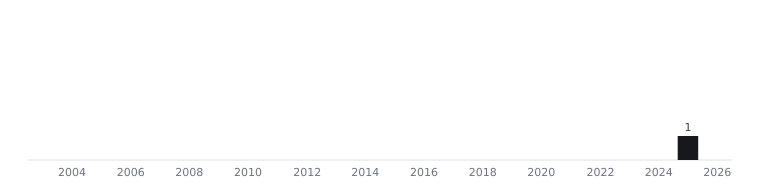
Since 2002, OSHA inspectors have visited Ferguson Signs in Nebraska 2 times.
The most recent inspection opened on Apr 3, 2025 as a planned inspection, in Scottsbluff.
In all, OSHA issued 6 citation items: 4 serious and 2 other-than-serious.
The proposed penalties came to $8,715; today they stand at $7,515, 14% less.
The rule cited most here is 1910.333 (working near live electrical parts), 2 times.
Among professional services employers, the typical cited inspection since 2015 ends with a $1,822 penalty. Ferguson Signs averages $4,965 across 1 cited inspection.
1 inspection on this page followed a fatal incident.
Inspection 303732093 OPENED JUN 27, 2002Closed
Accident · Complete · Safety · 6 employees at the site · Closed Aug 26, 2002
I-80 & Big Springs Road, Big Springs, NE 69122 · Indoor and Outdoor Display Advertising · OSHA's record · Phone and website on Google Maps
Incident on Jun 25, 2002 (fatal): Employee is electrocuted installing lighting socket
At approximately 5:40 p.m. on June 25, 2002, Employee #1 and Employee #2 (compan y owner) were working on a gas station awning (used to provide protection over t he gasoline pumps). They were servicing the perimeter decorative lighting as the company had a contract to replace non-functional bulbs and service the lighting units as necessary. On this particular unit (Southeast corner of the awning), t he end socket had been damaged requiring replacement. The roof/awning structure was completely composed of metal. Employee #1 was installing a florescent lighti ng socket. He was using a pair of wire strippers to clear away the insulation fr om the "hot" line coming from the ballast. Employee #1 was leaning against a met al cross member while performing the work. As he began stripping the wire, his r ight index finger and thumb came into contact with the metal portion of the stri ppers which were now carrying current from the ballast. He had cut through a liv e line. The circuit through Employee #1 was completed when the current traveled from the point of entry in his right thumb and index finger and exited through t he center of his chest where he was leaning against the metal cross member. Empl oyee #1 jerked away from the cross member and landed on his back, against a seco nd cross member. This created a second path which now exited the center of Emplo yee #1's back. This circuit was not broken until Employee #2 came over and grabb ed the live wire and jerked it out of the strippers which were still firmly gras ped in Employee #1's right hand. Employee #1 was electrocuted. The line was char ged to 600 volts and 800 milliamperes. The employees failed to turn off the powe r to the unit which was controlled by a circuit breaker inside of the service st ation. The line load was 120 volts at 20 amps. The voltage was stepped up using the lighting ballast. This converted the voltage to 600 volts which was required to cause the gas in the florescent tube to glow. The amperage was reduced to 80 0 milliamperes as high amperage was not required for the lighting. Both employee s were hot and covered with perspiration. Employee #1 was wearing a cotton t-shi rt which was saturated with sweat which aided in the grounding and conducted the electricity. The cause of death for Employee #1 was officially listed as cardio pulmonary arrest. The cause of the arrest was the electrical current passing thr ough his body. The company did not have a written lockout/tagout program nor had the Employee #1 been trained. The cause of incident was the failure of the comp any to employ proper lockout/tagout practices and, in this case, failing to deen ergize a circuit prior to performing work on that circuit.
| Citation and rule | Type | Proposed | Current | Issued | Status |
|---|
| Citation 1, item 1 |
Serious | $750 | $750 | Aug 7, 2002 | Closed |
| Citation 1, item 2 |
Serious | $1,500 | $300 | Aug 7, 2002 | Closed |
| Citation 1, item 3 |
Serious | $1,500 | $1,500 | Aug 7, 2002 | Closed |
| Citation 2, item 1a |
Other-than-serious | $0 | $0 | Aug 7, 2002 | Closed |
| Citation 2, item 1b |
Other-than-serious | $0 | $0 | Aug 7, 2002 | Closed |
Current text from the Code of Federal Regulations. Some citations were issued under older wording.
Alert subscribers get notified of each newly cited employer in Nebraska the morning it is posted. See the alert plans.
Source: U.S. Department of Labor, OSHA enforcement data. A citation is OSHA's allegation; employers can contest it, and the status column shows where each item stands. Something wrong on this page? Tell us.