Gerdau Ameristeel US, Inc.: OSHA inspections and violations
Wilton, Iowa · Iron and Steel Mills and Ferroalloy Manufacturing · NAICS 331111
13inspections
29citation items
$123,828current penalties
Jan 30, 2026last inspection
Since 2008, OSHA inspectors have visited Gerdau Ameristeel US, Inc. in Iowa 13 times.
The most recent inspection opened on Jan 30, 2026 after a complaint, in Wilton.
In all, OSHA issued 29 citation items: 13 serious and 16 other-than-serious.
The proposed penalties came to $135,094; today they stand at $123,828, 8% less.
The rule cited most here is 1910.147 (lockout/tagout), 5 times.
Among manufacturing employers, the typical cited inspection since 2015 ends with a $3,600 penalty. Gerdau Ameristeel US, Inc. averages $13,136 across 7 cited inspections.
Gerdau Ameristeel US, Inc. also files yearly injury logs with OSHA, summarized below.
The Wage and Hour Division has 1 case on it since 2015, with $6,464 in back wages owed to workers.
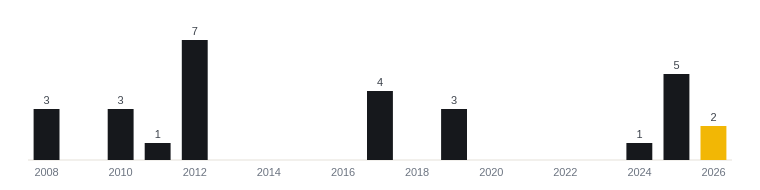
Citation items per year, by inspection date.
Iowa · latest 90 days of OSHA records
59employers cited
Get notified the morning OSHA posts each new citation in Iowa: the employer, the site address, the rules broken and the penalty.
Checking a subcontractor, a client or your own company? Watch Gerdau Ameristeel US, Inc. and get notified the morning OSHA posts a new citation for it.
OSHA records show Gerdau Ameristeel US, Inc. at 14 sites in 5 states. Together they've had 53 inspections and $181,673 in current penalties.
We match records by employer name and industry, so these sites are likely the same company, not certainly. Franchises and subsidiaries can file under one name.
Included with any plan: the site-by-site record for all 14 sites, with repeat and willful violations and citations per year for the whole company. Already a subscriber? Sign in.
Incident on May 31, 2019: Employee is burned when steel melting furnace explodes
At 11:30 p.m. on May 31, 2019, an employee was walking away from the steel melting furnace when a water leak caused an explosion resulting in molten metal to spray out of the furnace and contacted the back of the employee's head and neck causing burns. The employee was not wearing any PPE in the form of a flame-resistant hood or a balaclava for the back of the head and neck. The employee was hospitalized to treat burns to the back of his head, neck, back, hands and feet.
Incident on Nov 7, 2018: Employee fractures several ribs when dragged over crane rail
At 7:15 a.m. on November 7, 2018, an employee was setting up an Ace World Companies 15 Ton Overhead Crane and connected his lanyard to a horizontal lifeline mounted on the building wall. The employee was pulled over the railing of the crane when the lanyard's snap hook came into contact with an eye bolt of a horizontal lifeline and fractured several ribs. The employee was hospitalized.
No citations from this inspection.
5 older inspections
Inspection 342663390 OPENED SEP 25, 2017Closed
Unprogrammed related · Partial · Safety · 220 employees at the site · Closed Jun 8, 2018
Incident on Sep 20, 2017: Two employees burned when loader cab catches fire and explod
At 10:30 p.m. on September 20, 2017, Employee #1 was moving material to control the inflow of water. The water entered the slag pit under the furnace and resulted in an explosion. The loader cab caught fire. Employee #1 and #2 were burned in the explosion and hospitalized.
Incident on Jun 6, 2012: Three employees were burned in flash arc fire
At approximately 9:00 a.m. on June 6, 2012, Employee #1 an electrical engineer, Employee #2 and Employee #3 electricians worked for the Gerdau Ameristeel, Wilto n, IA., and for Davenport Electric Contract Company to provide electrical mainte nance in the Shredder area. A Fluke meter, rated for a maximum of 1000 volts, wa s applied to a live circuit, energized at 4160 volts. Employee #2 replaced broke n conduit which was used to bring power to the 3000 hp Shredder Motor. Employee #3 was called to assist Employee #2. Two extra cables were found in a Shredder j unction box and Employee #1 asked Employee's #2 and #3 to trace the cables. Sing le line prints were analyzed and a connection to a capacitor was noted. Employee #1 reported that he did not notice there were two different capacitors on the d rawing. One capacitor was south of the shredder building, installed for voltage stabilization and was not labeled. The other capacitor, located in the Shredder Area electrical substation, north of the Shredder building, was for power correc tion and was labeled "CAPACITOR BANK". The Shredder was locked out at the substa tion. The breaker, in the substation panel marked "CAPACITOR BANK", was open and the panel door was initially locked out to prepare for testing. Employee #2 cal led Employee #1 to ask if the "CAPACITOR BANK" breaker could be closed because t he initial continuity test did not work. Employee #1 entered the substation encl osure to discuss the work with Employee #2 and Employee #3. Employee #1 agreed t hat it would be safe to close the breaker. The interlock, on the substation cabi net door marked "CAPACITOR BANK", was defeated so the door could remain open whe n the breaker was closed. The handle was in the "on" position. Employee #2 used a Fluke meter, rated for a maximum of 1000 volts, to try to test for ohms to con firm circuit continuity. The upstream lockout acted upon the power stabilization capacitor bank, and was not upstream of the "CAPACITOR BANK" power correction c apacitor, the meter was applied to a live circuit, energized at 4160 volts. A fa ult occurred and caused an arc flash. Employee #1 reported he heard a buzz and t hen felt the flash. He saw that Employee #2 was on fire. Employee #1 attempted t o extinguish Employee #2's clothing by rolling Employee #2 on the ground while y elling for help. Employee #4 heard a pop and saw smoke rise from the substation area and alerted the plant Emergency Response Team (ERT). Shredder Department Em ployees, who were ERT members, responded immediately with an AED, fire extinguis her and a medical equipment bag. Employee #2 was extinguished with a fire exting uisher. A polyester blanket was placed over Employee #2 to cover and prevent sho ck. Then the blanket caught on fire. The blanket was pulled away and a fire exti nguisher was used a second time to extinguish Employee #2's clothes. One respond er reported that a fire appeared to be coming from under Employee #2, so they ro lled him and patted the fire down. First aid was provided. Employee #1 reported he was approximately 8 to 10 feet away from the arc flash origin. Personal Prote ctive Equipment (PPE) worn at the time of the incident included safety glasses, a 100 polyester high visibility safety vest, denim blue jeans, hard hat w/chin s trap, steel toed work boots and a long sleeve flame resistant (ATPV 7.7 rated) s hirt. Employee #1 was burned on his hands while trying to extinguish Employee #2 . Employee #1 had flash burns to his face, with blisters in some areas. Employee #1 was taken by ambulance and kept overnight in the hospital. Employee #2 was n ot as seriously burned on his head and neck as he was on the lower portions of h is body. Employee #2's pants were consumed in the fire, except for part of the w aistband and approximately 6 inches of the bottom of the pant legs. Employee #2 was flown via medical helicopter to a hospital burn unit, where he was admitted with 55 percent of his body burned. Employee #3 reported he was approximately 8. 5 ft. away, diagonally, from the arc flash origin. Employee #3's exposure result ed in severe burns to his arms and some burns on his face. Employee #3 drove to the main plant security gate to get help. The alarm had already been sounded by the time Employee #3 arrived at the security gate. Employee #3 received first ai d in the facility first aid room. He was then taken by ambulance and kept overni ght in the hospital.
Citation and rule
Type
Proposed
Current
Issued
Status
Citation 1, item 1a
29 CFR 1910.132(c) · Personal protective equipment, general requirements
From the Form 300A summaries employers file with OSHA each year. Rate = recordable cases per 100 full-time workers.
In 2019, the Wilton site logged 10 recordable injuries or illnesses among about 239 workers: 4.0 per 100 full-time workers, against a median of 2.2 for its industry. Those cases cost 211 days away from work.
Site and year
Workers
Cases
Days-away cases
Rate
Industry median
Gerdau Ameristeel US Inc.
Wilton · 2019
239
10
3
4.0
2.2
Included with any plan: 1 more yearly log from these sites, back to 2018, with each site's average rate over its latest three years. Already a subscriber? Sign in.
(3) How quickly must each injury or illness be recorded? You must enter each recordable injury or illness on the OSHA 300 Log and 301 Incident Report within seven (7) calendar days of receiving information that a recordable injury or illness has occurred.
(d) Exposure determination—(1) General. Each employer who has a workplace or work operation covered by this section shall determine the 8-hour TWA exposure for each employee exposed to chromium (VI). This determination shall be made in accordance with either paragraph (d)(2) or paragraph (d)(3) of this section.
29 CFR 1910.1026(l)(2)(ib)
(B) The purpose and a description of the medical surveillance program required by paragraph (k) of this section.
Alert subscribers get notified of each newly cited employer in Iowa the morning it is posted. See the alert plans.
Source: U.S. Department of Labor, OSHA enforcement data. A citation is OSHA's allegation; employers can contest it, and the status column shows where each item stands. Something wrong on this page? Tell us.