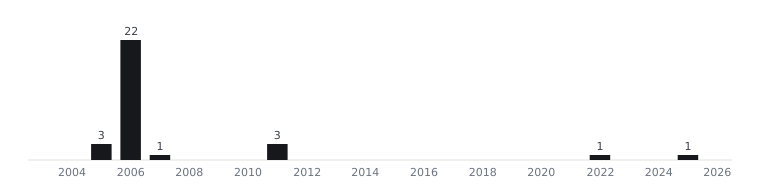
OSHA has inspected Madison-Kipp Corporation 22 times in Wisconsin since 1990.
The latest one began on Mar 3, 2025 on a referral, in Madison.
Those inspections ended with 53 citation items: 40 serious, 1 repeat and 12 other-than-serious.
Penalties were first proposed at $188,581 and now stand at $109,243, 42% lower after settlements or reviews.
Process safety management comes up most often in these citations: 7 items under 1910.119.
How that compares: the median penalty per cited inspection for manufacturing employers since 2015 is $3,600, and Madison-Kipp Corporation averages $12,936 (2 cited inspections).
Madison-Kipp Corporation also files yearly injury logs with OSHA, summarized below.
It reported 4 severe injuries to OSHA since 2015.
Citation items per year, by inspection date.
Wisconsin · latest 90 days of OSHA records
228employers cited
Get notified the morning OSHA posts each new citation in Wisconsin: the employer, the site address, the rules broken and the penalty.
OSHA records show Madison-Kipp Corporation at 3 sites in 2 states. Together they've had 23 inspections and $110,743 in current penalties.
We match records by employer name and industry, so these sites are likely the same company, not certainly. Franchises and subsidiaries can file under one name.
Included with any plan: the site-by-site record for all 3 sites, with repeat and willful violations and citations per year for the whole company. Already a subscriber? Sign in.
Incident on Feb 11, 2011: Employee is struck by fall dunnage and is injured
At approximately 3:10 p.m. on February 11, 2011, an employee and a coworker, bot h managers, were performing a walkthrough of the employer's facility during a sh ift change. They were walking through the shipping and receiving area and a skid of dunnage and parts weighing 472 pounds fell from the top of a stack. The skid of dunnage struck the employee on the back of his head knocking him to the floo r. The employee was hospitalized and treated for broken vertebrae, ruptured disc s, and lacerations. At the time of this accident dunnage was stacked 4 skids hig h, but normal procedure was to limit dunnage stacks to 3 in height.
Incident on Dec 12, 2010: Employee splashed with molten metal
Employee #1 failed to push the aluminum sow charge metal into the hot furnace, u sing the distancing rod attached to his fork lift. As the top sow fell into the molten furnace, hot metal splashed out and around the fork lift shield and Emplo yee #1 received second and third degree burns on his lower body. Employee #1 sta ted he was afraid they were running out of charge and he was unable to locate th e attachment quick enough to push the charge metal into the furnace.
Incident on Jan 31, 2007: Employee burned when dust collector explodes
On January 1, 2007, Employee #1 was loading a grit blaster with aluminum motorcy cle parts. During this process, the Torit dust collector for the blaster explode d, causing first and second degree burns to his right arm and the right side of his face and neck. His right shoulder was also injured when the blast knocked hi m to the concrete floor. He was transported by ambulance to the hospital and was treated and released the same day.
Incident on May 6, 2006: Employee amputates fingers in die-casting machine
On May 6, 2006, Employee #1 and a coworker were working as machine operators at an aluminum die-casting foundry. They were attempting to start up a die-casting machine. With the die open, Employee #1 placed two aluminum billets into the mac hine's shot sleeve. Employee #1 then placed his hand in the shot sleeve in an at tempt to remove the billet. The coworker was at the machine's control panel with the machine in "manual" mode. He jogged the plunger sleeve forward to remove th e billet from the sleeve. Employee #1's hand was caught by the plunger, which op erates at a pressure of approximately 2,000 psi. All five fingers on his hand we re amputated. He was hospitalized.
Incident on Jun 8, 2001: Employee amputated fingertip in a forklift accident
The tip of an employee's left ring finger was amputated when it was pinched betw een the fork of a lift truck and a 2,500-pound sleeve bag of silicon metal. The injured employee was trying to hold open a lifting sleeve so that the lift truck operator could insert the fork into the sleeve.
No citations from this inspection.
Inspection 300568565 OPENED JUL 14, 1999Closed
Complaint · Partial · Safety · 650 employees at the site · Closed Aug 17, 1999
From the Form 300A summaries employers file with OSHA each year. Rate = recordable cases per 100 full-time workers.
In 2025, the Sun Prairie site logged 12 recordable injuries or illnesses among about 131 workers: 12.5 per 100 full-time workers, against a median of 5.4 for its industry.
Site and year
Workers
Cases
Days-away cases
Rate
Industry median
Madison Kipp Corporation - Sun Prairie
Sun Prairie · 2025
131
12
0
12.5
5.4
Madison Kipp Corporation South Plant/Corporate
Madison · 2025
88
2
0
2.9
5.4
Madison Kipp Corporation - North
Madison · 2025
70
6
3
11.6
5.4
Madison-Kipp Corporation (South)
Madison · 2021
179
10
3
5.4
5.4
Madison-Kipp Corporation (Sun Prairie)
Sun Prairie · 2021
136
10
0
7.4
5.4
Madison-Kipp Corporation (North)
Madison · 2021
64
2
0
3.0
5.4
South Plant & Corporate
Madison · 2020
195
5
1
2.8
5.4
Sun Prairie Plant
Sun Prairie · 2020
156
5
2
3.8
5.4
Included with any plan: 19 more yearly logs from these sites, back to 2016, with each site's average rate over its latest three years. Already a subscriber? Sign in.
Employers must report any work-related amputation, in-patient hospitalization or loss of an eye to OSHA within 24 hours. 4 reports on file.
Feb 26, 2025, Madison: Hospitalization · thermal burns third degree or higher · leg(s) unspecified
The injured employee was connecting a scrap conveyor because of a machine startup. They were connecting a plug above their head. A die-cast case cell had a malfunction while making a part and the die-cast machine ejected molten aluminum that struck the injured employee approximately 25 feet away. The employee sustained second- and third-degree burns to their left leg.
An employee was operating a forklift when his foot was crushed between the forklift and a stationary object. The employee sustained crush injuries that required hospitalization.
An employee was hammering a piece of the die cast machine to flatten it out or flush into place when the brass hammer slipped from the employee's grip. As they went to catch it, the employee's right ring finger was caught between the brass hammer and the sliding pin of the die cast machine. The employee's right ring finger was partially amputated.
Jun 30, 2020, Sun Prairie: Hospitalization · puncture wounds, except gunshot wounds · finger(s), fingernail(s), unspecified
A maintenance employee was injected with hydraulic fluid in the right index finger while using their hand to try to feel for a hydraulic hose leak.
The rules behind these citations
Current text from the Code of Federal Regulations. Some citations were issued under older wording.
(iv) The Exposure Control Plan shall be reviewed and updated at least annually and whenever necessary to reflect new or modified tasks and procedures which affect occupational exposure and to reflect new or revised employee positions with occupational exposure. The review and update of such plans shall also:
29 CFR 1910.1030(f)(2)(iv)
(iv) The employer shall assure that employees who decline to accept hepatitis B vaccination offered by the employer sign the statement in appendix A.
(4) Design and construction of inside storage rooms—(i) Construction. Inside storage rooms shall be constructed to meet the required fire-resistive rating for their use. Such construction shall comply with the test specifications set forth in Standard Methods of Fire Tests of Building Construction and Materials, NFPA 251-1969. Where an automatic sprinkler system is provided, the system shall be designed and installed in an acceptable manner. Openings to other rooms or buildings shall be provided with noncombustible liquid-tight raised sills or ramps at least 4 inches in height, or the floor in the storage area shall be at least 4 inches below the surrounding floor. Openings shall be provided with approved self-closing fire doors. The room shall be liquid-tight where the walls join the floor. A permissible alternate to the sill or ramp is an open-grated trench inside of the room which dra
Alert subscribers get notified of each newly cited employer in Wisconsin the morning it is posted. See the alert plans.
Source: U.S. Department of Labor, OSHA enforcement data. A citation is OSHA's allegation; employers can contest it, and the status column shows where each item stands. Something wrong on this page? Tell us.