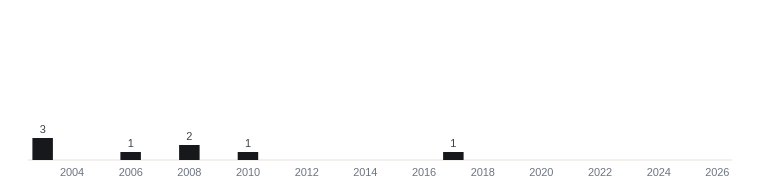
OSHA has inspected National Gypsum Company 17 times in California since 1972.
The latest one began on Sep 29, 2017 after an accident, in Richmond.
Those inspections ended with 31 citation items: 4 serious and 27 other-than-serious.
Penalties were first proposed at $59,065 and now stand at $20,365, 66% lower after settlements or reviews.
Belts, pulleys and power-transmission parts comes up most often in these citations: 4 items under 1910.219.
How that compares: the median penalty per cited inspection for manufacturing employers since 2015 is $4,500, and National Gypsum Company averages $900 (1 cited inspection).
National Gypsum Company also files yearly injury logs with OSHA, summarized below.
Citation items per year, by inspection date.
California · latest 90 days of OSHA records
1,135employers cited
Get notified the morning OSHA posts each new citation in California: the employer, the site address, the rules broken and the penalty.
OSHA records show National Gypsum Company at 11 sites in 6 states. Together they've had 40 inspections and $38,487 in current penalties.
We match records by employer name and industry, so these sites are likely the same company, not certainly. Franchises and subsidiaries can file under one name.
Included with any plan: the site-by-site record for all 11 sites, with repeat and willful violations and citations per year for the whole company. Already a subscriber? Sign in.
Incident on Sep 20, 2017: Employee suffers amputation of finger when caught in mixer l
At 10:10 a.m. on September 20, 2017, Employee #1, a production foreman, and a coworker/ the wet end operator, were working on the wet end line during the maintenance shutdown, cleaning the line. The coworker was cleaning the pin mixer and had partially placed the lid back on the mixer, using the available pneumatic hoist. The employee was standing on the opposite side of the line, cleaning the top of the mixer. Upon completion of another task, the coworker grabbed the handles of the mixer lid, lifted the lid, and pushed it back down to achieve a good seal. It was common practice for the wet end operator to lift and drop the lid several times to get it to seat properly in the seal around the perimeter of the lid. During the second lift of the lid, Employee #1 quickly leaned over and reached in to remove an object from the seal area of the lid with his left hand. The employee was unable to remove his hand quickly enough before the coworker pushed the lid back down, resulting in his middle finger becoming caught in the shearing and sealing process. Employee #1 suffered an amputation to the end of his left middle finger and was treated and released at a nearby hospital.
Citation and rule
Type
Proposed
Current
Issued
Status
Citation 1, item 1
29 CFR 3203(A)(3)
Other-than-serious
$600
$900
Mar 7, 2018
Final
Inspection 311076251 OPENED MAR 16, 2010Closed
Complaint · Partial · Safety · 53 employees at the site · Closed Aug 31, 2010
Incident on Dec 19, 2007: Employee crushes fingertip between machine and drywall
At 3:20 a.m. on December 19, 2007, Employee #1, a probationary employee dry end operator, was tending the Levelator machine. A sheet of drywall coming down the conveyor to the stacking table was misaligned. Instead of stopping the machine a nd realigning the sheet, Employee #1 attempted to realign it with the table movi ng and the machine's pushers caught his right finger, which he then yanked out, avulsing the tissue of the tip. Employee #1 was taken to Western Hand Center whe re surgeons removed the tip of the distal bone to allow reconstruction of the fi ngertip with a skin flap.
Citation and rule
Type
Proposed
Current
Issued
Status
Citation 1, item 1
29 CFR 3203 A
Other-than-serious
$375
$375
Mar 28, 2008
Final
Citation 2, item 1
29 CFR 4184 B
Other-than-serious
$22,500
$7,000
Mar 28, 2008
Final
Inspection 301128864 OPENED MAY 29, 2007Closed
Unprogrammed related · Partial · Safety · 2,300 employees at the site · Closed Mar 7, 2008
Incident on Apr 4, 2005: Employee's finger is amputated in gears of machine
At approximately 10:50 a.m. on April 4, 2005, Employee #1, a maintenance mechani c, was servicing the shaft drive and keyway on the upper level of a tipple hoist machine. Employee #1 locked out and blocked the machine, but he failed to relea se stored energy from the chain running the tipple hoist table and his gloved ha nd was caught in the gears of the machine when stored energy released in the cha in and caused the gears to move. Employee #1's ring finger on his right hand was amputated. Employee #1 was hospitalized and treated for his injury. Employee #1 was a regular employee of the company.
No citations from this inspection.
Inspection 300739448 OPENED MAR 28, 2003Closed
Planned · Complete · Health · 55 employees at the site · Closed Aug 9, 2006
Incident on Dec 17, 2000: Employee suffers finger amputation
At approximately 3:00 a.m. on December 17, 2000, Employee #1 was seriously injur ed when he inspecting rollers on a dry wall conveyor system, that had frozen up during operation. Employee #1 was working alone and was responsible for the remo val of the guards covering the pulleys, not locking out the system or using tool s designed for the task. During the troubleshooting Employee #1 pressed down on an idler used to keep the belts in a conveyor system taut. As Employee #1 touche d the idler, the system immediately started up, amputating the right hand middle finger tip. Employee #1 was hospitalized. .
From the Form 300A summaries employers file with OSHA each year. Rate = recordable cases per 100 full-time workers.
In 2020, the Long Beach site logged 1 recordable injury or illness among about 58 workers: 1.5 per 100 full-time workers, against a median of 2.1 for its industry.
Site and year
Workers
Cases
Days-away cases
Rate
Industry median
National Gypsum
Long Beach · 2020
58
1
0
1.5
2.1
The rules behind these citations
Current text from the Code of Federal Regulations. Some citations were issued under older wording.
(8) Sources of ignition. In addition to the previous restrictions of this paragraph, the following shall apply: There shall be no smoking or open flames in the areas used for fueling, servicing fuel systems for internal combustion engines, receiving or dispensing of flammable liquids. Conspicuous and legible signs prohibiting smoking shall be posted within sight of the customer being served. The motors of all equipment being fueled shall be shut off during the fueling operation.
29 CFR 1910.106(g)(9)
(9) Fire control. Each service station shall be provided with at least one fire extinguisher having a minimum approved classification of 6 B, C, located so that an extinguisher, will be within 75 feet of each pump, dispenser, underground fill pipe opening, and lubrication or service room.
(a) Scope and application. The requirements of this section apply to the placement, use, maintenance, and testing of portable fire extinguishers provided for the use of employees. Paragraph (d) of this section does not apply to extinguishers provided for employee use on the outside of workplace buildings or structures. Where extinguishers are provided but are not intended for employee use and the employer has an emergency action plan and a fire prevention plan that meet the requirements of 29 CFR 1910.38 and 29 CFR 1910.39 respectively, then only the requirements of paragraphs (e) and (f) of this section apply.
29 CFR 1910.178 · Forklifts and other powered industrial trucks
Alert subscribers get notified of each newly cited employer in California the morning it is posted. See the alert plans.
Source: U.S. Department of Labor, OSHA enforcement data. A citation is OSHA's allegation; employers can contest it, and the status column shows where each item stands. Something wrong on this page? Tell us.