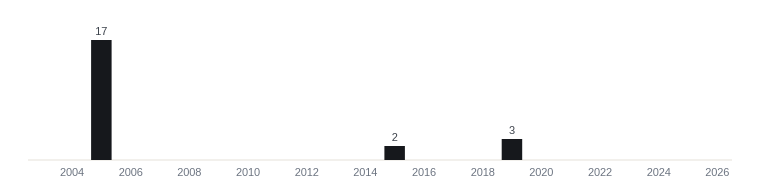
OSHA has inspected New Hampshire Plastics, Inc. 11 times in New Hampshire since 1975.
The latest one began on Nov 5, 2019 on a referral, in Manchester.
Those inspections ended with 66 citation items: 26 serious and 40 other-than-serious.
Penalties were first proposed at $30,346 and now stand at $22,408, 26% lower after settlements or reviews.
comes up most often in these citations: 9 items under 1910.309.
How that compares: the median penalty per cited inspection for manufacturing employers since 2015 is $4,500, and New Hampshire Plastics, Inc. averages $7,129 (2 cited inspections).
New Hampshire Plastics, Inc. also files yearly injury logs with OSHA, summarized below.
It reported 2 severe injuries to OSHA since 2015.
Citation items per year, by inspection date.
New Hampshire · latest 90 days of OSHA records
55employers cited
Get notified the morning OSHA posts each new citation in New Hampshire: the employer, the site address, the rules broken and the penalty.
Checking a subcontractor, a client or your own company? Watch New Hampshire Plastics, Inc. and get notified the morning OSHA posts a new citation for it.
Incident on Oct 30, 2019: Employee's hand is crushed when machinery is turned on early
At 3:30 a.m. on October 30, 2019, an employee was working as a machine operator for a firm that manufactured plastic material and resins. Accompanied by his supervisor, he was working on plastic extrusion line 3. A product run had just finished. The machinery needed to be reprogrammed to new specifications for the next run. This task took place two to five times per shift, depending on production needs. When the machine was reset, a startup procedure was necessary before the machine could be set back to full operating speed. An employee had to feed a plastic sheet through the machine's rollers by hand. The machine was placed into slow mode, in which the rollers moved at a minimal speed and were lifted so that an employee could thread the plastic. The rollers were then returned to their operating position, and the machine was turned back onto full speed. In this incident, as the employee was threading the plastic through the rollers, his supervisor went to the controls and pushed the button to lower the rollers back into their operating position. The employee's right hand was crushed between a pair of rollers. Hearing the employee cry out, the supervisor opened the rollers. He discovered the employee still inside the machine with a serious hand injury. Workers called emergency medical services. The employee was taken to the hospital, where portions of the middle and ring fingers on his right hand were surgically amputated. He was not hospitalized. Later, the supervisor said that he had lowered the upper roller after seeing plastic on the floor, usually an indication that the machine was ready to restart. The supervisor admitted that he had not checked to locate the employee first. Since the machine needed to run in slow mode for the threading, a traditional lockout was not possible. Additional measures, not in place at the time, were needed to protect an employee inside the equipment. A coworker could activate the controls while someone was still inside the machine.
From the Form 300A summaries employers file with OSHA each year. Rate = recordable cases per 100 full-time workers.
In 2020, the Manchester site logged 13 recordable injuries or illnesses among about 59 workers: 18.3 per 100 full-time workers, against a median of 2.6 for its industry. Those cases cost 353 days away from work.
Site and year
Workers
Cases
Days-away cases
Rate
Industry median
New Hampshire Plastics, LLC
Manchester · 2020
59
13
4
18.3
2.6
New Hampshire Plastics LLC
Manchester · 2018
72
13
4
14.2
2.6
Included with any plan: 3 more yearly logs from these sites, back to 2016, with each site's average rate over its latest three years. Already a subscriber? Sign in.
An employee was working as an assistant on the extrusion line, pulling plastic out from the machine. The roller was dropped on the injured employee's right hand, crushing two fingers between the machine's rollers. The employee sustained a partial amputation of the ring and middle fingers.
(c) Exposure control—(1) Exposure Control Plan. (i) Each employer having an employee(s) with occupational exposure as defined by paragraph (b) of this section shall establish a written Exposure Control Plan designed to eliminate or minimize employee exposure.
(d) Hazard classification. (1) Chemical manufacturers and importers shall evaluate chemicals produced in their workplaces or imported by them to classify the chemicals in accordance with this section. Employers are not required to classify chemicals unless they choose not to rely on the classification performed by the chemical manufacturer or importer for the chemical to satisfy this paragraph (d)(1). For each chemical, the chemical manufacturer or importer shall determine the hazard classes, and where appropriate, the category of each class that apply to the chemical being classified. The hazard classification shall include any hazards associated with the chemical's intrinsic properties including:
29 CFR 1910.1200(e)(1)
(e) Written hazard communication program. (1) Employers shall develop, implement, and maintain at each workplace, a written hazard communication program which at least describes how the criteria specified in paragraphs (f), (g), and (h) of this section for labels and other forms of warning, safety data sheets, and employee information and training will be met, and which also includes the following:
29 CFR 1910.132 · Personal protective equipment, general requirements
Alert subscribers get notified of each newly cited employer in New Hampshire the morning it is posted. See the alert plans.
Source: U.S. Department of Labor, OSHA enforcement data. A citation is OSHA's allegation; employers can contest it, and the status column shows where each item stands. Something wrong on this page? Tell us.