North Houston Pole Line, LP: OSHA inspections and violations
Houston, Texas · Power and Communication Line and Related Structures Construction · NAICS 237130
20inspections
15citation items
$59,920current penalties
Jul 23, 2020last inspection
Since 1979, OSHA inspectors have visited North Houston Pole Line, LP in Texas 20 times.
The most recent inspection opened on Jul 23, 2020 on a referral, in Porter.
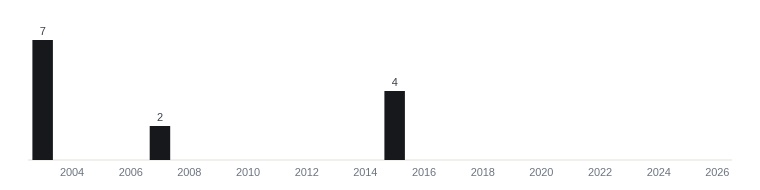
In all, OSHA issued 15 citation items: 5 serious and 10 other-than-serious.
The proposed penalties came to $74,245; today they stand at $59,920, 19% less.
The rule cited most here is 1910.269 (electric power generation, transmission, and distribution), 5 times.
Among construction employers, the typical cited inspection since 2015 ends with a $3,080 penalty. North Houston Pole Line, LP averages $10,500 across 2 cited inspections.
7 inspections on this page followed a fatal incident.
North Houston Pole Line, LP also files yearly injury logs with OSHA, summarized below.
It reported 10 severe injuries to OSHA since 2015.
Citation items per year, by inspection date.
Texas · latest 90 days of OSHA records
399employers cited
2 of them in the same industry
Get notified the morning OSHA posts each new citation in Texas: the employer, the site address, the rules broken and the penalty.
Checking a subcontractor, a client or your own company? Watch North Houston Pole Line, LP and get notified the morning OSHA posts a new citation for it.
Incident on Jul 21, 2020: Employee experiences electrical arc flash resulting in burns
At 3:00 p.m. on July 21, 2020, Employee #1 was transferring power lines from an old power pole to a newly installed one. During the process, the employee's lanyard came close enough to a live power line, resulting in an arc flash. The employee sustained second-degree burns on the areas of his body that made contact with the metal components of his safety harness. Emergency services were contacted, and the employee was transported to a medical facility for treatment and hospitalization.
No citations from this inspection.
Inspection 341295384 OPENED MAR 2, 2016Closed
Follow-up · Complete · Safety · 5 employees at the site · Closed Mar 2, 2016
Incident on Jan 6, 2015 (fatal): Employee was struck and killed by a falling wooden utility p
At 11:30 a.m. on January 6, 2015, a crew of three was removing the remaining portions of old wood utility poles. An employee was using a chainsaw to cut a pole while another employee was operating the forklift to push the pole over. The butt end of the cut pole struck the Employee #1 in the head and chest. The employee suffered and concussion and fractured chest, and died from the injuries.
Incident on Jun 30, 2012 (fatal): Employee is struck by lightning and is killed
On June 30, 2012, an employee was walking to his company truck. The employee was struck by lightning and fell to the ground. He received burns to pelvis and was killed.
No citations from this inspection.
Inspection 311314694 OPENED JUL 21, 2008Closed
Complaint · Complete · Safety · 2 employees at the site · Closed Jul 21, 2008
Incident on Aug 6, 2003 (fatal): Employee is electrocuted while working on structure
On August 6, 2003, an employee and three coworkers were working on a high power electrical structure. Two linemen were on the ground and two were on the high po wer electrical structure. The employee, an apprentice, and the coworker, a journ eyman, had climbed the high power electrical line structure to insert a link in the three lines, phases A, B, and C. The lines had already been deenergized by R eliant Energy. Before the employee and the coworker could insert the links in th e three lines the induction current had to be bled. They first checked the three lines for active voltage. The instrument used was set to detect electricity abo ve 100 KV. The induction current wasn't detected but the linemen knew the induct ion current had to be bled before it was safe to work the three lines. The cowor ker hooked a jumper from the A phase line to ground. The induction current was b led. The coworker connected a jumper from B phase to ground. The induction curre nt was bled. The coworker connected the jumper to C phase but connected the path to ground back to B-phase. The induction current was not bled down. The employe e and the coworker were working from the C phase arm. They were working from a f iberglass ladder to insert the links. The fiberglass ladder was held in place wi th a chainfall. The chainfall was touching the C phase line. When the employee g rabbed the chainfall and the electrical line structure to get on the fiberglass ladder, he became the path to ground. The employee stated that he was being shoc ked. The employee climbed back on C phase arm and collapsed where the coworker s tarted Cardio pulmonary resuscitation. The employee was killed.
Incident on Nov 2, 2001 (fatal): Burn - electrical fault in overhead power line
Two power line workers were working in the bucket of an aerial lift. The two emp loyees made contact with an overhead power line and created an electrical fault. The ensuing electric arc apparently ignited hydraulic fluid, and a fire started in the bucket. One of the employees was able to jump free of the bucket. He use d a backhoe truck to free his coworker by forcing the bucket down and knocking h im out of the bucket. The employee who escaped was hospitalized with burn injuri es. The other employee later died of his burns.
No citations from this inspection.
Inspection 304505803 OPENED NOV 1, 2001Closed
Complaint · Partial · Safety · 500 employees at the site · Closed Nov 14, 2001
Incident on Mar 4, 1988 (fatal): Electric shock - direct contact with overhead line
Two power line workers were in an aerial lift, installing a switch on a pole tha t had been replaced. Neither of them was using electrical protective equipment. Both employees were holding onto the switch, and employee #1 had his arm around the pole. Employee #2 contacted an unguarded overhead power line with his back, and the two employees were electrocuted.
No citations from this inspection.
Inspection 109450502 OPENED FEB 2, 1993Closed
Accident · Partial · Safety · 220 employees at the site · Closed Jan 9, 1995
Incident on Jan 28, 1993 (fatal): Electric shock - direct contact with overhead line
A POWER LINE WORKER WAS RAISING A NO. 4/0 AWG TRIPLEX CABLE. ABOUT 2 FEET ABOVE WHERE THE TRIPLEX WAS FASTENED TO A UTILITY POLE, IT WAS FED BY A 7200-240/120-V OLT TRANSFORMER. THE EMPLOYEE REMOVED THE TRIPLEX FROM ITS BRACKET AND LAID IT O N THE EDGE OF THE BUCKET. HE HELD THE CABLE WITH ONE HAND AND RAISED THE BUCKET OF THE AERIAL LIFT HE WAS WORKING FROM WITH THE OTHER. WHEN HE DID THIS, THE NO. 4 AWG JUMPER CONNECTED TO THE TRIPLEX NEUTRAL BECAME TAUT. THE COPPER POLE GROU ND HAD BEEN STOLEN FOR A LENGTH OF ABOUT 8 FEET UP FROM THE GROUND. ADDITIONALLY , THE ALUMINUM BONDING BRACKET HAD NOT BEEN CONNECTED TO THE SECONDARY NEUTRAL B USHING ON THE TRANSFORMER. THUS, THE JUMPER WIRE WAS THE ONLY GROUND ON THE POLE . THE EMPLOYEE TOOK A PAIR OF KLEIN PLIERS AND CUT THE JUMPER APPARENTLY SO THAT HE COULD CONTINUE MOVING THE AERIAL LIFT BUCKET. THIS OPENED THE ONLY GROUND ON THE PRIMARY WINDING OF THE TRANSFORMER, AND THE EMPLOYEE WAS ELECTROCUTED.
No citations from this inspection.
Inspection 103567780 OPENED AUG 8, 1986Closed
Complaint · Complete · Safety · 5 employees at the site · Closed Sep 25, 1986
From the Form 300A summaries employers file with OSHA each year. Rate = recordable cases per 100 full-time workers.
In 2016, the Houston site logged 27 recordable injuries or illnesses among about 976 workers: 1.9 per 100 full-time workers, against a median of 1.0 for its industry. Those cases cost 1,059 days away from work.
Site and year
Workers
Cases
Days-away cases
Rate
Industry median
North Houston Pole Line LP
Houston · 2016
976
27
11
1.9
1.0
Severe injury reports
Employers must report any work-related amputation, in-patient hospitalization or loss of an eye to OSHA within 24 hours. 10 reports on file, the 6 most recent shown.
The employee was working from a bucket truck transferring live wires from an old power pole to a new pole. The employee's lanyard got close enough to a live wire that an arc flash occurred. The employee sustained second degree burns where the metal parts of the harness contacted his body.
An employee was changing out the insulator on a buswork at a substation. An energized lightning arrester shocked the employee, causing burns to the left hand. The employee was hospitalized.
An employee was standing near the area where an auger crew was preparing to drill a hole to install a light pole. A pin holding the auger broke, causing it to fall. When the auger fell, it hit a security fencing and then landed on the employee's right foot, smashing the fourth and fifth toes.
An employee was replacing a hydraulic lift cylinder on a forklift. As he unbolted the oil line, the second stage of the forklift began to drop, lacerating and crushing his finger between the frame and the second stage. He was hospitalized for surgery.
Aug 5, 2015, Houston: Hospitalization · traumatic injuries and disorders, unspecified · nonclassifiable
An employee was descending from a pole and got into a neutral position. He unclipped his belt and fell approximately 20 feet.
The rules behind these citations
Current text from the Code of Federal Regulations. Some citations were issued under older wording.
29 CFR 1910.269 · Electric power generation, transmission, and distribution
29 CFR 1910.269(a)(2)(i)
(2) Training. (i) All employees performing work covered by this section shall be trained as follows:
29 CFR 1910.269(a)(2)(ii)
(ii) Each qualified employee shall also be trained and competent in:
29 CFR 1910.269(a)(2)(vii)
(vii) The training shall establish employee proficiency in the work practices required by this section and shall introduce the procedures necessary for compliance with this section.
Alert subscribers get notified of each newly cited employer in Texas the morning it is posted. See the alert plans.
Source: U.S. Department of Labor, OSHA enforcement data. A citation is OSHA's allegation; employers can contest it, and the status column shows where each item stands. Something wrong on this page? Tell us.