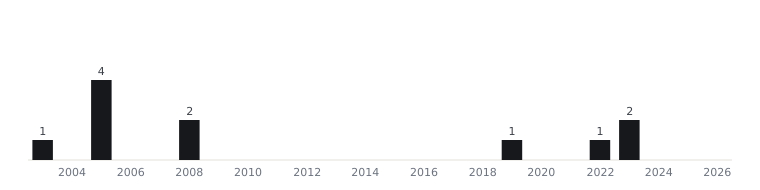
Nouveau Elevator Industries Inc. has 9 OSHA inspections on record in New York, the first in 1997.
OSHA's last visit started on Jan 19, 2023 on a referral, in New York, and the case has not closed yet.
Across those inspections OSHA issued 20 citation items: 14 serious and 6 other-than-serious.
OSHA proposed $64,907 in penalties. After settlements and reviews the total is $63,357, down 2%.
Most often, OSHA cited Section 5(a)(1), the General Duty Clause (6 items).
For context, across all construction employers the median penalty per cited inspection since 2015 is $3,080. Nouveau Elevator Industries Inc. averages $14,386 over 3 cited inspections in that time.
1 inspection on this page followed a fatal incident.
It reported 3 severe injuries to OSHA since 2015.
Inspection 305769911 OPENED APR 8, 2003Closed
Referral · Partial · Safety · 6 employees at the site · Closed Sep 29, 2003
234 East 149th Street, Bronx, NY 10451 · Masonry Contractors · OSHA's record · Phone and website on Google Maps
Incident on Apr 7, 2003: Employee injured when struck by elevator
Employee #1 was installing a cover on a junction box in an elevator shaft as par t of a modernization project. To gain leverage Employee #1 wrapped his left leg around pit ladders and had part of his leg in the adjacent shaft. The car in the adjacent shaft came down and struck Employee #1 pinning his leg between the ele vator car and the ladder. Employee #1 sustained serious injuries to the leg and was hospitalized.
| Citation and rule | Type | Proposed | Current | Issued | Status |
|---|
| Citation 1, item 1 |
Serious | $4,000 | $3,200 | Aug 26, 2003 | Closed |
Inspection 305768061 OPENED DEC 12, 2002Closed
Accident · Complete · Safety · 8 employees at the site · Closed Aug 18, 2004
234 East 149th Street, Bronx, NY 10451 · Other Building Equipment Contractors · OSHA's record · Phone and website on Google Maps
Incident on Dec 12, 2002 (fatal): Employee killed after being struck by elevator car
On December 12, 2002, Employee #1 was chipping out a hole in a block wall in an elevator shaft to install an access switch in the hall frame of an elevator, whi le standing on a ladder set up on the pit floor. The elevator car came down and struck and killed Employee #1, when it pinned him in between the elevator car an d the shaft wall. At the time of the accident, the elevator car was not locked o ut, not in inspection mode and the car doors were closed. The access switch was being installed as part of a modernization project. The pit was 10.4 feet below the lowest floor level, and there were two pit switches in the shaft. The lower pit switch was in the run position and was approximately 48 inches above the pit floor. The upper pit switch was approximately 48 inches above the floor level a nd wasn't fully in either the run or stop position but a New York City building inspector determined that the switch contacts were made which meant it was in th e run position. Employee #1 was working in close proximity to the upper pit swit ch. The inspector surmised that the employee may have accidentally hit the switc h causing it to go into the run mode, which would have placed the elevator car " in service", assuming that it had been placed in the stop position prior to that . The pit switches were installed in series, which meant if both or either of th e pit switches were in the stop mode the elevator would not operate as long as t hey were functioning properly. A foreman had installed all the other access swit ches up to that point of the project. The foreman performed that work from atop of the respective elevator cars with the cars in inspection mode and the main li ne turned off for the respective car. The main lines were not locked or tagged o ut. The foreman explained that although he didn't lockout or tagout the car he h ad full control of the car and in order to move the car, even if someone turned on the main line two buttons located on a control box on top of the car would ha ve to be pressed at the same time. The foreman explained that he and Employee #1 had discussed how the foreman had done the work. The foreman explained that Emp loyee #1 borrowed his saw sall and said he would first use the saw sall in the h allway and then use a hammer drill to chop from inside the shaft. The foreman ex plained that he expected to see Employee #1 during the morning break to see how things were going and didn't expect him to have finished the portion of the work done in the hallway with the saw sall by that time. The foreman explained that he didn't know why Employee #1 didn't perform the chopping portion of the work f rom atop the car like he did. The foreman also explained that the access switch installation normally took approximately 3-4 hours per elevator to complete. Emp loyee #1's coworker explained the Employee #1 set the ladders up in the shaft an d had the car up 1 floor above. He explained that he suggested to Employee #1 th at he would ride the car up further on inspection and then lockout the main line but Employee #1 said not to and that he had shut off the pit switch. The cowork er further explained that Employee #1 chipped the hole a good 15 minutes with th e doors open and then told the coworker he needed to close the doors to reach th e rest of the work. The coworker explained that approximately 15 seconds went by after the doors were closed and he heard what he believed to be the ladder fall ing. He called out to Employee #1 but heard no response. He said he opened the d oors and noticed that the elevator was level with the floor and knew something w as seriously wrong. Both Employee #1 and the coworker had completed a safety cla ss provided by the company prior to the accident. The class did cover Lockout an d tagout procedures, and the employees were provided with lock out and tagout ki ts, which included locks, tags and multi-lockout device hardware.
| Citation and rule | Type | Proposed | Current | Issued | Status |
|---|
| Citation 1, item 1 |
Serious | $4,000 | $3,000 | Apr 8, 2003 | Final |
Employers must report any work-related amputation, in-patient hospitalization or loss of an eye to OSHA within 24 hours. 3 reports on file.
Oct 31, 2024, New York: Hospitalization · fractures · skull
The injured employee was replacing hoist cables in an elevator pit when a hand tool from another employee working on the elevator car top fell down the elevator shaft and struck him in the head, knocking his hard hat off. Then, a second tool hit him on the top right front of his skull resulting in a fracture.
May 21, 2024, New York: Amputation · amputations, avulsions, enucleations unspecified · finger or thumb tip(s), nail(s)
An elevator mechanic was adjusting the elevator brake clearance with a feeler gage used to monitor clearance between the brake shoe and operating shaft. The mechanic was holding the feeler gage in his left hand, and wrenches in his right hand. He instructed a helper inside the elevator to cab up. As the cab went up, his left middle finger got pinched in the elevator hoist cable and the fingertip was amputated.
May 1, 2019, New York: Hospitalization, amputation · amputations · finger(s), fingernail(s), n.e.c.
On May 1, 2019, an employee's thumb was amputated by machinery.
Current text from the Code of Federal Regulations. Some citations were issued under older wording.
Alert subscribers get notified of each newly cited employer in New York the morning it is posted. See the alert plans.
Source: U.S. Department of Labor, OSHA enforcement data. A citation is OSHA's allegation; employers can contest it, and the status column shows where each item stands. Something wrong on this page? Tell us.