Ricoh Electronics, Inc.: OSHA inspections and violations
Santa Ana, California · Other Electronic Component Manufacturing · NAICS 334419
8inspections
15citation items
$45,445current penalties
Nov 21, 2024last inspection
Ricoh Electronics, Inc. has 8 OSHA inspections on record in California, the first in 1988.
OSHA's last visit started on Nov 21, 2024 after an accident, in Ontario, and the case has not closed yet.
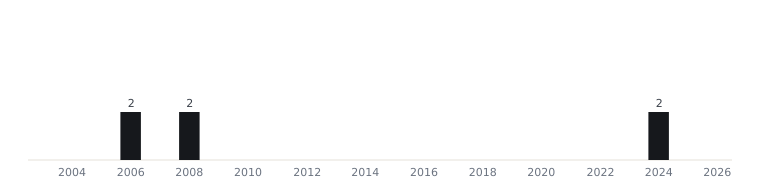
Across those inspections OSHA issued 15 citation items: 8 serious and 7 other-than-serious.
OSHA proposed $52,195 in penalties. After settlements and reviews the total is $45,445, down 13%.
For context, across all manufacturing employers the median penalty per cited inspection since 2015 is $3,600. Ricoh Electronics, Inc. averages $18,185 over 1 cited inspection in that time.
Ricoh Electronics, Inc. also files yearly injury logs with OSHA, summarized below.
Citation items per year, by inspection date.
California · latest 90 days of OSHA records
1,120employers cited
Get notified the morning OSHA posts each new citation in California: the employer, the site address, the rules broken and the penalty.
OSHA records show Ricoh Electronics, Inc. at 6 sites in 2 states. Together they've had 15 inspections and $66,945 in current penalties.
We match records by employer name and industry, so these sites are likely the same company, not certainly. Franchises and subsidiaries can file under one name.
Included with any plan: the site-by-site record for all 6 sites, with repeat and willful violations and citations per year for the whole company. Already a subscriber? Sign in.
Incident on Nov 17, 2008: Employee's finger is amputated in punch press
At approximately 2:17 p.m. on November 17, 2008, Employee #1 operates a 45-ton p unch press machine, a Hidaka, Type Mark-45-11, Control Number 000019, Machine Nu mber 123, asset Number 87PP040. This press cuts various copier machine parts fro m sheet metal, which is laid flat under the master die on a table area. The die is attached with bolts to the bottom portion of a moving ram. Employee #1 has to push both buttons on a two-button controller. A light curtain also surrounds th e machine to stop the operation process if any body part breaks the plane of the light curtain. One of Employee #1's duties includes changing the die approximat ely one to five times a week. He was removing the die and changed the machine fr om run mode to the jog mode. He loosened the bolts on the die that keep it in pl ace on the moving ram. The normal operation would be to run the machine in jog m ode using the two-button controller, which would raise the machine's ram, and th e die would separate. Employee #1 was unaware that he had not completely loosene d a bolt. He started to operate the machine in the slow jog mode and the die did not separate from the machine. The die raised approximately 6-in. Employee #1 n oticed that the die was not completely removed and stopped the machine. He stepp ed towards the machine and put his hands under the machine's ram that was holdin g the die. The bolt that was holding the die loosened, and the approximately 200 to 240 pound die fell onto his finger tips. Employee #1's finger tip was amputa ted.
Citation and rule
Type
Proposed
Current
Issued
Status
Citation 1, item 1
29 CFR 3314 H
Other-than-serious
$315
$315
Feb 5, 2009
Closed
Citation 1, item 2
29 CFR 3314 J01
Other-than-serious
$315
$315
Feb 5, 2009
Closed
Inspection 305356933 OPENED FEB 28, 2006Closed
Accident · Partial · Safety · 140 employees at the site · Closed Aug 24, 2009
Incident on Nov 11, 2005: Employee amputates fingertip in hydraulic press
On November 11, 2005, Employee #1 was operating a 5-ton hydraulic press manufact ured by Advanced Hydraulic Inc., Serial Number CPE 51104. The press was used for inserting pins into a sheet metal part, which was approximately 20.5 inches by 16.5 inches with cutouts for the insertion of other parts. The machine installed two pins onto two flanges at the opposite edges of the sheet metal part. Pins w ere manually placed into the machine slots and then the sheet metal part was ins erted vertically between the two pin slots. A two-hand control was used for acti vating the machine cycle, which pushed pins into the sheet metal part. After the pin insertion was complete, a foot control was used for ejecting the part out o f the point of operation. The foot pedal activated a pneumatically powered pisto n which pushed the part up to facilitate its removal. The sheet metal part sat o n a 2-inch by 2.5-inch metal disk, which was attached to the shaft of a pneumati c piston. The part ejection mechanism was operated by pressing on the foot pedal , which pushed the metal disk up while releasing the foot pedal pushed the disk down. Air pressure of 90 psi controlled the up and down movement of the ejection disk in each direction. Every time the foot pedal was pressed, it created a gap of approximately 0.5 inches between the air cylinder and the ejection disk, wit h air pressure pushing the disk in the up position and the gap closing rapidly w ith air pressure pushing down as a result of the foot pedal release. At the time of the accident, Employee #1 was removing a pin that had fallen inside the gap between the ejection disk and the air cylinder. While he had the foot pedal pres sed down, he reached in with his left index finger to push the pin out of the ga p. He accidentally released the foot pedal and the ejection disk came down on hi s finger. He amputated his fingertip. He was treated in a hospital emergency roo m and released.
Citation and rule
Type
Proposed
Current
Issued
Status
Citation 1, item 1
29 CFR 3314 C
Other-than-serious
$600
$600
May 5, 2006
Closed
Citation 2, item 1
29 CFR 4215 A
Serious
$5,400
$5,400
May 5, 2006
Closed
Inspection 300847076 OPENED MAY 2, 2000Closed
Accident · Partial · Safety · 191 employees at the site · Closed Feb 1, 2001
Incident on Apr 19, 2000: Employee suffers amputation
Employee #1 was a production supervisor for a company using injection molding ma chines to make audio discs. Employee #1 was called to a malfunctioning machine. When Employee #1 reached under the sliding interlocking safety door to remove a stuck disc he intended to hit a control button that would eject the disc, but in stead pressed a button one line away, which closed the mold. Employee #1 suffere d the amputation of his left index finger near the knuckle. Employee #1 was trea ted for his injuries but not hospitalized.
Citation and rule
Type
Proposed
Current
Issued
Status
Citation 1, item 1
29 CFR 342 A
Other-than-serious
$300
$300
May 12, 2000
Closed
Citation 2, item 1
29 CFR 4600 A
Serious
$18,000
$18,000
May 12, 2000
Closed
Inspection 120252499 OPENED JUL 20, 1995Closed
Accident · Partial · Safety · 430 employees at the site · Closed Jul 24, 1995
Incident on Jun 5, 1995: Employee's fingertips amputated by metal fittings
Employee #1, a coating machine operator, and a coworker were reassembling a sect ion of an exhaust duct. The duct has flanges on each end and bolt holes to conne ct it. The coworker lifted the duct to align it at the same time that Employee # 1 was attempting to push a bolt out of a hole with his fingers. The tips of Empl oyee's finger were amputated at midnail.
No citations from this inspection.
Inspection 119888758 OPENED OCT 26, 1994Closed
Complaint · Partial · Health · 390 employees at the site · Closed Apr 1, 1996
From the Form 300A summaries employers file with OSHA each year. Rate = recordable cases per 100 full-time workers.
In 2023, the Ontario site logged 0 recordable injuries or illnesses among about 17 workers: 0.0 per 100 full-time workers, against a median of 2.1 for its industry.
Site and year
Workers
Cases
Days-away cases
Rate
Industry median
Ricoh Electronics, Inc. Ontario
Ontario · 2023
17
0
0
0.0
2.1
Ricoh - CA
Tustin · 2020
74
0
0
0.0
1.6
Tustin site
Tustin · 2019
106
0
0
0.0
1.6
Santa Ana site
Santa Ana · 2018
6
1
0
15.3
2.1
Included with any plan: 5 more yearly logs from these sites, back to 2017, with each site's average rate over its latest three years. Already a subscriber? Sign in.
(a) Machine guarding—(1) Types of guarding. One or more methods of machine guarding shall be provided to protect the operator and other employees in the machine area from hazards such as those created by point of operation, ingoing nip points, rotating parts, flying chips and sparks. Examples of guarding methods are—barrier guards, two-hand tripping devices, electronic safety devices, etc.
Each employer shall furnish to each of his employees employment and a place of employment which are free from recognized hazards that are causing or are likely to cause death or serious physical harm to his employees.
Other other electronic component manufacturing employers in California
Alert subscribers get notified of each newly cited employer in California the morning it is posted. See the alert plans.
Source: U.S. Department of Labor, OSHA enforcement data. A citation is OSHA's allegation; employers can contest it, and the status column shows where each item stands. Something wrong on this page? Tell us.