Sunflower Electric Power Corporation: OSHA inspections and violations
Ulysses, Kansas · Electric Power Distribution · NAICS 221122
4inspections
4citation items
$32,573current penalties
Feb 5, 2021last inspection
OSHA has inspected Sunflower Electric Power Corporation 4 times in Kansas since 2016.
The latest one began on Feb 5, 2021 on a referral, in Ulysses.
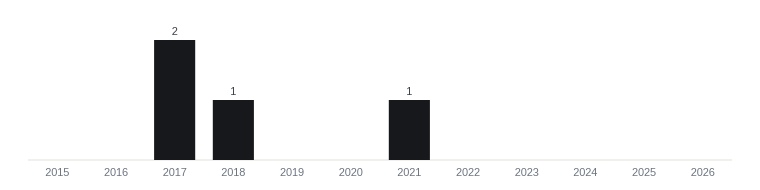
Those inspections ended with 4 citation items: 3 serious and 1 other-than-serious.
Penalties were first proposed at $33,682 and now stand at $32,573, 3% lower after settlements or reviews.
How that compares: the median penalty per cited inspection for utility employers since 2015 is $0, and Sunflower Electric Power Corporation averages $10,858 (3 cited inspections).
Sunflower Electric Power Corporation also files yearly injury logs with OSHA, summarized below.
It reported 4 severe injuries to OSHA since 2015.
Citation items per year, by inspection date.
Kansas · latest 90 days of OSHA records
49employers cited
Get notified the morning OSHA posts each new citation in Kansas: the employer, the site address, the rules broken and the penalty.
Checking a subcontractor, a client or your own company? Watch Sunflower Electric Power Corporation and get notified the morning OSHA posts a new citation for it.
Incident on Feb 2, 2021: Employee sustains burns due to induced voltage from bucket t
At 9:40 a.m. on February 2, 2021, two employees were performing grounding operations on a 115KV line while executing a Switching Order on the deenergized side. Clearance #21-016 was issued at 9:19 a.m. During the process of applying personal protective ground chains, the upper boom of the bucket truck made contact with an ungrounded phase, energizing the basket. The energized truck boom and ground chain put the Journeyman Lineman in series with the induced voltage. The employee lost consciousness for approximately 30 seconds but was able to exit the bucket on his own. He was taken to the hospital in Ulysses, KS, and then transferred to the Via Christi burn unit in Wichita. The employee was treated for burns to his left hand, minor burns on his back, and one burn on his left leg just above the knee. The employee was released on February 3, 2021, with follow-up doctor visits to change burn dressings.
Incident on Sep 24, 2018: Employee is struck by air horn and injures side of head
At 10:40 a.m. on September 24, 2018, an employee was observing several coworkers while they were working and looked away from a tank, striking his head against an air horn. The employee sustained a head injury and was hospitalized. hospitalized.
Incident on May 18, 2017: Employee reaches into bandsaw and amputates index finger
At 11:55 a.m. on May 18, 2017, an employee was cutting metal using a Band saw. The employee reached into the saw while it was operating to see if oil was dripping from it and his finger came into contact with the saw blade. The employee amputated their left hand index finger.
From the Form 300A summaries employers file with OSHA each year. Rate = recordable cases per 100 full-time workers.
In 2025, the Holcomb site logged 1 recordable injury or illness among about 142 workers: 0.7 per 100 full-time workers, against a median of 1.0 for its industry.
Site and year
Workers
Cases
Days-away cases
Rate
Industry median
Holcomb Station
Holcomb · 2025
142
1
0
0.7
1.0
Hays site
Hays · 2025
66
0
0
0.0
1.0
Rubart Station
Ulysses · 2025
6
0
0
0.0
1.0
Included with any plan: 12 more yearly logs from these sites, back to 2016, with each site's average rate over its latest three years. Already a subscriber? Sign in.
An employee was drilling a 15-16-inch hole in a flat steel bracket. The bracket was in a vise, but was not clamped on the table when it started to spin while the employee's hand was resting on it. The employee's finger was caught between the base and bracket, resulting in a partial amputation of the left ring finger at the first knuckle.
An employee was observing work being performed by other employees and was struck by the air horn in use. The employee was hospitalized for a head injury.
While working on nearby equipment, an employee drew an arc of approximately 12 inches from an unpowered electrical line. The power in the line was induced into the circuit from a nearby power source. The employee suffered an electrical shock/burns to the pointer finger and thumb.
The rules behind these citations
Current text from the Code of Federal Regulations. Some citations were issued under older wording.
29 CFR 1910.132 · Personal protective equipment, general requirements
29 CFR 1910.132(d)(1)(i)
(i) Select, and have each affected employee use, the types of PPE that will protect the affected employee from the hazards identified in the hazard assessment;
(a) Machine guarding—(1) Types of guarding. One or more methods of machine guarding shall be provided to protect the operator and other employees in the machine area from hazards such as those created by point of operation, ingoing nip points, rotating parts, flying chips and sparks. Examples of guarding methods are—barrier guards, two-hand tripping devices, electronic safety devices, etc.
(9) Exposure adjustment. Safety guards of the types described in subparagraphs (3) and (4) of this paragraph, where the operator stands in front of the opening, shall be constructed so that the peripheral protecting member can be adjusted to the constantly decreasing diameter of the wheel. The maximum angular exposure above the horizontal plane of the wheel spindle as specified in paragraphs (b) (3) and (4) of this section shall never be exceeded, and the distance between the wheel periphery and the adjustable tongue or the end of the peripheral member at the top shall never exceed one-fourth inch. (See Figures O-18, O-19, O-20, O-21, O-22, and O-23.)
29 CFR 1910.269 · Electric power generation, transmission, and distribution
Other electric power distribution employers in Kansas
Alert subscribers get notified of each newly cited employer in Kansas the morning it is posted. See the alert plans.
Source: U.S. Department of Labor, OSHA enforcement data. A citation is OSHA's allegation; employers can contest it, and the status column shows where each item stands. Something wrong on this page? Tell us.