OSHA has inspected Trade Well Pallet, Inc. 12 times in Nebraska since 1983.
The latest one began on Dec 13, 2023 on a referral, in Gretna.
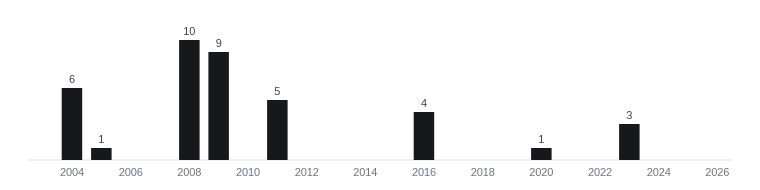
Those inspections ended with 40 citation items: 31 serious, 1 repeat and 8 other-than-serious.
Penalties were first proposed at $78,126 and now stand at $63,058, 19% lower after settlements or reviews.
Lockout/tagout comes up most often in these citations: 9 items under 1910.147.
How that compares: the median penalty per cited inspection for manufacturing employers since 2015 is $4,500, and Trade Well Pallet, Inc. averages $10,492 (3 cited inspections).
Trade Well Pallet, Inc. also files yearly injury logs with OSHA, summarized below.
It reported 2 severe injuries to OSHA since 2015.
Citation items per year, by inspection date.
Nebraska · latest 90 days of OSHA records
30employers cited
Get notified the morning OSHA posts each new citation in Nebraska: the employer, the site address, the rules broken and the penalty.
Incident on Jan 7, 2020: Employee is scalped when hair is caught in chain and sprocke
At 12:00 noon on January 7, 2020, an employee was attempting to remove pieces of lumber that were jamming the trim saw conveyor belt. The employee could not free the jammed pieces of lumber so she crawled under the machine and her hair became caught in a spinning chain and sprocket. The employee was hospitalized to treat scalp and facial injuries.
Incident on Jun 26, 2009: Employee is injured by radial arm saw cutting pallets
On June 26, 2009, upon arrival at work at a pallet manufacturing facility, Emplo yee #1 was directed by the production manager to report to the "north saw" to cu t 4 in. by 4 in. by 4 in. material wood needed for pallet-making cutting from 4 in. by 4 in. by 40 in. stock lumber. The "north saw" was a De Walt radial arm sa w located in the NW corner of the facility. The cutting surface was somewhat gre ater than an inch wide, where the saw blade cuts through the 4 in. by 4 in. by 4 in. wood block. Employee #1 had done some limited work with this saw, cutting t hese blocks the day prior to the accident, and, although was not usually assigne d this task, he did have saw experience on the table saws throughout the facilit y. Initially, the production manager supervised Employee #1 to ensure that all p rocedures and safety were followed and then left after about 10 minutes. Employe e #1 continued to work, took a break, and then returned to work on cutting the b locks. At approximately 10:30 a.m., he ran the radial arm saw over his left hand leaving a laceration that almost amputated the left thumb and cut approximately 2 in. beyond the wrist. Fellow employees came to his aid with the nearest worke r operating other equipment about 20 ft away. Emergency services were summoned, and Employee #1 was taken by ambulance to UNMC. He had received a severe lacerat ion that amputated the top inch of the left index finger, which was surgically r eattached. He also sustained a laceration beginning between the left thumb and i ndex finger that went approximately 4 to 5 in. up and past the left wrist. Facto rs that may have caused or contributed to the accident were (a) The machine had all guards, although restraints can also be used as a method to ensure the off-s et hand cannot be caught, and (b) Employee #1 had only worked in the facility fo r three weeks. It is possible that the employee was not as familiar with the pro duct being cut or the saw being used as supervisors believed. Additional trainin g and/or experience might have been warranted.
Incident on Jan 15, 2008: Employee amputates arm while using gang saw
At approximately 10:20 a.m. on January 15, 2008, Employee #1, a lumber handler, was removing sawn planks from the discharge side of a Brewer Gang Saw, Model Nu mber BR-8112, Serial Number 080403, when the machine became congested with debri s. Employee #1 stopped the lower set of blades and assumed a coworker stopped th e upper set of blades. It was not specified how the blades were 'stopped'. Emplo yee #1 reached into the unguarded opening with her right arm and came in contact with the rotating top blades. Employee #1 was hospitalized with multiple lacera tions and a severe fracture to the right forearm. The injury resulted in an ampu tation. Upon further investigation, it was determined the machine was not locked out. To 'stop' the rotation of the blades, employees used boards and wedged the m against the shaft the blades were mounted on so they could reach into the encl osure and remove the debris. Approximately two years prior to the accident, the employer removed one of the guards to allow employees to view the blades in the event they became clogged.
From the Form 300A summaries employers file with OSHA each year. Rate = recordable cases per 100 full-time workers.
In 2023, the Gretna site logged 6 recordable injuries or illnesses among about 63 workers: 9.2 per 100 full-time workers, against a median of 4.6 for its industry. Those cases cost 351 days away from work.
Site and year
Workers
Cases
Days-away cases
Rate
Industry median
Trade Well Pallet, Inc. - Gretna
Gretna · 2023
63
6
2
9.2
4.6
Trade Well Pallet, Inc. - Ashland Sawmill
Ashland · 2023
16
0
0
0.0
4.2
Included with any plan: 4 more yearly logs from these sites, back to 2020, with each site's average rate over its latest three years. Already a subscriber? Sign in.
An employee was attempting to change the knives of a tub grinder when his left index finger was caught between the shaft's end and a grinding knife. The employee's finger was amputated.
Aug 29, 2016, Gretna: Hospitalization · internal injuries to organs and blood vessels of the trunk · abdomen, except internal location of diseases or disorders
An employee was pushing a pallet into a pallet dismantling machine. The blade caught the pallet and pushed it back into the employee's left side causing internal injuries.
The rules behind these citations
Current text from the Code of Federal Regulations. Some citations were issued under older wording.
(b) Implementation—(1) What do I need to do to complete the OSHA 300 Log? You must enter information about your business at the top of the OSHA 300 Log, enter a one or two line description for each recordable injury or illness, and summarize this information on the OSHA 300-A at the end of the year.
(a) Basic requirement. You must consider an injury or illness to be work-related if an event or exposure in the work environment either caused or contributed to the resulting condition or significantly aggravated a pre-existing injury or illness. Work-relatedness is presumed for injuries and illnesses resulting from events or exposures occurring in the work environment, unless an exception in § 1904.5(b)(2) specifically applies.
(h) Employee information and training. (1) Employers shall provide employees with effective information and training on hazardous chemicals in their work area at the time of their initial assignment, and whenever a new chemical hazard the employees have not previously been trained about is introduced into their work area. Information and training may be designed to cover categories of hazards (e.g., flammability, carcinogenicity) or specific chemicals. Chemical-specific information must always be available through labels and safety data sheets.
29 CFR 1910.132 · Personal protective equipment, general requirements
Alert subscribers get notified of each newly cited employer in Nebraska the morning it is posted. See the alert plans.
Source: U.S. Department of Labor, OSHA enforcement data. A citation is OSHA's allegation; employers can contest it, and the status column shows where each item stands. Something wrong on this page? Tell us.