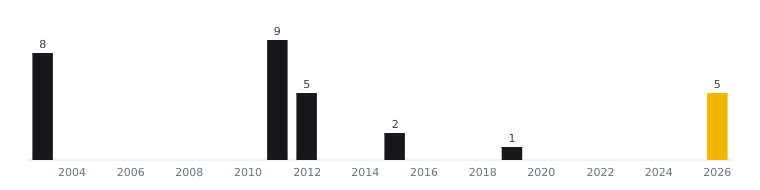
OSHA has inspected U.S. Cotton LLC 11 times in Ohio since 2003.
The latest one began on Jun 22, 2026 after a complaint, in Cleveland.
Those inspections ended with 30 citation items: 24 serious, 1 repeat and 5 other-than-serious.
Penalties were first proposed at $367,071 and now stand at $159,394, 57% lower after settlements or reviews.
Lockout/tagout comes up most often in these citations: 10 items under 1910.147.
How that compares: the median penalty per cited inspection for manufacturing employers since 2015 is $3,600, and U.S. Cotton LLC averages $20,331 (3 cited inspections).
It reported 2 severe injuries to OSHA since 2015.
Citation items per year, by inspection date.
Ohio · latest 90 days of OSHA records
265employers cited
Get notified the morning OSHA posts each new citation in Ohio: the employer, the site address, the rules broken and the penalty.
Incident on Sep 5, 2021: Employee amputates fingertip while performing maintenance on
At 8:30 a.m. on September 5, 2021, an employee working as a machine operator for a cotton products manufacturer was performing maintenance on the #10 card machine. The employee attempted to guide a belt onto the drive motor manually. The belt would not engage fully with the belt pulley, so the employee tried again with the machine energized. As the employee was manually guiding the belt he caught his hand between the belt and pulley. The employee received medical treatment without hospitalization for an amputated fingertip.
No citations from this inspection.
Inspection 343893418 OPENED MAR 29, 2019Closed
Referral · Partial · Safety · 1,200 employees at the site · Closed Jan 14, 2022
Incident on Mar 21, 2019: Employee amputates finger when caught in wheel and sprocket
At 9:15 a.m. on March 21, 2019, Employee #1 was troubleshooting the equipment. The employee removed an interlocked guard over the transfer wheel area. The interlock was bypassed with the use of an interlock magnet which allowed for the equipment to run without the guard in place. The employee also removed the fixed barrier guard covering the chain and sprocket under the transfer wheel. The employee did not have the hazardous energies of the equipment isolated. The employee placed his hand under the transfer wheel area. His hand became caught in the wheel and sprocket, which drives the transfer, and Employee #1's left index finger was amputated. Hospitalization was not required.
Incident on Jan 27, 2012: Employee amputates finger in baler
At 12:00 a.m. Employee #1 was training a new coworker on how to remove the cardboard bale from the baler. While attempting to train the coworker on how to remove a cardboard bale from the baler, Employees #1 proceeded to the back of the baler to the discharge area of the bailer machine. Employee #1 placed his hand on the T-bar. An additional coworker, who was located in the front of the bailer machine fell against the controls, accidentally actuating the baler. When the machine engaged, Employee #1 was unable to remove his hand from the T-bar and the angle iron. This resulted in the immediate amputation of Employee #1 right ring finger above the 1st digit. The employee suffered a partial finger amputation while working on a baler.
An employee was replacing a 3-inch belt that had fallen off a flywheel. When he placed the belt back on the flywheel, the spinning wheel caused his left hand to be pulled into a pinch point. He suffered amputations to the index and middle fingers.
An employee's left index finger was amputated as he was troubleshooting a machine. The machine was not locked out or guarded at the time, and was running.
The rules behind these citations
Current text from the Code of Federal Regulations. Some citations were issued under older wording.
(2) Within twenty-four (24) hours after the in-patient hospitalization of one or more employees or an employee's amputation or an employee's loss of an eye, as a result of a work-related incident, you must report the in-patient hospitalization, amputation, or loss of an eye to OSHA.
(i) A list of the hazardous chemicals known to be present using a product identifier that is referenced on the appropriate safety data sheet (the list may be compiled for the workplace as a whole or for individual work areas); and,
29 CFR 1910.1200(h)
(h) Post-mortem data: Increased incidence and/or severity of post-mortem findings may be indicative of maternal toxicity. This can include gross or microscopic pathological findings or organ weight data, including absolute organ weight, organ-to-body weight ratio, or organ-to-brain weight ratio. When supported by findings of adverse histopathological effects in the affected organ(s), the observation of a significant change in the average weight of suspected target organ(s) of treated dams (mothers), compared to those in the control group, may be considered evidence of maternal toxicity.
29 CFR 1910.132 · Personal protective equipment, general requirements
Alert subscribers get notified of each newly cited employer in Ohio the morning it is posted. See the alert plans.
Source: U.S. Department of Labor, OSHA enforcement data. A citation is OSHA's allegation; employers can contest it, and the status column shows where each item stands. Something wrong on this page? Tell us.