Becton, Dickinson and Company: OSHA inspections and violations
Columbus, Nebraska · Surgical and Medical Instrument Manufacturing · NAICS 339112
10inspections
32citation items
$126,432current penalties
May 20, 2025last inspection
OSHA has inspected Becton, Dickinson and Company 10 times in Nebraska since 1976.
The latest one began on May 20, 2025 after a complaint, in Columbus.
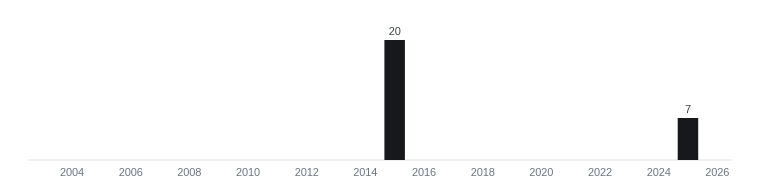
Those inspections ended with 32 citation items: 28 serious, 1 repeat and 3 other-than-serious.
Penalties were first proposed at $176,360 and now stand at $126,432, 28% lower after settlements or reviews.
Lockout/tagout comes up most often in these citations: 8 items under 1910.147.
How that compares: the median penalty per cited inspection for manufacturing employers since 2015 is $3,600, and Becton, Dickinson and Company averages $23,306 (5 cited inspections).
1 inspection on this page followed a fatal incident.
It reported 5 severe injuries to OSHA since 2015.
Citation items per year, by inspection date.
Nebraska · latest 90 days of OSHA records
30employers cited
Get notified the morning OSHA posts each new citation in Nebraska: the employer, the site address, the rules broken and the penalty.
Checking a subcontractor, a client or your own company? Watch Becton, Dickinson and Company and get notified the morning OSHA posts a new citation for it.
OSHA records show Becton, Dickinson and Company at 7 sites in 3 states. Together they've had 16 inspections and $127,182 in current penalties.
We match records by employer name and industry, so these sites are likely the same company, not certainly. Franchises and subsidiaries can file under one name.
Included with any plan: the site-by-site record for all 7 sites, with repeat and willful violations and citations per year for the whole company. Already a subscriber? Sign in.
Incident on Mar 7, 2001 (fatal): Electric shock - direct contact with energized parts
Employee #1, a mold mechanic for a medical syringe manufacturer, was retrofittin g injection-molding machines with fireproofing blankets. The plant had over 20 i njection molding machines, and the work was split between several maintenance wo rkers. The employer had no standard procedure for installing the blankets. Emplo yee #1 would partially move the guard away from the area as he wrapped the blank et around the heating rings of the injection arm. By 3:00 am, Employee #1 had co mpleted all of his assigned machines and started on machines that had not been a ssigned to him. He began working on one 480-volt, 30-ampere machine without lock ing it out. The employee was found dead. It was concluded that he had been elect rocuted. A postaccident inspection of the machine conducted by the company's ele ctricians and an outside electrician determined that one of the three relays con trolling the heating ring zones on the injection arm had a contact that remained closed. This contact allowed the circuit controlling the heat rings to remain e nergized while the employee was working. The manner in which Employee #1 had bee n installing the blankets exposed him to ready contact with energized terminals. The coroner's autopsy did not address the possibility of electrocution because the circumstances behind the death were not relayed to him until after the autop sy had been completed. The coroner did not examine the possibility of electrocut ion or look for any evidence of electrocution on the body.
An employee had been operating a machine. They were testing the belt tension beneath the machine when their left thumb became caught between the belts and pulleys of the machine. The employee sustained a distal thumb amputation.
Dec 9, 2020, Holdrege: Hospitalization · fractures · hip(s)
An employee tripped on a step stool and fell to the floor, suffering a broken hip.
Oct 22, 2015, Holdrege: Amputation · amputations · fingertip(s)
An employee was clearing a jam and jogging the equipment due to a "barrel trip gate fault." The operator noticed a large jam and entered a gloved finger into the point of operation to clear the jam while jogging the machine. The left index finger was caught in the dial (part of the machine that brings the plunger up into the barrel for assembly of the syringe) and the fingertip was amputated. …
An employee was troubleshooting a form fill and seal machine. When the machine inadvertently cycled, the employee's right index finger was amputated above the first joint.
An employee was troubleshooting an assembly line in the needle assembly area. When he bent over to look at the bottom of the machine, he rested his hand on a guard on the belt assembly. His finger overlapped with the edge of the guard, tripping a motion sensor that activated the machine push bar. His right-hand middle finger got caught between the push bar and the machine.
The rules behind these citations
Current text from the Code of Federal Regulations. Some citations were issued under older wording.
(3) How quickly must each injury or illness be recorded? You must enter each recordable injury or illness on the OSHA 300 Log and 301 Incident Report within seven (7) calendar days of receiving information that a recordable injury or illness has occurred.
(h) Employee information and training. (1) Employers shall provide employees with effective information and training on hazardous chemicals in their work area at the time of their initial assignment, and whenever a new chemical hazard the employees have not previously been trained about is introduced into their work area. Information and training may be designed to cover categories of hazards (e.g., flammability, carcinogenicity) or specific chemicals. Chemical-specific information must always be available through labels and safety data sheets.
(6) Periodic inspection. (i) The employer shall conduct a periodic inspection of the energy control procedure at least annually to ensure that the procedure and the requirements of this standard are being followed.
Alert subscribers get notified of each newly cited employer in Nebraska the morning it is posted. See the alert plans.
Source: U.S. Department of Labor, OSHA enforcement data. A citation is OSHA's allegation; employers can contest it, and the status column shows where each item stands. Something wrong on this page? Tell us.