OSHA has inspected Bennett Lumber Products, Inc. 11 times in Idaho since 1975.
The latest one began on Jan 7, 2020 on a referral, in Princeton.
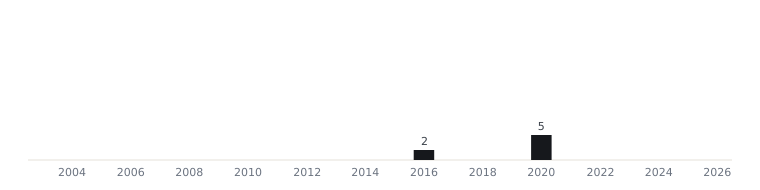
Those inspections ended with 38 citation items: 6 serious, 2 repeat and 30 other-than-serious.
Penalties were first proposed at $23,824 and now stand at $16,884, 29% lower after settlements or reviews.
Sawmills comes up most often in these citations: 12 items under 1910.265.
How that compares: the median penalty per cited inspection for manufacturing employers since 2015 is $4,500, and Bennett Lumber Products, Inc. averages $7,087 (2 cited inspections).
1 inspection on this page followed a fatal incident.
Bennett Lumber Products, Inc. also files yearly injury logs with OSHA, summarized below.
It reported 6 severe injuries to OSHA since 2015.
Citation items per year, by inspection date.
Idaho · latest 90 days of OSHA records
62employers cited
Get notified the morning OSHA posts each new citation in Idaho: the employer, the site address, the rules broken and the penalty.
Checking a subcontractor, a client or your own company? Watch Bennett Lumber Products, Inc. and get notified the morning OSHA posts a new citation for it.
Incident on Nov 9, 2019: Employee lacerates head and eye when stuck in unscrambler
At 2:00 a.m. on November 9, 2019, an employee working for a sawmill was clearing a jam in a unscrambler machine. The employee had been flipping boards and misjudged the hazard. He placed his head too close to the point of operation. The employee got stuck in the machine and sustained cuts, lacerations and abrasions to his and a laceration to one of his eyes. The employee was taken to the hospital, where he received stitches and was hospitalized for observation for 24 hours.
Incident on Oct 14, 2002 (fatal): Employee crushed by bulldozer
On October 14, 2002, some employees of Bennett Lumber Products, Inc. were perfor ming a controlled burn on their mountainside clear-cut property. A bulldozer ope rator cleared trees and debris around the outside border to create a blackened l ine. The blackened line is an area cleared by a bulldozer to contain the fire. T he bulldozer was traveling from one side of the site to the other side and was u sing the upper road. The operator turned the bulldozer to the left instead of fo llowing the path to the right and drove the machine down a steep mountainside to ward the fire below. The operator then jumped from the bulldozer and was caught by the machine. He was trapped under the machine and crushed by the tracks. The operator died from the injuries.
Citation and rule
Type
Proposed
Current
Issued
Status
Citation 1, item 1
29 CFR 1910.132(a) · Personal protective equipment, general requirements
From the Form 300A summaries employers file with OSHA each year. Rate = recordable cases per 100 full-time workers.
In 2025, the Princeton site logged 21 recordable injuries or illnesses among about 172 workers: 12.2 per 100 full-time workers, against a median of 4.2 for its industry. Those cases cost 283 days away from work.
Site and year
Workers
Cases
Days-away cases
Rate
Industry median
Bennett Lumber Products, Inc.
Princeton · 2025
172
21
8
12.2
4.2
Included with any plan: 9 more yearly logs from these sites, back to 2016, with each site's average rate over its latest three years. Already a subscriber? Sign in.
Employers must report any work-related amputation, in-patient hospitalization or loss of an eye to OSHA within 24 hours. 6 reports on file.
Feb 24, 2023, Princeton: Hospitalization · fractures · thigh(s)
An employee was welding and grinding the motor mounts under the tail sawyer. The equipment was repressurized, causing the hydraulic unit to actuate and pin the employee. They sustained a right femur fracture that required hospitalization.
An employee and co-worker were taking out the outfeed roll from a non-energized planer used for spare parts. When lifting the pivot housing, the outfeed roll became bound up, so the co-worker pushed while the employee was trying guide the roll. The roll sprung out and rolled forward, smashing the employee's hand between the roll housing and the planer housing. The employee suffered a crushed…
Nov 9, 2019, Princeton: Hospitalization · cuts, lacerations · multiple head locations
An employee was reaching down to pull a stuck board from an unscrambler machine. The machine gate came down and smashed the employee's upper body. He suffered a cut above the eye, as well as cuts and scrapes to the head that required stitches.
Mar 3, 2018, Princeton: Hospitalization · fractures · ankle(s)
An employee broke an ankle while working in the lumber facility, requiring hospitalization.
An employee activated a gate with his left hand while his right hand was still on product. His right thumb then became caught between the gate and the product. When he pulled his hand back, his right thumb tip was amputated.
An employee locked out the rip saw to remove a jam when his glove got caught on the blade. The blade, which was still moving under its own momentum, pulled the employee's right hand into a pinch point and crushed three fingers, which were then amputated.
The rules behind these citations
Current text from the Code of Federal Regulations. Some citations were issued under older wording.
(iv) Handling liquids at point of final use. (a) Category 1 or 2 flammable liquids, or Category 3 flammable liquids with a flashpoint below 100 °F (37.8 °C), shall be kept in covered containers when not actually in use.
29 CFR 1910.106(e)(6)(i)
(6) Sources of ignition—(i) General. Adequate precautions shall be taken to prevent the ignition of flammable vapors. Sources of ignition include but are not limited to open flames; lightning; smoking; cutting and welding; hot surfaces; frictional heat; static, electrical, and mechanical sparks; spontaneous ignition, including heat-producing chemical reactions; and radiant heat.
29 CFR 1910.132 · Personal protective equipment, general requirements
29 CFR 1910.132(a)
(a) Application. Protective equipment, including personal protective equipment for eyes, face, head, and extremities, protective clothing, respiratory devices, and protective shields and barriers, shall be provided, used, and maintained in a sanitary and reliable condition wherever it is necessary by reason of hazards of processes or environment, chemical hazards, radiological hazards, or mechanical irritants encountered in a manner capable of causing injury or impairment in the function of any part of the body through absorption, inhalation or physical contact.
Alert subscribers get notified of each newly cited employer in Idaho the morning it is posted. See the alert plans.
Source: U.S. Department of Labor, OSHA enforcement data. A citation is OSHA's allegation; employers can contest it, and the status column shows where each item stands. Something wrong on this page? Tell us.