OSHA has inspected Consolidated Metco Inc 47 times in Oregon since 1972.
The latest one began on Mar 15, 2024 after a complaint, in Clackamas.
Those inspections ended with 139 citation items: 64 serious, 3 repeat and 72 other-than-serious.
Penalties were first proposed at $27,995 and now stand at $23,245, 17% lower after settlements or reviews.
Electrical wiring methods comes up most often in these citations: 9 items under 1910.305.
How that compares: the median penalty per cited inspection for manufacturing employers since 2015 is $3,600, and Consolidated Metco Inc averages $2,075 (1 cited inspection).
Consolidated Metco Inc also files yearly injury logs with OSHA, summarized below.
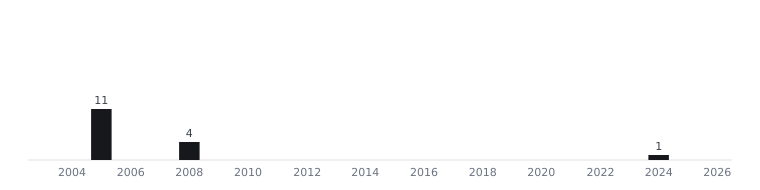
Citation items per year, by inspection date.
Oregon · latest 90 days of OSHA records
396employers cited
Get notified the morning OSHA posts each new citation in Oregon: the employer, the site address, the rules broken and the penalty.
OSHA records show Consolidated Metco Inc at 6 sites in 2 states. Together they've had 79 inspections and $72,639 in current penalties.
We match records by employer name and industry, so these sites are likely the same company, not certainly. Franchises and subsidiaries can file under one name.
Included with any plan: the site-by-site record for all 6 sites, with repeat and willful violations and citations per year for the whole company. Already a subscriber? Sign in.
Incident on Jun 14, 2011: Employee injures arm when cut on hardened aluminum
On June 14, 2011, an employee working as a die caster tender was skimming slag f rom an aluminum smelting vat with a hand held ladle. When he reached up to hang the ladle on a post, the employee scrapped his right forearm on a small spike of hardened aluminum. The employee suffered a cut and was transported to the hospi tal for treatment.
No citations from this inspection.
Inspection 312837032 OPENED DEC 2, 2008Closed
Planned · Complete · Health · 86 employees at the site · Closed Jun 1, 2009
Incident on Aug 30, 2005: Employee is injured when crushed in milling machine
Employee #1, a production engineer, was inside a CNC milling machine, when he wa s crushed between the moving tool and the wall of the machine. He was hospitaliz ed with a fracture.
Incident on Apr 18, 2005: Employee fractures ribs when caught between mold machines
On April 18, 2005, Employee #1 was using a chipper bar to remove dross (dropped metal) from the table beneath a Rimrock robotic ladle. This ladle delivers molte n metal to mold machines, but it operates independently of them. Employee #1 had removed some of the dross by standing outside the operation area. Now he moved directly in front of the robotic ladle, inside the hub cell, to get better acces s to the dipwell, which contained the molten metal. He stood between the two mol d machines. Turning to leave after he had completed his task, he fell, and as he was getting up, he got caught between the two mold machines. The mold machines automatically rotate between being vertical and horizontal. Employee #1 sustaine d fractured ribs, and he was hospitalized.
Incident on Oct 6, 2004: Worker injured when struck by machine part
On October 6, 2004, Employee #1, a machine operator at Consolidated Metco, Inc., sustained left hand and abdominal injuries when an adjustment bolt on the cylin der ram for an aluminum molding press failed and struck him.
No citations from this inspection.
Inspection 307822452 OPENED JUN 3, 2004Closed
Planned · Complete · Health · 241 employees at the site · Closed May 16, 2005
Incident on Jun 27, 2001: Employee's foot is burned when molten metal spills
On June 27, 2001, Employee #1 was using a monorail crane to move a bull ladle fu ll of molten aluminum along a walkway ramp. The ladle struck an object at the si de of the ramp, and molten material spilled from the ladle onto Employee #1's sh irt and trousers. The molten material was held by, and burned through, a fold in his trousers, and then ran down into his boot. He was hospitalized with a serio us burn to his left foot.
Incident on Mar 16, 2001: Employee fractured leg when washer split
On March 16, 2001, Employee #1 was using a torque wrench with a handle approxima tely 3 ft-long to tighten nuts onto a truck wheel hub. The hub was being secured to an empowered test fixture in a test stand in the laboratory and was not atta ched to any vehicle. As the 450-ft-lb tightening specification was approached, t he washer located between the nut and hub split. The energy released forcefully ejected the torque wrench socket and headed off the nut, causing Employee #1's b ody to twist. Employee #1's right foot was firmly planted on the floor and his b odily motion caused his right leg to twist, resulting in a fracture.
No citations from this inspection.
Inspection 303360150 OPENED JAN 25, 2001Closed
Planned · Complete · Safety · 190 employees at the site · Closed Dec 6, 2001
Incident on Jan 15, 1999: Electric shock - ground fault in junction box
An operator noticed sparks and a flash coming from a 480-volt cord. Another empl oyee was summoned to repair the cord. This employee took a stepladder to access the junction box to which the cord was connected. He determined the length of th e damaged cord so that he could replace it. As he descended the stepladder, the cord touched the metal junction box. The victim received an electric shock and w ent into convulsions. The injured employee was hospitalized with second-degree b urns to his right hand and left ankle.
Incident on Nov 1, 1998: Employee's leg injured when caught in molding machine
On November 1, 1998, Employee #1 was cleaning an aluminum mold on the hub mold m achine. He used a wire brush on half of the inside of the mold from in front of the equipment and then decided to clean the other half of the mold from behind t he equipment by standing within the back. After he finished cleaning, he leaned over and hit the equipment safety button. The machine activated, trapping his le gs in the pinch point at the base. Employee #1 sustained a massive injury to his left lower leg. He was finally extracted and flown to Emanuel Hospital in Portl and, where he underwent several surgeries to repair the damage to his leg.
Incident on Jun 16, 1995: Employee lacerates hand in carbide saw
At approximately 10:15 a.m. on June 15, 1995, Employee #1, a molder, was working in a work cell with a sawyer who was operating a 36 in. carbide saw. A bolt tha t held down the saw became loose and the sawyer left to call maintenance to tigh ten it. Employee #1, believing there was a nut on the other end of the bolt, rea ched into the saw with his left hand to check for a nut. A blade to the saw that was in close proximity to the nut caught Employee #1's glove. His hand was draw n into the saw, severely cutting the back of it across the base of his fingers.
From the Form 300A summaries employers file with OSHA each year. Rate = recordable cases per 100 full-time workers.
In 2023, the Clackamas site logged 7 recordable injuries or illnesses among about 83 workers: 8.6 per 100 full-time workers, against a median of 2.3 for its industry.
Site and year
Workers
Cases
Days-away cases
Rate
Industry median
Consolidated Metco INC
Clackamas · 2023
83
7
0
8.6
2.3
Consolidated Metco - Clackamas
Clackamas · 2022
77
4
2
5.2
5.4
Consolidated Metco
Clackamas · 2020
72
1
1
1.5
5.4
Included with any plan: 3 more yearly logs from these sites, back to 2017, with each site's average rate over its latest three years. Already a subscriber? Sign in.
(3) Duties of employers and building and facility owners. (i) Building and facility owners shall determine the presence, location, and quantity of ACM and/or PACM at the work site. Employers and building and facility owners shall exercise due diligence in complying with these requirements to inform employers and employees about the presence and location of ACM and PACM.
(b) Compressed gases. The in-plant handling, storage, and utilization of all compressed gases in cylinders, portable tanks, rail tankcars, or motor vehicle cargo tanks shall be in accordance with Compressed Gas Association Pamphlet P-1-1965, which is incorporated by reference as specified in § 1910.6.
(2) Quantity. The quantity of flammable liquids or liquids with a flashpoint greater than 199.4 °F (93 °C) kept in the vicinity of spraying operations shall be the minimum required for operations and should ordinarily not exceed a supply for 1 day or one shift. Bulk storage of portable containers of flammable liquids or liquids with a flashpoint greater than 199.4 °F (93 °C) shall be in a separate, constructed building detached from other important buildings or cut off in a standard manner.
Alert subscribers get notified of each newly cited employer in Oregon the morning it is posted. See the alert plans.
Source: U.S. Department of Labor, OSHA enforcement data. A citation is OSHA's allegation; employers can contest it, and the status column shows where each item stands. Something wrong on this page? Tell us.