Consumers Power Inc: OSHA inspections and violations
Philomath, Oregon · Electric Power Distribution · NAICS 221122
18inspections
23citation items
$18,294current penalties
Jan 29, 2025last inspection
Consumers Power Inc has 18 OSHA inspections on record in Oregon, the first in 1986.
OSHA's last visit started on Jan 29, 2025 after an accident, in Monroe.
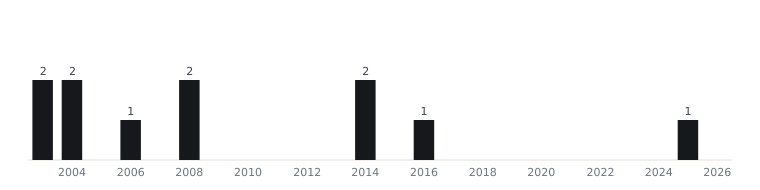
Across those inspections OSHA issued 23 citation items: 12 serious and 11 other-than-serious.
OSHA proposed $24,839 in penalties. After settlements and reviews the total is $18,294, down 26%.
Most often, OSHA cited 1910.304, grounding and circuit protection (2 items).
For context, across all utility employers the median penalty per cited inspection since 2015 is $0. Consumers Power Inc averages $4,237 over 2 cited inspections in that time.
Consumers Power Inc also files yearly injury logs with OSHA, summarized below.
Citation items per year, by inspection date.
Oregon · latest 90 days of OSHA records
388employers cited
Get notified the morning OSHA posts each new citation in Oregon: the employer, the site address, the rules broken and the penalty.
Incident on Mar 5, 2014: Employee contacts electrical cable and is injured or dies
On March 5, 2014, Employee #1 was working with a line crew. They were replacing an underground cable. While he worked, Employee #1 contacted an energized electr ical cable and either sustained unspecified injuries or died.
Incident on Aug 23, 2006: Employee's chest is fractured in fall from manbasket
On August 23, 2006, Employee #1, an electrician, was working from an elevated ma nbasket that was mounted to a service truck. The truck rolled over an embankment , causing Employee #1 to fall from the basket to the ground. Employee #1 was hos pitalized and treated for a fractured chest.
Incident on Mar 21, 2001: Burn - electrical fault in bushing
A power line crew responded to an outage call. A power line worker on the crew e ntered a vault and placed an elbow for the cable with the presumed fault on a pa rking stand. He then asked his coworkers to refuse and close the cutout at the r iser pole. The power line worker went to a junction box and found a 7200-volt el bow disengaged. He then called to the crew to refuse and close the cutout at the tap pole. As the crew was closing the tap feed, the power line worker began cle aning the lip of the bushing. When he contacted the energized bushing, he caused an electrical fault. The ensuing electric arc burned his left leg and both of h is hands. He was hospitalized for his injuries.
No citations from this inspection.
Inspection 302728118 OPENED SEP 28, 1999Closed
Planned · Complete · Safety · 80 employees at the site · Closed Mar 2, 2000
Incident on Dec 16, 1986: Electric shock- direct contact with underground line
A CREW OF LINEMEN WAS ATTEMPTING TO LOCATE AN ELECTRIC FAULT IN ONE OF SEVERAL U NDERGROUND CABLES WITH A THUMPER (A FAULT LOCATOR). THEY WERE WORKING AT GROUND LEVEL WHERE THE SOURCE TRANSFORMER FED A SPLITTER HOUSED IN A SMALL CONCRETE VAU LT LOCATED A FEW FEET IN FRONT OF THE TRANSFORMER. AS THEIR WORK PROGRESSED, IT BECAME EVIDENT THAT THE THUMPER WAS NOT WORKING CORRECTLY. THIS INDICATED THAT T HERE WERE SEVERAL POSSIBLE TROUBLE SPOTS THAT WOULD HAVE TO BE TRACKED DOWN SYST EMATICALLY. IT WAS DETERMINED THAT THE LEAD BETWEEN THE TRANSFORMER AND THE VAUL T HAD A FAULT. THE CREW THEN SET UP A JUMPER TO BYPASS THE LEAD. THERE WERE SEVE RAL TIES OFF THE SPLITTER, SO THE CREW CALLED TO DETERMINE WHAT THE COLOR CODING WOULD BE INTO THE TRANSFORMER SPLITTER. IT WAS ASSUMED THAT CERTAIN PROCEDURES HAD BEEN FOLLOWED AT THE INITIAL WIRING OF THE VAULT, SO THE LINEMEN PROCEEDED T O HOOK UP THE THUMPER TO A CABLE IN ORDER TO CHECK IT. THE THUMPER DID NOT FUNCT ION PROPERLY, SO ONE WORKER WENT TO CHECK THE JUMPER CABLE. HE BELIEVED THE CLAM P TO THE FUSE LINK MIGHT BE LOOSE, SO HE GRABBED THE CABLE IN ORDER TO TIGHTEN I T. AS A RESULT, HE RECEIVED A 7200-VOLT ELECTRIC SHOCK, WHICH KNOCKED HIM TO THE GROUND. HE RETAINED CONSCIOUSNESS, BUT RECEIVED ELECTRICAL BURNS ON HIS HANDS A ND SUFFERED A MILD CASE OF SHOCK. HE HAD NOT BEEN WEARING RUBBER GLOVES AS REQUI RED WITH USE OF THE THUMPER, NOR HAD ANYONE CHECKED THE TEMPORARY CABLE JUMBER T O SEE IF IT WAS ENERGIZED AFTER THE THUMPER WAS SHUT OFF. ADDITIONALLY, THE COLO R CODING OF THE VAULT TIES WAS NOT CONSISTENT WITH THAT FOR THE TIES OF THE TRAN SFORMER, WHICH MEANT THEY WERE WORKING WITH A DIFFERENT TIE THAN THEY BELIEVED.
Citation and rule
Type
Proposed
Current
Issued
Status
Citation 1, item 1
29 CFR 7840049
Serious
$400
$400
Mar 2, 1987
Closed
Citation 1, item 2
29 CFR 7840173
Serious
$400
$400
Mar 2, 1987
Closed
Injury and illness logs
From the Form 300A summaries employers file with OSHA each year. Rate = recordable cases per 100 full-time workers.
In 2025, the Philomath site logged 3 recordable injuries or illnesses among about 71 workers: 4.5 per 100 full-time workers, against a median of 1.0 for its industry. Those cases cost 97 days away from work.
Site and year
Workers
Cases
Days-away cases
Rate
Industry median
Consumers Power Incorporated Philomath Office
Philomath · 2025
71
3
1
4.5
1.0
Consumers Power, Inc
Philomath · 2021
65
1
0
1.6
1.0
Included with any plan: 4 more yearly logs from these sites, back to 2018, with each site's average rate over its latest three years. Already a subscriber? Sign in.
(4) Work rests. On offhand grinding machines, work rests shall be used to support the work. They shall be of rigid construction and designed to be adjustable to compensate for wheel wear. Work rests shall be kept adjusted closely to the wheel with a maximum opening of one-eighth inch to prevent the work from being jammed between the wheel and the rest, which may cause wheel breakage. The work rest shall be securely clamped after each adjustment. The adjustment shall not be made with the wheel in motion.
29 CFR 1910.215(b)(9)
(9) Exposure adjustment. Safety guards of the types described in subparagraphs (3) and (4) of this paragraph, where the operator stands in front of the opening, shall be constructed so that the peripheral protecting member can be adjusted to the constantly decreasing diameter of the wheel. The maximum angular exposure above the horizontal plane of the wheel spindle as specified in paragraphs (b) (3) and (4) of this section shall never be exceeded, and the distance between the wheel periphery and the adjustable tongue or the end of the peripheral member at the top shall never exceed one-fourth inch. (See Figures O-18, O-19, O-20, O-21, O-22, and O-23.)
Alert subscribers get notified of each newly cited employer in Oregon the morning it is posted. See the alert plans.
Source: U.S. Department of Labor, OSHA enforcement data. A citation is OSHA's allegation; employers can contest it, and the status column shows where each item stands. Something wrong on this page? Tell us.