Since 1988, OSHA inspectors have visited Frit Car, Inc. in North Carolina 5 times.
The most recent inspection opened on May 4, 2022 after a complaint, in Bridgeton.
In all, OSHA issued 74 citation items: 36 serious, 2 repeat and 36 other-than-serious.
The penalties, $29,540 in total, stand where OSHA first set them.
The rule cited most here is 1910.134 (respiratory protection), 15 times.
Among transportation and warehousing employers, the typical cited inspection since 2015 ends with a $2,415 penalty. Frit Car, Inc. averages $4,500 across 1 cited inspection.
Frit Car, Inc. also files yearly injury logs with OSHA, summarized below.
The Wage and Hour Division has 1 case on it since 2015, with $139 in back wages owed to workers.
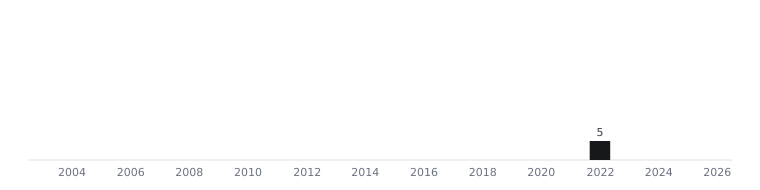
Citation items per year, by inspection date.
North Carolina · latest 90 days of OSHA records
236employers cited
Get notified the morning OSHA posts each new citation in North Carolina: the employer, the site address, the rules broken and the penalty.
OSHA records show Frit Car, Inc. at 2 sites in 2 states. Together they've had 12 inspections and $213,747 in current penalties.
We match records by employer name and industry, so these sites are likely the same company, not certainly. Franchises and subsidiaries can file under one name.
Included with any plan: the site-by-site record for all 2 sites, with repeat and willful violations and citations per year for the whole company. Already a subscriber? Sign in.
Incident on Nov 26, 1991: Employee burned in railroad tank car explosion/fire
On November 26, 1991, Employee #1 went down into a tank car referred to as a "mo lten sulfur" car (#TGIX 530) with his coworker to metalize the interior surface of the previously-cleaned car. Employee #1 started metalizing a section of the c ar with a metalizing gun (PG-550 Universal Flame spray system metalizer). The me talizer used oxygen, napolene gas, and aluminum powder. The aluminum spray was n ot adhering to the bottom of the car due to excessive moisture; therefore, Emplo yee #1 used the metalizer gun to heat the metal without the powder. Employee #1 indicated that heating the tank car with the metalizer didn't work. He turned of f the gas, left the metalizer inside the car, and then climbed out of the car. H e and his coworker got a propane torch, referred to as the "flame thrower." Empl oyee #1 used the flame thrower to preheat the car but the torch kept going out. Employee #1 came out of the tank with the propane torch. After break, at approxi mately 2:40 p.m., Employee #1 intended to use the Rosebud torch to preheat the t ank car. The Rosebud uses chemolene and oxygen gas from a manifold system. Emplo yee #1 lowered the Rosebud torch and line into the tank and his coworker removed the ladder and placed the ventilation air mover over the manway hole. Employee #1 picked up the metalizer gun and attached it to the side of the metalizing mac hine. He was approximately one foot from the manway hole. Employee #1's intentio ns were to light the metalizer gun and then to light the Rosebud from the flame of the metalizer gun. Employee #1 had not turned on the gas to the Rosebud torch . With the Rosebud in his left hand and the striker in his right hand, Employee #1 put the striker to the metalizer gun. An explosion occurred, throwing Employe e #1 approximately one foot. He sustained second- and third-degree burns to his hands, forearms, buttocks, neck, leg, and corner of his hip. He was hospitalized at Pitt Memorial Hospital in Greenville, NC.
Incident on Dec 27, 1988: Employee burned in fire in railroad tank car
Employee #1 was part of a five man crew removing the rubber lining of a railroad tank car to prepare the car for relining. The new process for removing the lini ng involved an employee on the outside of the car with a gas torch heating the c ar shell and another employee on the inside of the car scraping off the lining o f the shell, loosened by the heating. There were to be two teams heating and scr aping and a safety observer. Employee #1 began as the scraper for one pair. The scraper for the other pair had trouble fitting his respirator and had not yet go tten into the car to begin scraping. For some reason, the heater for the other p air began heating the shell of the car at the opposite end of the car, prior to his assigned scraper getting into the car. The heat torch caused the rubber lini ng at the end of the car to catch on fire because it was not being scraped clear of the heating. Although the safety observer yelled to warn him, Employee #1 su ffered burns on 70 percent of his body before getting out of the car.
From the Form 300A summaries employers file with OSHA each year. Rate = recordable cases per 100 full-time workers.
In 2017, the Bridgeton site logged 7 recordable injuries or illnesses among about 39 workers: 17.9 per 100 full-time workers, against a median of 1.6 for its industry.
Site and year
Workers
Cases
Days-away cases
Rate
Industry median
Bridgeton N.C.
Bridgeton · 2017
39
7
0
17.9
1.6
Wage and hour cases
Cases by the Labor Department's Wage and Hour Division since 2015: unpaid minimum wage or overtime, child labor, family leave and more.
Period reviewed
Violations
Workers owed
Back wages
Penalties
May 29, 2020 to Jun 5, 2020
Bridgeton
2
1
$139
$0
The rules behind these citations
Current text from the Code of Federal Regulations. Some citations were issued under older wording.
(2) Other substances—8-hour Time Weighted Averages. An employee's exposure to any substance in Table Z-1, the exposure limit of which is not preceded by a “C”, shall not exceed the 8-hour Time Weighted Average given for that substance in any 8-hour work shift of a 40-hour work week.
29 CFR 1910.1000(e)
(e) To achieve compliance with paragraphs (a) through (d) of this section, administrative or engineering controls must first be determined and implemented whenever feasible. When such controls are not feasible to achieve full compliance, protective equipment or any other protective measures shall be used to keep the exposure of employees to air contaminants within the limits prescribed in this section. Any equipment and/or technical measures used for this purpose must be approved for each particular use by a competent industrial hygienist or other technically qualified person. Whenever respirators are used, their use shall comply with 1910.134.
(b) Compressed gases. The in-plant handling, storage, and utilization of all compressed gases in cylinders, portable tanks, rail tankcars, or motor vehicle cargo tanks shall be in accordance with Compressed Gas Association Pamphlet P-1-1965, which is incorporated by reference as specified in § 1910.6.
Alert subscribers get notified of each newly cited employer in North Carolina the morning it is posted. See the alert plans.
Source: U.S. Department of Labor, OSHA enforcement data. A citation is OSHA's allegation; employers can contest it, and the status column shows where each item stands. Something wrong on this page? Tell us.