Herbert Malarkey Roofing Co has 23 OSHA inspections on record in Oregon, the first in 1985.
OSHA's last visit started on Aug 21, 2024 after an accident, in Portland, and the case has not closed yet.
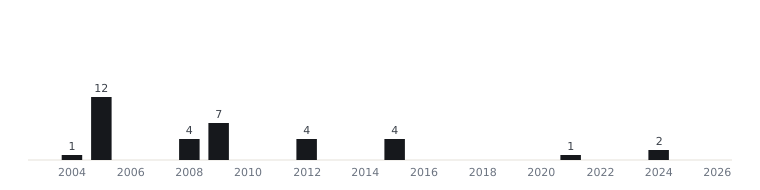
Across those inspections OSHA issued 103 citation items: 66 serious and 37 other-than-serious.
OSHA proposed $34,557 in penalties. After settlements and reviews the total is $33,382, down 3%.
Most often, OSHA cited 1910.95, noise (10 items).
For context, across all manufacturing employers the median penalty per cited inspection since 2015 is $4,500. Herbert Malarkey Roofing Co averages $4,761 over 3 cited inspections in that time.
Herbert Malarkey Roofing Co also files yearly injury logs with OSHA, summarized below.
Citation items per year, by inspection date.
Oregon · latest 90 days of OSHA records
388employers cited
Get notified the morning OSHA posts each new citation in Oregon: the employer, the site address, the rules broken and the penalty.
Checking a subcontractor, a client or your own company? Watch Herbert Malarkey Roofing Co and get notified the morning OSHA posts a new citation for it.
Incident on Apr 26, 2012: Roofer fractures arm in shingle delivery conveyer belt drum
On April 26, 2012, an employee was working for a roofing company. Bundles of shi ngles were being conveyed on either a belt or a rollcase. The narrative was not clear on that point. He reached into a drum at the end of the outfeed conveyor a t which bundles of shingles were delivered. Either his arm was caught in the dru m or it was caught be a roller in the rollcase. He sustained a fracture in his l ower arm.
Incident on Mar 27, 2011: Worker is burned when hot aspalt sprays in face
On March 27, 2011, Employee #1, a 45-year-old male with Herbert Malarkey Roofing Company, was changing out a gasket in a hot asphalt pump. He was sprayed in the face with hot asphalt. Employee #1 was hospitalized, as a result of this event.
No citations from this inspection.
Inspection 313952848 OPENED DEC 1, 2009Closed
Complaint · Partial · Health · 130 employees at the site · Closed Feb 10, 2010
Incident on Apr 23, 2008: Employee is burnt from hot asphalt
On April 23, 2008, Employee #1, of Herbert Malarkey Roofing Company, was unplugg ing a valve that contained hot asphalt. He was heating the valve with a torch to melt the plug and was not wearing a face shield or protective gloves. When the plug came out under pressure, Employee #1 was splashed in the hands and face wit h hot asphalt. He was hospitalized and treated for the burns he sustained.
Incident on Jan 10, 2008: Worker dislocates hip in fall from tanker truck
Employee #1 was on top of tanker truck and fell approximately 10 feet and 8 inch es to ground below. Employee #1 suffered facial injuries and dislocated hip in t his event.
Incident on Aug 25, 2005: Employee amputates finger on auger
On August 25, 2005, Employee #1, during preventative maintenance cleaning, reach ed into an auger discharge tube to clean it out. He was not aware that the auger was in operation and sustained lacerations to three fingers on his right hand a nd amputation of one of his fingers. He was hospitalized for his injuries.
Incident on Aug 1, 2004: Employee is burned in vapor explosion
At approximately 9:30 a.m. on August 1, 2004, Employee #1 was beginning the proc ess of transferring hot asphalt from a blending tank to a holding tank. The blen ding tank was nearly filled with hot asphalt which was heated to approximately 3 85 degrees Fahrenheit. Added into the hot asphalt were styrenic block copolymer pellets are which are known to form flammable hydrocarbons in the presence of he at above 250 degrees Fahrenheit. Employee #1 was standing on an enclosed platfor m above the tanks and was opening a transfer valve. A flash fire occurred in the blending tank, which had a large top hatch with an unlatched door. He was throw n backwards and struck the transfer pipe. Employee #1 was hospitalized with seco nd-degree burns on both forearms and the left side of his face. One possible ign ition source was an elevator lift and chute system that was not grounded and bon ded. Another possible ignition source was clumps of un-dissolved pellets that we re found conglomerated around the elevator chute entry point due to the upper ag itator paddle for the blending tank breaking off several days before the explosi on. Per the styrenic block copolymer MSDS, the pellets "contain residual unsatur ation which can undergo exothermic oxidative degradation. Accumulation of produc t in areas exposed to elevated temperatures for extended periods in air may resu lt in self-heating and auto-ignition". A third possible ignition source was the tank transfer valve wheel that was being opened by Employee #1 at the time that the fire occurred. One final factor was the blockage of the tank's vent, which w as 90-percent plugged with styrenic pellets, reducing the emergency relief capac ity.
Incident on Jul 8, 2002: Employee fractures arm in machine
On July 8, 2002, an employee fed a fiberglass sheet into a CWL machine. He got h is arm caught between the guide roll and the machine framework and was hospitali zed for treatment of a fractured arm.
Incident on Jun 1, 1993: Employee amputates hand while cleaning running rollers
On May 28, 1993, Employee #1 caught his right hand in the rollers of the cutter/ rewinder for 3-tab roofing shingles. He was being trained by an experienced oper ator and had been running the equipment for several hours. He was using a putty knife to scrape the accumulated asphalt from the upper roller while the machine was running at approximately 450 rpm. His hand was drawn into the rollers, which have cutting knives, and was amputated above the wrist.
From the Form 300A summaries employers file with OSHA each year. Rate = recordable cases per 100 full-time workers.
In 2025, the Portland site logged 3 recordable injuries or illnesses among about 250 workers: 0.9 per 100 full-time workers, against a median of 0.6 for its industry.
Site and year
Workers
Cases
Days-away cases
Rate
Industry median
Portland site
Portland · 2025
250
3
0
0.9
0.6
Herbert Malarkey Roofing Company
Portland · 2024
257
8
1
2.5
0.6
Herbert Malarkey Roofing Company: Portland, OR
Portland · 2021
252
15
9
6.3
0.6
Included with any plan: 7 more yearly logs from these sites, back to 2016, with each site's average rate over its latest three years. Already a subscriber? Sign in.
(e) Written hazard communication program. (1) Employers shall develop, implement, and maintain at each workplace, a written hazard communication program which at least describes how the criteria specified in paragraphs (f), (g), and (h) of this section for labels and other forms of warning, safety data sheets, and employee information and training will be met, and which also includes the following:
29 CFR 1910.1200(f)(5)(i)
(5) Transportation. (i) Chemical manufacturers, importers, or distributors shall ensure that each container of hazardous chemicals leaving the workplace is labeled, tagged, or marked in accordance with this section in a manner which does not conflict with the requirements of the Hazardous Materials Transportation Act (49 U.S.C. 5101 et seq.) and regulations issued under that Act by the Department of Transportation (49 CFR subtitle B).
29 CFR 1910.1200(h)(1)
(h) Employee information and training. (1) Employers shall provide employees with effective information and training on hazardous chemicals in their work area at the time of their initial assignment, and whenever a new chemical hazard the employees have not previously been trained about is introduced into their work area. Information and training may be designed to cover categories of hazards (e.g., flammability, carcinogenicity) or specific chemicals. Chemical-specific information must always be available through labels and safety data sheets.
29 CFR 1910.132 · Personal protective equipment, general requirements
Alert subscribers get notified of each newly cited employer in Oregon the morning it is posted. See the alert plans.
Source: U.S. Department of Labor, OSHA enforcement data. A citation is OSHA's allegation; employers can contest it, and the status column shows where each item stands. Something wrong on this page? Tell us.