Kiska Construction: OSHA inspections and violations
Bronx, New York · Highway, Street, and Bridge Construction · NAICS 237310
18inspections
28citation items
$47,332current penalties
Aug 23, 2018last inspection
OSHA has inspected Kiska Construction 18 times in New York since 1993.
The latest one began on Aug 23, 2018 on a referral, in Long Island City.
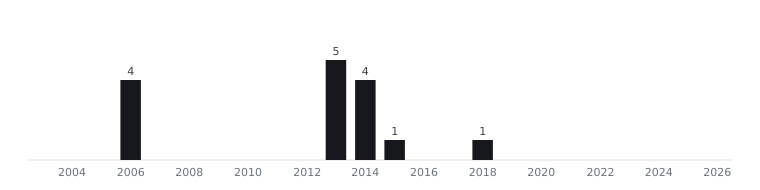
Those inspections ended with 28 citation items: 24 serious and 4 other-than-serious.
Penalties were first proposed at $59,417 and now stand at $47,332, 20% lower after settlements or reviews.
Arc welding and cutting comes up most often in these citations: 3 items under 1926.351.
How that compares: the median penalty per cited inspection for construction employers since 2015 is $3,079, and Kiska Construction averages $3,886 (2 cited inspections).
Kiska Construction also files yearly injury logs with OSHA, summarized below.
It reported 2 severe injuries to OSHA since 2015.
Citation items per year, by inspection date.
Want to know if OSHA cites Kiska Construction again? Add it to a watchlist and we will email you the morning the citation shows up.
Incident on Aug 3, 2017: Worker painting bridge falls and fractures leg
At 12:15 p.m. on August 3, 2017, Employee #1, employed by a construction company, was engaged in painting a bridge. Employee #1 fell. Emergency services were called, and Employee #1 was transported to the hospital. He was admitted and treated for a fractured leg. The subsequent investigation determined that Employee #1 was not wearing fall protection at the time of the fall.
No citations from this inspection.
Inspection 340855485 OPENED JUL 28, 2015Closed
Complaint · No inspection · Safety · 1 employee at the site · Closed Feb 1, 2016
From the Form 300A summaries employers file with OSHA each year. Rate = recordable cases per 100 full-time workers.
In 2019, the Long Island City site logged 1 recordable injury or illness among about 57 workers: 2.6 per 100 full-time workers, against a median of 2.2 for its industry. Those cases cost 180 days away from work.
Site and year
Workers
Cases
Days-away cases
Rate
Industry median
Kiska Construction - Marine Parkway - Gil Hodges Bridge
Long Island City · 2019
57
1
1
2.6
2.2
Kiska Construction - Main Office
Long Island City · 2019
22
0
0
0.0
2.2
Kiska Construction Bronx Whitestone Bridge
Long Island City · 2019
50
2
2
16.8
2.2
Kiska Construction 9 Stations
Long Island City · 2019
61
0
0
0.0
2.2
Marine Parkway Bridge
Breezy Point · 2017
92
5
4
4.2
2.2
62 Bridges
Bronx · 2017
42
1
1
1.8
2.2
Kiska Construction Inc.
Long Island City · 2016
246
21
14
6.3
2.2
Severe injury reports
Employers must report any work-related amputation, in-patient hospitalization or loss of an eye to OSHA within 24 hours. 2 reports on file.
Aug 3, 2017, Breezy Point: Hospitalization · dislocation of joints · shoulder(s), including clavicle(s), scapula(e)
An employee fell approximately 52 feet to the water below while painting a bridge, dislocating a shoulder.
An employee was injured while welding a joint on a field plate. When the joint was re-lifted, the weld broke, and a field plate landed on his left foot. The resulting fractures required surgery.
The rules behind these citations
Current text from the Code of Federal Regulations. Some citations were issued under older wording.
(2) Within twenty-four (24) hours after the in-patient hospitalization of one or more employees or an employee's amputation or an employee's loss of an eye, as a result of a work-related incident, you must report the in-patient hospitalization, amputation, or loss of an eye to OSHA.
(h) Employee information and training. (1) Employers shall provide employees with effective information and training on hazardous chemicals in their work area at the time of their initial assignment, and whenever a new chemical hazard the employees have not previously been trained about is introduced into their work area. Information and training may be designed to cover categories of hazards (e.g., flammability, carcinogenicity) or specific chemicals. Chemical-specific information must always be available through labels and safety data sheets.
(1) The test instrument must have an effective audio-warning device, or a visual-warning device in the form of a screen tracing, that indicates when the test subject fails to hold his or her breath during the test. The test must be terminated and restarted from the beginning when the test subject fails to hold his or her breath during the test. The test subject then may be refitted and retested.
Source: U.S. Department of Labor, OSHA enforcement data. A citation is OSHA's allegation; employers can contest it, and the status column shows where each item stands. Something wrong on this page? Tell us.