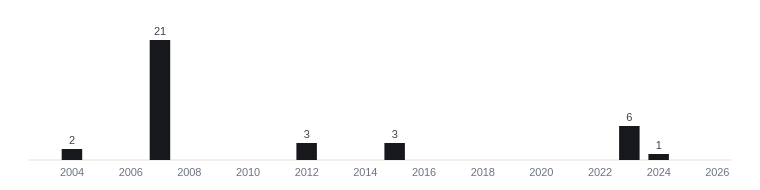
Since 1982, OSHA inspectors have visited Sea Watch International, Ltd. in Delaware 19 times.
The most recent inspection opened on Feb 2, 2024 on a referral, in Milford.
In all, OSHA issued 73 citation items: 48 serious and 25 other-than-serious.
The proposed penalties came to $120,022; today they stand at $92,662, 23% less.
The rule cited most here is 1910.1200 (hazard communication), 11 times.
Among manufacturing employers, the typical cited inspection since 2015 ends with a $4,870 penalty. Sea Watch International, Ltd. averages $12,135 across 4 cited inspections.
Sea Watch International, Ltd. also files yearly injury logs with OSHA, summarized below.
It reported 3 severe injuries to OSHA since 2015.
Citation items per year, by inspection date.
Delaware · latest 90 days of OSHA records
32employers cited
Get notified the morning OSHA posts each new citation in Delaware: the employer, the site address, the rules broken and the penalty.
Checking a subcontractor, a client or your own company? Watch Sea Watch International, Ltd. and get notified the morning OSHA posts a new citation for it.
OSHA records show Sea Watch International, Ltd. at 3 sites in 3 states. Together they've had 36 inspections and $230,007 in current penalties.
We match records by employer name and industry, so these sites are likely the same company, not certainly. Franchises and subsidiaries can file under one name.
Included with any plan: the site-by-site record for all 3 sites, with repeat and willful violations and citations per year for the whole company. Already a subscriber? Sign in.
From the Form 300A summaries employers file with OSHA each year. Rate = recordable cases per 100 full-time workers.
In 2025, the Milford site logged 9 recordable injuries or illnesses among about 173 workers: 5.7 per 100 full-time workers, against a median of 4.8 for its industry. Those cases cost 21 days away from work.
Site and year
Workers
Cases
Days-away cases
Rate
Industry median
Milford site
Milford · 2025
173
9
3
5.7
4.8
Included with any plan: 5 more yearly logs from these sites, back to 2016, with each site's average rate over its latest three years. Already a subscriber? Sign in.
Employers must report any work-related amputation, in-patient hospitalization or loss of an eye to OSHA within 24 hours. 3 reports on file.
Jan 29, 2024, Milford: Hospitalization · poison, toxic, or allergenic effects other respiratory · body systems
An employee was exposed to chlorine dioxide, an anti-bacterial chemical, when processing seafood in two mixing tanks. The gas permeated the room and the employee suffered upper respiratory distress.
Aug 31, 2023, Milford: Hospitalization · heat (thermal) burns, unspecified · multiple body parts, n.e.c.
An employee was cleaning a clam tank in the shucking room when a valve was opened and hot water was released. The water bounced off an adjacent wall and contacted the employee, causing burns to their neck, left shoulder, and the back of their left arm.
An employee was working for a canning operation when her left hand contacted the conveyor belt on the can track, resulting in a partial amputation of her middle finger and an avulsion to her ring finger.
The rules behind these citations
Current text from the Code of Federal Regulations. Some citations were issued under older wording.
(2) Design, construction, and capacity of containers—(i) General. Only approved containers and portable tanks shall be used. Metal containers and portable tanks meeting the requirements of and containing products authorized by chapter I, title 49 of the Code of Federal Regulations (regulations issued by the Hazardous Materials Regulations Board, Department of Transportation), shall be deemed to be acceptable.
(b) Miscellaneous provisions—(1) General hazard. No person shall store, handle, or transport explosives or blasting agents when such storage, handling, and transportation of explosives or blasting agents constitutes an undue hazard to life.
29 CFR 1910.109(c)(1)(i)
(c) Storage of explosives—(1) General provisions. (i) All Class A, Class B, Class C explosives, and special industrial explosives, and any newly developed and unclassified explosives, shall be kept in magazines which meet the requirements of this paragraph.
29 CFR 1910.110 · Storage and handling of liquefied petroleum gases
29 CFR 1910.120 · Hazardous waste operations and emergency response
Source: U.S. Department of Labor, OSHA enforcement data. A citation is OSHA's allegation; employers can contest it, and the status column shows where each item stands. Something wrong on this page? Tell us.