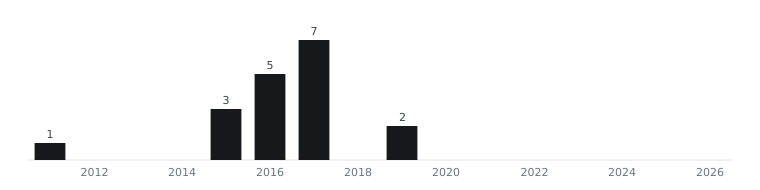
OSHA has inspected Sweet Specialty Solutions, LLC 9 times in Illinois since 2011.
The latest one began on Dec 23, 2019 after a fatality or catastrophe, in Woodridge.
Those inspections ended with 18 citation items: 13 serious, 3 repeat and 2 other-than-serious.
Penalties were first proposed at $177,472 and now stand at $107,786, 39% lower after settlements or reviews.
Lockout/tagout comes up most often in these citations: 5 items under 1910.147.
How that compares: the median penalty per cited inspection for manufacturing employers since 2015 is $4,875, and Sweet Specialty Solutions, LLC averages $21,067 (5 cited inspections).
1 inspection on this page followed a fatal incident.
Sweet Specialty Solutions, LLC also files yearly injury logs with OSHA, summarized below.
It reported 1 severe injury to OSHA since 2015.
Citation items per year, by inspection date.
Illinois · latest 90 days of OSHA records
426employers cited
Get notified the morning OSHA posts each new citation in Illinois: the employer, the site address, the rules broken and the penalty.
Checking a subcontractor, a client or your own company? Watch Sweet Specialty Solutions, LLC and get notified the morning OSHA posts a new citation for it.
Incident on Dec 23, 2019 (fatal): Employee is crushed when struck by falling container of suga
At 10:15 a.m. on December 23, 2019, an employee was operating a forklift in reverse between two single rows of ten tiers when he struck the stacked bulk sugar containers and one started to leak. The employee attempted to patch the container and went to collect some more material. When he returned and began to apply his patch, the higher container that was supported by the lower fell and struck the employee, crushing and killing him.
29 CFR 1910.132(a) · Personal protective equipment, general requirements
Serious
$3,500
$2,450
Sep 1, 2011
Final
Injury and illness logs
From the Form 300A summaries employers file with OSHA each year. Rate = recordable cases per 100 full-time workers.
In 2025, the Lemont site logged 1 recordable injury or illness among about 77 workers: 1.1 per 100 full-time workers, against a median of 4.6 for its industry.
Site and year
Workers
Cases
Days-away cases
Rate
Industry median
Sweet Specialty Solutions
Lemont · 2025
77
1
0
1.1
4.6
Included with any plan: 4 more yearly logs from these sites, back to 2016, with each site's average rate over its latest three years. Already a subscriber? Sign in.
An employee was operating a sugar mill and partially amputated the right index finger.
The rules behind these citations
Current text from the Code of Federal Regulations. Some citations were issued under older wording.
29 CFR 1910.132 · Personal protective equipment, general requirements
29 CFR 1910.132(a)
(a) Application. Protective equipment, including personal protective equipment for eyes, face, head, and extremities, protective clothing, respiratory devices, and protective shields and barriers, shall be provided, used, and maintained in a sanitary and reliable condition wherever it is necessary by reason of hazards of processes or environment, chemical hazards, radiological hazards, or mechanical irritants encountered in a manner capable of causing injury or impairment in the function of any part of the body through absorption, inhalation or physical contact.
(7) Training and communication. (i) The employer shall provide training to ensure that the purpose and function of the energy control program are understood by employees and that the knowledge and skills required for the safe application, usage, and removal of the energy controls are acquired by employees. The training shall include the following:
29 CFR 1910.147(d)
(d) Application of control. The established procedures for the application of energy control (the lockout or tagout procedures) shall cover the following elements and actions and shall be done in the following sequence:
Alert subscribers get notified of each newly cited employer in Illinois the morning it is posted. See the alert plans.
Source: U.S. Department of Labor, OSHA enforcement data. A citation is OSHA's allegation; employers can contest it, and the status column shows where each item stands. Something wrong on this page? Tell us.