Koch & Co., Inc. has 11 OSHA inspections on record in Kansas, the first in 1998.
OSHA's last visit started on Jan 19, 2024 after a complaint, in Topeka.
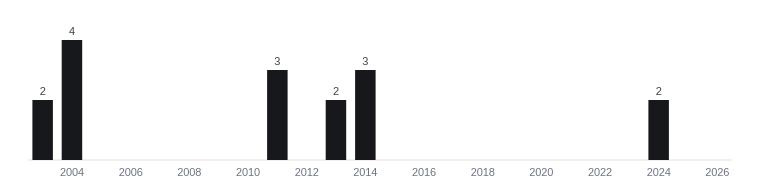
Across those inspections OSHA issued 17 citation items: 9 serious and 8 other-than-serious.
OSHA proposed $48,277 in penalties. After settlements and reviews the total is $33,899, down 30%.
Most often, OSHA cited 1910.212, machine guarding (5 items).
For context, across all manufacturing employers the median penalty per cited inspection since 2015 is $3,600. Koch & Co., Inc. averages $17,054 over 1 cited inspection in that time.
Koch & Co., Inc. also files yearly injury logs with OSHA, summarized below.
It reported 6 severe injuries to OSHA since 2015.
Citation items per year, by inspection date.
Kansas · latest 90 days of OSHA records
48employers cited
Get notified the morning OSHA posts each new citation in Kansas: the employer, the site address, the rules broken and the penalty.
From the Form 300A summaries employers file with OSHA each year. Rate = recordable cases per 100 full-time workers.
In 2025, the Seneca site logged 12 recordable injuries or illnesses among about 285 workers: 4.8 per 100 full-time workers, against a median of 4.6 for its industry. Those cases cost 28 days away from work.
Site and year
Workers
Cases
Days-away cases
Rate
Industry median
Seneca Cabinets
Seneca · 2025
285
12
2
4.8
4.6
Hiawatha Cabinets
Hiawatha · 2025
147
6
1
4.4
4.6
Seneca Frameless
Seneca · 2025
114
1
0
0.9
4.6
Seneca Door
Seneca · 2025
69
3
0
4.7
4.6
Seneca Midland
Seneca · 2025
61
1
1
1.6
4.6
Topeka Parts
Topeka · 2025
27
1
0
3.3
4.6
Topeka Molding
Topeka · 2025
20
1
0
4.9
4.6
Topeka Correctional Facility - TCF
Topeka · 2025
21
2
1
10.5
4.6
Included with any plan: 74 more yearly logs from these sites, back to 2016, with each site's average rate over its latest three years. Already a subscriber? Sign in.
An employee knelt to look at a machine. They stood up and felt a pop in their right knee. Later in the day, the employee experienced swelling in their knee, resulting in hospitalization for a ruptured bursa.
Jan 27, 2024, Topeka: Hospitalization, amputation · amputations involving bone loss · other finger(s) n.e.c.
An employee was feeding boards into a six-head molder. The employee opened the machine to clear a small piece of wood, and their right index finger contacted a moving blade. The finger was amputated at the lower knuckle. The machine was running at the time of the incident.
An employee was running doors through an edging machine. Their fingernail and some skin on the right middle finger was lost, requiring surgical amputation at the first knuckle. The right index finger was also lacerated.
May 29, 2020, Seneca: Hospitalization · fractures · hip(s)
An employee tripped and fell on the concrete floor while carrying a flat piece of cardboard to be recycled. There was a score in the concrete at the site of the fall but nothing was sticking up. She sustained a fractured left hip requiring surgery.
An employee on the north end of the veneer-cutting area was cutting 80-inch by 5.5-inch veneer on a table saw. The employee grabbed the cut from the front of the table saw while it was running. The blade caught the glove on the employee's left index finger and amputated the finger at or near the first knuckle. All guards were in place at the time.
The rules behind these citations
Current text from the Code of Federal Regulations. Some citations were issued under older wording.
(i) The spraying operations except electrostatic spraying operations shall be so designed, installed and maintained that the average air velocity over the open face of the booth (or booth cross section during spraying operations) shall be not less than 100 linear feet per minute. Electrostatic spraying operations may be conducted with an air velocity over the open face of the booth of not less than 60 linear feet per minute, or more, depending on the volume of the finishing material being applied and its flammability and explosion characteristics. Visible gauges or audible alarm or pressure activated devices shall be installed to indicate or insure that the required air velocity is maintained. Filter rolls shall be inspected to insure proper replacement of filter media.
(h) Employee information and training. (1) Employers shall provide employees with effective information and training on hazardous chemicals in their work area at the time of their initial assignment, and whenever a new chemical hazard the employees have not previously been trained about is introduced into their work area. Information and training may be designed to cover categories of hazards (e.g., flammability, carcinogenicity) or specific chemicals. Chemical-specific information must always be available through labels and safety data sheets.
(4) Energy control procedure. (i) Procedures shall be developed, documented and utilized for the control of potentially hazardous energy when employees are engaged in the activities covered by this section.
29 CFR 1910.178 · Forklifts and other powered industrial trucks
Alert subscribers get notified of each newly cited employer in Kansas the morning it is posted. See the alert plans.
Source: U.S. Department of Labor, OSHA enforcement data. A citation is OSHA's allegation; employers can contest it, and the status column shows where each item stands. Something wrong on this page? Tell us.