OSHA has inspected Massachusetts Electric Company 30 times in Massachusetts since 1975.
The latest one began on Nov 6, 2025 on a referral, in Attleboro.
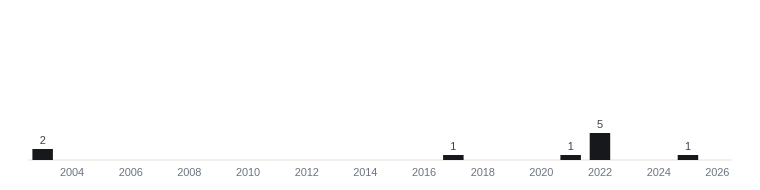
Those inspections ended with 52 citation items: 20 serious, 3 willful, 1 repeat and 28 other-than-serious.
Penalties were first proposed at $184,366 and now stand at $124,862, 32% lower after settlements or reviews.
Electric power generation, transmission, and distribution comes up most often in these citations: 11 items under 1910.269.
How that compares: the median penalty per cited inspection for utility employers since 2015 is $0, and Massachusetts Electric Company averages $17,752 (4 cited inspections).
3 inspections on this page followed a fatal incident.
Massachusetts Electric Company also files yearly injury logs with OSHA, summarized below.
It reported 1 severe injury to OSHA since 2015.
Citation items per year, by inspection date.
Massachusetts · latest 90 days of OSHA records
256employers cited
Get notified the morning OSHA posts each new citation in Massachusetts: the employer, the site address, the rules broken and the penalty.
Checking a subcontractor, a client or your own company? Watch Massachusetts Electric Company and get notified the morning OSHA posts a new citation for it.
Incident on May 26, 2022 (fatal): Employee is killed by electric arc
At 12:30 a.m. on May 26, 2022, an employee was tying an electrical line to a transformer. A 13,000-volt electric arc was produced, and the employee sustained an electric shock. The employee was killed.
Incident on Aug 20, 2021: Employee sustains multiple injuries due to arc flash power l
At 9:30 a.m. on August 20, 2021, an employee working as a lineman for an electrical power generation company was part of a crew working on high voltage power lines. The crew was installing a low side cutout lead to the conductor on the road side phase. They were not aware of how to sufficiently cover the exposed live equipment with adequate lengths of protective line hoses and blankets prior to commencing with making low side connections. Additionally, the crew did not position themselves on the outside of the roadside line to minimize the arc flash potential posed by the center phase line. The employee was in the process of installing solid blades disconnects to tie two separate feeders together. The employee positioned himself between the center and road side phase in order to install a cut out when an arc flash occurred. The employee was hospitalized to treat chest, ear, and head injuries due to electrical shock, burns and the effects of the arc blast.
Incident on Sep 13, 2003: Employee is injured in electric arc
On September 13, 2003, an employee received burns to his hand when a Greelee met er malfunctioned causing an electrical arch while trying to get a test reading f rom a 480 volt panel. The employee had no Class O rubber gloves on at the time o f the incident. The employee was hospitalized and treated for burns.
Citation and rule
Type
Proposed
Current
Issued
Status
Citation 1, item 2
29 CFR 1910.269(c) · Electric power generation, transmission, and distribution
Serious
$5,000
$3,500
Mar 8, 2004
Final
22 older inspections
Inspection 306095662 OPENED APR 23, 2003Closed
Referral · Partial · Safety · 2,000 employees at the site · Closed Jan 30, 2004
Incident on Apr 22, 2003: Employee's head is injured by cable pulling rig
On April 22, 2003, Employee #1 was a splicer for Massachusetts Electric, a Natio nal Grid Company. He was working in a manhole, removing and replacing a failed 1 5 KV cable. The cable was being pulled by a pickup truck. Employee #1 was injure d when the rigging system struck him in the head. He was hospitalized for treatm ent of an unspecified injury to his head.
Incident on Jan 3, 2001 (fatal): Burn - electrical fault in circuit breaker
Four electric utility employees were servicing a circuit breaker in a substation . The senior member of the crew was instructing two of the employees in performi ng routine service on a circuit breaker. The fourth employee was assisting. Befo re performing the service, the lead worker called the dispatch office for permis sion to deenergize circuit breaker #6P3. The dispatcher provided him with the pr ocedural steps for deenergizing the circuit breaker and permission to perform th e service. With circuit breaker #6P3 deenergized and grounded, the lead worker a nd the two employees he was instructing began working on circuit breaker #6C3, w hich was still energized at 4160 volts. The fourth employee left the building to retrieve tools from his truck. On his return to the building through the front door, he heard an electric arc resulting from his colleagues' contact with energ ized parts of circuit breaker #6C3. A fire accompanied the electric arc and engu lfed the three employees who had been working on the circuit breaker. With the e ntrance blocked by flames, the fourth employee returned to his vehicle and radio ed for help. He grabbed a fire extinguisher and went back toward the building. O ne of the three employees inside exited the building with her clothes on fire. T he fourth employee smothered the flames on her clothing with his sweater. The le ad worker exited through the rear door, and the last employee exited through the front door. The clothing of both of these employees was also burning. Passersby assisted in extinguishing the employees' burning clothing. Emergency medical se rvice personnel arrived and transported the three injured employees to a hospita l for treatment. The lead worker died of his injuries. (The other two injured em ployees were not listed on injury lines on the original form.)
Incident on Jun 11, 1992: Electric shock - direct contact with overhead line
TWO POWER LINE WORKERS WERE USING LIVE-LINE TOOLS TO REPLACE DAMAGED INSULATORS ON A 115-KILOVOLT OVERHEAD POWER LINE. ALTHOUGH THIS TASK WAS INCLUDED IN THEIR JOB DESCRIPTIONS, IT WAS NOT ONE THAT WAS PERFORMED ON A ROUTINE BASIS. ONE OF T HE EMPLOYEES WAS TWISTING A HOT STICK TO CLOSE A CLAMP ON A BLOCK AND TACKLE. TH E CLAMP WAS HOLDING THE BLOCK AND TACKLE ONTO A PHASE CONDUCTOR. HE WAS BEING SU PERVISED BY THE OTHER WORKER, WHO WAS POSITIONED HIGHER ON THE UTILITY POLE. A S WIVEL RING AT THE CONDUCTOR END OF THE HOT STICK BECAME WRAPPED AROUND THE STICK . THE EMPLOYEE HOLDING THE TOOL REACHED OUT TO UNTANGLE THE BLOCK AND TACKLE, AN D HIS ARM ENTERED WITHIN THE 3-FOOT, 4-INCH MINIMUM APPROACH DISTANCE FOR THE PO WER LINE. AN ELECTRIC ARC OCCURRED, AND BOTH EMPLOYEES WERE SEVERELY BURNED. THE EMPLOYEE WHO HAD CAUSED THE ARC ALSO RECEIVED AN ELECTRIC SHOCK. THE EMPLOYEES WERE HOSPITALIZED FOR THEIR INJURIES.
From the Form 300A summaries employers file with OSHA each year. Rate = recordable cases per 100 full-time workers.
In 2025, the Worcester site logged 8 recordable injuries or illnesses among about 497 workers: 1.8 per 100 full-time workers, against a median of 1.0 for its industry. Those cases cost 195 days away from work.
Site and year
Workers
Cases
Days-away cases
Rate
Industry median
Worc Southbridge Street-MA61
Worcester · 2025
497
8
4
1.8
1.0
Malden-MA63
Malden · 2025
202
6
1
3.3
1.0
Hopedale-MA14
Hopedale · 2025
161
5
1
3.3
1.0
Monson-MA23
Monson · 2025
54
2
1
4.1
1.0
Northampton-MA32
Northampton · 2025
53
1
0
2.1
1.0
North Andover-Haverhill-MA29
Haverhill · 2025
37
0
0
0.0
1.0
Attleboro-MA04
Attleboro · 2025
28
0
0
0.0
1.0
Tewksbury-MA47
Tewksbury · 2025
25
1
0
3.7
1.0
Included with any plan: 44 more yearly logs from these sites, back to 2016, with each site's average rate over its latest three years. Already a subscriber? Sign in.
Employers must report any work-related amputation, in-patient hospitalization or loss of an eye to OSHA within 24 hours. 1 report on file.
Aug 10, 2022, Worcester: Amputation · amputations · fingertip(s)
An employee was caught by a winch cable, which pinched his finger against its roller. The fingertip was later amputated.
The rules behind these citations
Current text from the Code of Federal Regulations. Some citations were issued under older wording.
29 CFR 1903.2 · Posting of notice; availability of the Act, regulations and applicable standards
29 CFR 1904.2 · Partial exemption for establishments in certain industries
29 CFR 1904.2(b)(2)
(2) How do I determine the correct NAICS code for my company or for individual establishments? You can determine your NAICS code by using one of three methods, or you may contact your nearest OSHA office or State agency for help in determining your NAICS code:
(h) Employee information and training. (1) Employers shall provide employees with effective information and training on hazardous chemicals in their work area at the time of their initial assignment, and whenever a new chemical hazard the employees have not previously been trained about is introduced into their work area. Information and training may be designed to cover categories of hazards (e.g., flammability, carcinogenicity) or specific chemicals. Chemical-specific information must always be available through labels and safety data sheets.
29 CFR 1910.132 · Personal protective equipment, general requirements
29 CFR 1910.132(a)
(a) Application. Protective equipment, including personal protective equipment for eyes, face, head, and extremities, protective clothing, respiratory devices, and protective shields and barriers, shall be provided, used, and maintained in a sanitary and reliable condition wherever it is necessary by reason of hazards of processes or environment, chemical hazards, radiological hazards, or mechanical irritants encountered in a manner capable of causing injury or impairment in the function of any part of the body through absorption, inhalation or physical contact.
Alert subscribers get notified of each newly cited employer in Massachusetts the morning it is posted. See the alert plans.
Source: U.S. Department of Labor, OSHA enforcement data. A citation is OSHA's allegation; employers can contest it, and the status column shows where each item stands. Something wrong on this page? Tell us.