Rocky Mountain Prestress: OSHA inspections and violations
Denver, Colorado · Other Concrete Product Manufacturing · NAICS 327390
28inspections
58citation items
$82,703current penalties
May 5, 2017last inspection
OSHA has inspected Rocky Mountain Prestress 28 times in Colorado since 1978.
The latest one began on May 5, 2017 on a referral, in Greeley.
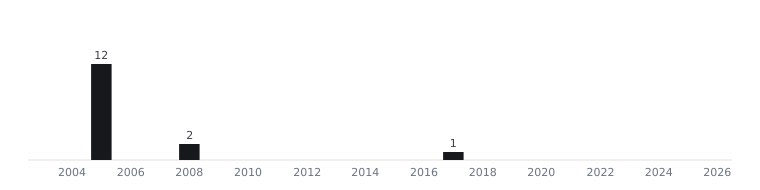
Those inspections ended with 58 citation items: 17 serious, 1 willful and 40 other-than-serious.
Penalties were first proposed at $114,615 and now stand at $82,703, 28% lower after settlements or reviews.
Overhead and gantry cranes comes up most often in these citations: 7 items under 1910.179.
How that compares: the median penalty per cited inspection for manufacturing employers since 2015 is $4,500, and Rocky Mountain Prestress averages $10,000 (1 cited inspection).
2 inspections on this page followed a fatal incident.
Rocky Mountain Prestress also files yearly injury logs with OSHA, summarized below.
It reported 3 severe injuries to OSHA since 2015.
Citation items per year, by inspection date.
Colorado · latest 90 days of OSHA records
138employers cited
Get notified the morning OSHA posts each new citation in Colorado: the employer, the site address, the rules broken and the penalty.
Incident on May 3, 2017: Employee falls 19 feet while using an improperly installed p
At 7:45 a.m. on May 3, 2017, an employee was walking along the side of an unprotected precast beam. The employee attempted to surpass the 30 foot maximum length of the self retractable lanyard. The employee was pulled off the edge of the unprotected beam. The employee fell 19 feet to a concrete surface. The employee sustained face lacerations, bruises, and a fractured wrist and fractured neck. The wrist fracture required surgery.
Incident on Oct 31, 2008 (fatal): Employee is struck by pre-cast concrete slab and dies
At approximately 7:10 a.m. on October 31, 2008, Employee #1 and a coworker were placing a precast concrete slab that weighed approximately 5,000 lb into a metal racking system. The precast concrete slab was supported by a travel lift. The c oworker was working from inside the catwalk in the metal racking system as Emplo yee #1 worked outside the catwalk. Employee #1 was located in between the slab b eing moved and another stationary stored concrete slab. The concrete slab that w as being moved, unexpectedly shifted and struck Employee #1 as he occupied the o utside of the catwalk. He was transported to a hospital where succumbed to his i njuries and died.
Incident on Oct 16, 2000 (fatal): Employee is killed when run over by crane
At approximately 12:00 p. m., Employee #1, Employee #2, and Employee #3 were inv olved with the task of moving two bundles of wire 4 x 4 mesh from a stockpile to an area where it would be placed inside precast concrete forms. A Drott brand 5 00AI travelift was being used to remove the bundles of mesh which were being pla ce onto a "mesh wagon" for transport to the precast beds. Employee #1 was a grou nd spotter, Employee #2 was the crane operator, and Employee #3 was as a lead su pervisor overseeing the materials which were being placed into the precast form. Employee #3 notified Employee #2 that more mesh was needed from a pile approxim ately 100 ft away. Employees #1, Employee #2, and Employee #3 went to the large stockpile (approximate 8 ft high) area where the wire mesh was to be moved from. The plan was to move two loads in total from the stockpile to the mesh wagon. E mployee #1 and Employee #3 attached the rigging of the Travel lift crane to the first bundle. Employee #2 transported/moved the rubber tire gantry crane to the mesh wagon and placed the first load on to the wagon. While Employee #2 drove fo rward to pick the second load of mesh, the wheel on the opposite side of the ope rator cab struck and ran over Employee #1. Employee #1 died. At approximately 4: 00 p.m. on January 8, 2001, Employee #1, who was the operator of a concrete tran sport vehicle also known as a sidewinder, was preparing to wash out wet residual concrete from it's hopper and trough area. Employee #1 drove to the wash rock a nd removed the protective covers to expose the trough to expose the auger mechan ism. Employee #1 then started the engine and engaged the auger control to begin rotating it. While using a water hose, Employee #1 began washing the residue con crete from both the hopper and trough area. While employee was standing above th e rotating auger assembly washing the auger, he stepped/slipped into the rotatin g auger. Employee #1 suffered an amputation above his knee. He was hospitalized with amputation above his knee.
From the Form 300A summaries employers file with OSHA each year. Rate = recordable cases per 100 full-time workers.
In 2019, the Denver site logged 0 recordable injuries or illnesses among about 145 workers: 0.0 per 100 full-time workers, against a median of 3.4 for its industry.
Site and year
Workers
Cases
Days-away cases
Rate
Industry median
Rocky Mountain Prestress
Denver · 2019
145
0
0
0.0
3.4
Rocky Mountain Prestress-Field
Denver · 2019
59
0
0
0.0
3.4
Rocky Mountain Prestress-Structural
Denver · 2018
108
0
0
0.0
3.4
Rocky Mountain Prestress-Architectural
Denver · 2018
48
1
0
1.7
3.4
Included with any plan: 7 more yearly logs from these sites, back to 2016, with each site's average rate over its latest three years. Already a subscriber? Sign in.
Employers must report any work-related amputation, in-patient hospitalization or loss of an eye to OSHA within 24 hours. 3 reports on file.
Aug 25, 2017, Denver: Amputation · amputations · fingertip(s)
An employee was working with a coworker to build concrete forms that consist of a metal plate and metal rails held together with magnets. They were moving the rails when the magnets pulled the pieces together, pinching and amputating the injured employee's right ring fingertip.
May 3, 2017, Greeley: Hospitalization · soreness, pain, hurt-nonspecified injury · multiple body parts, n.e.c.
An employee was walking on a fifth floor precast beam between two columns when he fell off the edge and landed on the concrete fourth floor, injuring the left side of his face and his right thumb. He was hospitalized.
Dec 18, 2015, Aurora: Amputation · amputations · fingertip(s)
On 12/18/15 at approximately 9:30am, two employees were offloading pre-cast concrete stairs off of a truck with a link belt crane at a new commercial construction project. As they unloaded the third piece, one of the employees was using both hands to guide the piece to the ground. The suspended stair came into contact with a stair on the ground. As the pieces came together, the employee's left…
The rules behind these citations
Current text from the Code of Federal Regulations. Some citations were issued under older wording.
29 CFR 1904.2 · Partial exemption for establishments in certain industries
(2) Initial determination. Each employer who has a workplace or work operation covered by this standard shall determine if any exployee may be exposed to lead at or above the action level.
29 CFR 1910.1025(i)(1)(i)
(i) Hygiene facilities and practices. (1) The employer shall assure that in areas where employees are exposed to lead above the PEL, without regard to the use of respirators, food or beverage is not present or consumed, tobacco products are not present or used, and cosmetics are not applied, except in change rooms, lunchrooms, and showers required under paragraphs (i)(2) through (i)(4) of this section.
29 CFR 1910.1025(i)(1)(ii)
(i) Hygiene facilities and practices. (1) The employer shall assure that in areas where employees are exposed to lead above the PEL, without regard to the use of respirators, food or beverage is not present or consumed, tobacco products are not present or used, and cosmetics are not applied, except in change rooms, lunchrooms, and showers required under paragraphs (i)(2) through (i)(4) of this section.
29 CFR 1910.132 · Personal protective equipment, general requirements
Alert subscribers get notified of each newly cited employer in Colorado the morning it is posted. See the alert plans.
Source: U.S. Department of Labor, OSHA enforcement data. A citation is OSHA's allegation; employers can contest it, and the status column shows where each item stands. Something wrong on this page? Tell us.