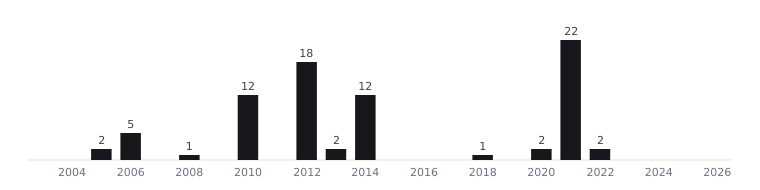
Since 2003, OSHA inspectors have visited Valley Proteins, Inc. in North Carolina 25 times.
The most recent inspection opened on Dec 5, 2022 on a referral, in Wadesboro.
In all, OSHA issued 79 citation items: 47 serious and 32 other-than-serious.
The proposed penalties came to $207,054; today they stand at $154,210, 26% less.
The rule cited most here is 1910.147 (lockout/tagout), 8 times.
Among manufacturing employers, the typical cited inspection since 2015 ends with a $4,875 penalty. Valley Proteins, Inc. averages $17,000 across 6 cited inspections.
3 inspections on this page followed a fatal incident.
Valley Proteins, Inc. also files yearly injury logs with OSHA, summarized below.
Citation items per year, by inspection date.
North Carolina · latest 90 days of OSHA records
234employers cited
Get notified the morning OSHA posts each new citation in North Carolina: the employer, the site address, the rules broken and the penalty.
OSHA records show Valley Proteins, Inc. at 17 sites in 6 states. Together they've had 73 inspections and $241,614 in current penalties.
We match records by employer name and industry, so these sites are likely the same company, not certainly. Franchises and subsidiaries can file under one name.
Included with any plan: the site-by-site record for all 17 sites, with repeat and willful violations and citations per year for the whole company. Already a subscriber? Sign in.
Incident on Sep 12, 2021 (fatal): Two employees are killed when overcome by hydrogen sulfide
On September 12, 2021, two employees entered a pit to work on unjamming an auger. The employees removed the cover of the auger, at which time a large amount of hydrogen sulfide was released. The employees were both overcome by the gas. The employees were found over an hour later face down in the pit and were pronounced dead at the scene.
Incident on Sep 16, 2016 (fatal): Employee falls off trailer and is killed
On September 16, 2016, an employee accessed the top of a Summit 1995 open top trailer via a four-rung fixed ladder on the side of the trailer, to retrieve a tarp that had fallen inside the trailer. The employee had one foot on the top of the trailer and another on the top rung of the fixed ladder. The employee fell 8 feet 2 inches and was killed.
No citations from this inspection.
17 older inspections
Inspection 341301539 OPENED MAR 4, 2016Closed
Follow-up · Partial · Health · 68 employees at the site · Closed Feb 14, 2017
Incident on Sep 3, 2013: Employee suffers facial burns when sprayed with degreaser
On September 3, 2013, Employee #1 was performing cleaning operations on evaporat or #2 immediately adjacent to a grease house at the facility. The employee finis hed the first part of the cleaning operation where an industrial grade degreaser was introduced into the system. Employee #1 removed a hose from the water pump and the pressure in the hose caused the employee to lose control which resulted in Employee #1 being sprayed in the face with the degreaser and hot water mixtur e. Employee #1 was transported to an area hospital, where he was treated for fac ial burns and later released.
Incident on Nov 24, 2008: Two employees are burned by hot water and steam
On November 24, 2008, two employees were servicing a cleanout valve line. They w ere burned when hot water and steam were released from the 6-inch line. Both emp loyees were hospitalized.
Incident on Aug 28, 2006 (fatal): Employee is electrocuted when resetting circuit breaker
On August 28, 2006, Employee #1, the maintenance supervisor who was trained/list ed as a qualified electrician, was resetting a circuit breaker, which had appare ntly tripped due to operating system overpressure. The circuit breaker was insid e a steel cabinet, within a room, which had a bare concrete floor and was design ated for high voltage electrical systems. Employee #1 may have made contact with live, 480-volt AC (alternating current) electricity and was apparently killed b y an electric shock. According to witnesses, no protective/insulating gloves wer e used in the area, and Employee #1 was not wearing any at the time of the accid ent.
From the Form 300A summaries employers file with OSHA each year. Rate = recordable cases per 100 full-time workers.
In 2016, the Fayetteville site logged 8 recordable injuries or illnesses among about 211 workers: 3.1 per 100 full-time workers, against a median of 3.7 for its industry. Those cases cost 48 days away from work.
Site and year
Workers
Cases
Days-away cases
Rate
Industry median
VP-Fayetteville Plnt
Fayetteville · 2016
211
8
1
3.1
3.7
Vp-Rose Hill Plnt
Rose Hill · 2016
141
7
0
3.9
3.7
VP-Wadesboro Plnt
Wadesboro · 2016
127
6
0
4.0
3.7
VP-Gastonia Plnt
Gastonia · 2016
103
3
1
2.4
3.7
The rules behind these citations
Current text from the Code of Federal Regulations. Some citations were issued under older wording.
29 CFR 1904.10 · Recording criteria for cases involving occupational hearing loss
29 CFR 1904.10(a)
(a) Basic requirement. If an employee's hearing test (audiogram) reveals that the employee has experienced a work-related Standard Threshold Shift (STS) in hearing in one or both ears, and the employee's total hearing level is 25 decibels (dB) or more above audiometric zero (averaged at 2000, 3000, and 4000 Hz) in the same ear(s) as the STS, you must record the case on the OSHA 300 Log.
(d) Exposure determination—(1) General. Each employer who has a workplace or work operation covered by this section shall determine the 8-hour TWA exposure for each employee exposed to chromium (VI). This determination shall be made in accordance with either paragraph (d)(2) or paragraph (d)(3) of this section.
29 CFR 1910.1026(l)(1)
(l) Communication of chromium (VI) hazards to employees—(1) Hazard communication—general—(i) Chemical manufacturers, importers, distributors and employers shall comply with all requirements of the Hazard Communication Standard (HCS) (§ 1910.1200) for chromium (VI).
Alert subscribers get notified of each newly cited employer in North Carolina the morning it is posted. See the alert plans.
Source: U.S. Department of Labor, OSHA enforcement data. A citation is OSHA's allegation; employers can contest it, and the status column shows where each item stands. Something wrong on this page? Tell us.